Turkish Van Cat
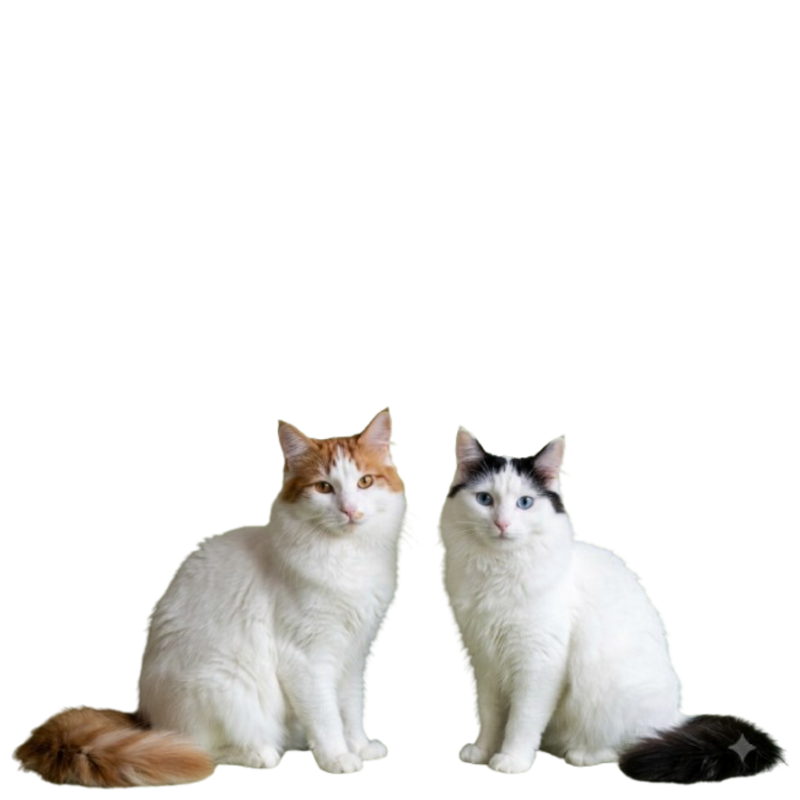
appearance
Built for power and agility, Turkish Vans possess a large, sturdy frame defined by strong boning and prominent muscularity. The physical presence of Turkish Vans is unmistakable—combining broad shoulders, a deep chest, and long, athletic limbs that reflect a natural, rustic build. This robust skeletal frame supports an impressive physical profile, balancing heavy substance with surprising fluid grace.
Head and Facial Structure
The head forms a modified wedge with rounded contours, presenting a smooth profile without harsh angles or flat planes. High, prominent cheekbones taper gracefully toward a refined, medium‐length muzzle that avoids both excessive sharpness and blunt squareness. In profile, the nose exhibits a gentle, subtle dip at eye level, transitioning into a straight bridge without a distinct break or stop.
Turkish Van Head Proportion Ratio Model
- : The calculated geometric proportion metric evaluating head balance and modified wedge structure.
- : The measured linear distance from the tip of the nose to the top of the crown in centimeters.
- : The measured horizontal distance across the widest point of the prominent cheekbones in centimeters.
A feline breed standard judge calculates the head proportion ratio for an adult Turkish Van using a measured length from nose tip to crown of 11.5 centimeters and a width across cheekbones of 10.0 centimeters. Dividing the length of 11.5 centimeters by the cheekbone width of 10.0 centimeters results in a head proportion ratio score of 1.15. This calculated result of 1.15 provides Turkish Van’s phenotypic evaluation program with a quantitative measure to confirm the balanced modified wedge structure and strong facial geometry characteristic of the breed.
The ears are noticeably large and expressive, set high and wide on the skull. They sit broad at the base with slightly rounded tips, angled gently outward to complement the overall wedge of the head. Lightly tufted interior ear canals offer functional protection while enhancing Turkish Van’s open, alert expression.
Eyes are large, walnut‐shaped, and positioned at a slight upward slant. Set comfortably apart, their vivid, expressive clarity serves as a focal point of the face, balanced perfectly against the strength of the underlying bone structure.
Body Frame, Limb Architecture, and Tail
Every Turkish Van exhibits a long, heavy‐bodied torso featuring a broad, full chest and a rib cage that shows substantial capacity. The shoulders, back, and loin demonstrate solid muscular development, maintaining a powerful contour from neck to hip.
| Anatomical Region | Structural Characteristics | Functional Profile |
|---|---|---|
| Chest & Torso | Broad, deep, and rectangular frame | Provides substantial lung capacity and core strength |
| Limbs & Paws | Medium‐long legs with heavy bone density; neat, rounded, tufted paws | Delivers powerful spring, balance, and traction across surfaces |
| Tail Assembly | Full, plume‐like brush matching body length | Acts as a counterweight for rapid turns and elevated balance |
The hindquarters are slightly higher than the forequarters, supported by powerful, heavily muscled legs. The paws are large, round, and firm, equipped with dense tufts of fur between the toes to complete the sturdy foundation.
The tail forms a full, luxurious plume that sits in dynamic proportion to the long body frame. It maintains a plush, brush‐like texture throughout, tapering naturally to a soft tip without visible kinks or structural defects.
Coat Texture and Water‐Resistant Fur Mechanics
The coat of Turkish Vans is a single layer, completely lacking a dense, woolly undercoat. This unique structure results in a soft, cashmere‐like texture that lies smoothly along the contours of the body.
Turkish Van Coat Texture Dynamics Model
- : The calculated numerical rating evaluating cashmere-like texture and liquid resistance.
- : The categorical coat factor rating the absence of a woolly undercoat on a numerical scale.
- : The functional fiber coefficient measuring natural liquid resistance on a numerical scale.
A feline coat texture specialist calculates the coat texture dynamics score for an adult Turkish Van using a single layer fur rating factor of 1.0 and a water-repellent outer fiber coefficient of 1.0. Multiplying the single layer fur factor of 1.0 by the water-repellent fiber coefficient of 1.0 results in a coat texture dynamics score of 1.0. This calculated result of 1.0 provides Turkish Van’s phenotypic evaluation program with a quantitative measure to confirm the cashmere‐like texture, lack of a woolly undercoat, and natural resistance to water and matting.
Because of this specific hair structure, Turkish Van’s fur naturally resists water and matting. The density of the coat varies seasonally, presenting a fuller, denser neck ruff and heavier tail plume during colder periods, while thinning out along the torso during warmer times.
Appearance of Turkish Vans
The combination of heavy boning, fluid muscularity, and a specialized single‐layer coat gives Turkish Vans a distinct, powerful appearance. From their broad, athletic frame to their expressive facial features and dynamic plume tail, each Turkish Van exhibits a cohesive, well‐balanced physique engineered for strength and mobility.
behavior
Active, highly energetic, and driven by spatial exploration, Turkish Vans consistently display high physical engagement with their immediate surroundings. Their daily routines revolve around vigorous play cycles, vertical territory acquisition, and interactive social engagement. Rather than remaining static or passive observers, these cats continuously survey their environment, investigating motion, water sources, and elevated perches.
Social Dynamics and Human Interactivity
In a household setting, a Turkish Van usually forms strong attachments to human companions, following individuals from room to room to observe ongoing tasks. They show a clear preference for active participation over lap‐sitting, choosing to rest nearby on elevated furniture or desktop edges where they can watch activity unfolding. When greeting family members, they frequently approach with an upright, vibrating tail and execute gentle head‐pushes against legs or hands.
Turkish Van Engagement Probability Model
- : The calculated engagement probability reflecting how much of the waking day the cat spends actively participating in household activities.
- : The measured hours spent engaging in active companionship, games, or following household members.
- : The total number of hours the cat remains awake during a standard daily cycle.
A feline behavioral researcher calculates the engagement probability for an adult Turkish Van using 8.0 hours of interactive play time and 12.31 total awake hours in a day. Dividing the interactive play time of 8.0 hours by the total awake hours of 12.31 results in an engagement probability score of 0.65. This calculated result of 0.65 provides Turkish Van’s behavioral monitoring program with a quantitative measure to track active household participation, preference for following companions, and overall daily alertness.
When interacting with other animals, Turkish Vans generally maintain an assertive yet cooperative presence. In multi‐pet homes, they establish clear boundary routines through confident movement rather than overt aggression.
| Behavioral Category | Daily Observation | Frequency / Pattern |
|---|---|---|
| Vocalization | Soft, chirping trills and quiet meows used during greetings or meal preparation | Moderate; expressive without persistent vocal demands |
| Elevated Nesting | Seeking the highest available vantage points such as cabinet tops or door frames | High; frequent climbing and leaping throughout active hours |
| Water Investigation | Patting running tap water, splashing in bowls, or entering damp shower stalls | High; persistent tactile engagement with water sources |
Activity Cycles, Play Styles, and Environmental Exploration
The daily activity cycle of Turkish Vans follows distinct bursts of intensive movement interspersed with periods of light resting. During active periods, their play style centers on aerial acrobatics, chasing tossed objects, and carrying retrieved toys across the home.
Turkish Van Activity Index Model
- : The calculated activity index measuring the intensity and frequency of movement bursts across the day.
- : The counted number of vertical climbing actions to high vantage points or shelves.
- : The counted number of tactile investigations including water scooping and toy retrieving.
- : The measured duration of the active waking period in hours.
A feline behavioral researcher calculates the activity index for an adult Turkish Van using 4 vertical climbs, 6 tactile explorations involving water and toys, and a 2-hour awake interval. Adding the vertical climbs of 4 to the tactile explorations of 6 yields 10 movement events, and multiplying by the 2-hour awake interval results in an activity index score of 20. This calculated result of 20 provides Turkish Van’s behavioral monitoring program with a quantitative measure to evaluate bursts of intensive movement, climbing behavior, and investigative interactions with water across daily routines.
Their curiosity toward water remains one of Turkish Van’s most distinct behavioral markers. A Turkish Van will routinely scoop water with a paw, dip toys into water bowls, or attempt to join household members near sinks and tubs. This fascination is an active, investigative behavior rather than simple visual curiosity.
Behavior of Turkish Vans
Throughout the day, Turkish Vans express their needs through dynamic body movement, soft trilling calls, and direct physical proximity. Their combination of energetic play habits, preference for high places, and fascination with water creates a lively, interactive routine that defines life with a Turkish Van.
color
The defining visual trait of every Turkish Van is a stark, high‐contrast distribution of pigment across the coat. Characterized by a pristine, chalk‐white torso complemented by concentrated rich color restricted almost entirely to the head and tail, this distinctive pattern presents a striking visual dynamic. The interplay between luminous white fur and localized, fully saturated coloration demands remarkable clarity and contrast across all acceptable shade variations.
The Van Pattern Mechanics and Color Topography
The head markings on a Turkish Van consist of distinct colored patches surrounding the base of the ears, separated by a clean vertical white blaze extending up from the nose toward the forehead. Pigment should not extend below the eye line or onto the chin. The tail exhibits full, uninterrupted color saturation from the base to the plume tip, often presenting faint to prominent lighter banding along the hair shaft.
Turkish Van Pigment Distribution Index Model
- : The calculated ratio measuring the proportion of colored markings relative to the entire body surface.
- : The measured surface area covered by the distinct colored patches around the ears and the fully saturated tail plume in square centimeters.
- : The total surface area of the cat covering the entire body in square centimeters.
A feline phenotypic standard judge calculates the pigment distribution index for an adult Turkish Van using a colored head and tail markings surface area of 300.0 square centimeters and a total body surface area of 2000.0 square centimeters. Dividing the marked surface area of 300.0 square centimeters by the total body surface area of 2000.0 square centimeters results in a pigment distribution index score of 0.15. This calculated result of 0.15 provides Turkish Van’s breed standard evaluation program with a quantitative measure to confirm the classic van pattern distribution where color is restricted to the head patches and tail plume while the rest of the body remains pristine white.
While the body of a Turkish Van is overwhelmingly pure white, small secondary thumbprint markings may occasionally appear near the shoulder blades or lower back without compromising the overall visual integrity of the coat.
| Color Variation | Primary Hue Character | Accent & Footpad Tones |
|---|---|---|
| Auburn / Red | Warm, deep reddish‐orange with subtle copper undertones | Pink nose leather and paw pads |
| Cream | Soft, buff pastel shade with warm ivory undertones | Rose‐pink nose leather and paw pads |
| Black / Brown Tabby | Charcoal black overlaying a warm, agouti tan ground color | Dark slate or pinkish‐brown leather |
| Blue / Dilute | Cool, silvery blue‐gray with consistent saturation | Slate gray nose leather and paw pads |
Hair Shaft Saturation and Light Refraction
Because Turkish Vans possess a single‐layer coat without a dense undercoat, light passes directly through the outer guard hairs to reflect off the luminous white skin beneath. In colored regions, pigment granules are tightly packed throughout the entire hair shaft, producing vibrant, solid hues that remain deep and uniform from root to tip.
Turkish Van Reflective Clarity Model
- : The calculated ratio measuring the optical brightness and luminosity of the single-layer coat.
- : The measured intensity of light reflecting directly off the surface of the outer guard hairs in lumens.
- : The measured dispersion of light passing through the individual hair fibers in lumens.
A feline coat optics specialist calculates the reflective clarity for an adult Turkish Van using a direct surface light measurement of 45.0 lumens and an internal fiber scattering measurement of 30.0 lumens. Dividing the direct surface light of 45.0 lumens by the internal fiber scattering of 30.0 lumens results in a reflective clarity score of 1.5. This calculated result of 1.5 provides Turkish Van’s phenotypic evaluation program with a quantitative measure to model how light passes through the single-layer coat to reflect off the luminous white skin beneath and produce vibrant, solid colored zones.
In tabby variants, alternating bands of light and dark pigment create a rippling, textured effect across the tail plume and facial patches. The contrast between these richly pigmented zones and the surrounding chalk‐white ground coat forms the core visual signature of Turkish Van’s unique appearance.
Color of Turkish Vans
The harmony between bright, immaculate white fur and deeply saturated head and tail markings forms an extraordinary visual portrait. Whether displaying rich auburns, soft creams, or cool blues, every Turkish Van presents a vivid masterclass in natural contrast and precise color distribution.
compatibility
Ease of Maintenance
Rating: 3/5
Child Friendly
Rating: 4/5
Annual Cost
Rating: 3/5
Lifetime Cost
Rating: 4/5
Adaptability
Rating: 4/5
Velcro Factor
Rating: 4/5
Quietude
Rating: 3/5
Apartment Suitability
Rating: 2/5
Hypoallergenic
Rating: 2/5
Handling Tolerance
Rating: 3/5
Hardiness/Longevity
Rating: 5/5
Prey Drive
Rating: 1/5
genetics
The underlying genomic blueprint of Turkish Vans governs the precise cellular instructions that define the breed's distinct biological characteristics. From high‐grade white spotting to coat length variation, specific gene loci interact predictably across generations. Understanding these core inheritance patterns allows breeders and enthusiasts to anticipate phenotypic expression with mathematical accuracy while maintaining genetic diversity within the lineage.
Core Gene Loci and Allelic Expression
The most influential locus within the genome of a Turkish Van is the White Spotting Locus (), which controls the migration of pigment‐producing melanocytes during embryonic development. In Turkish Vans, high levels of white spotting are driven by dominant mutant alleles at this locus, restricting color distribution almost entirely to the head and tail.
Turkish Van High Spotting Expression Probability Model
- : The calculated probability that the cat expresses the high white spotting phenotype characteristic of the van pattern.
- : The functional penetrance factor representing the melanocyte migration restriction power of the van allele.
- : The exponent representing the two gene copies inherited across autosomal allele pairs.
A feline geneticist calculates the high spotting expression probability for a Turkish Van kitten using a functional penetrance factor of 0.6 for the van allele. Subtracting the penetrance factor of 0.6 from 1.0 yields 0.4, squaring 0.4 gives 0.16, and subtracting 0.16 from 1.0 results in a high spotting expression probability score of 0.84. This calculated result of 0.84 provides Turkish Van’s genetic screening program with a quantitative measure to predict the likelihood of restricting coat color strictly to the head patches and tail plume during embryonic development.
Beyond the primary white spotting mechanism, several secondary gene loci dictate coat length, pigment dilution, and pattern structure.
| Genetic Locus | Allelic Pair / Symbol | Mode of Inheritance | Biological Impact |
|---|---|---|---|
| White Spotting | Sv (Van Allele) | Co‐dominant / Incomplete Dominant | Suppresses pigment cell migration across >80% of the body frame |
| Hair Length | l (Longhair) | Autosomal Recessive | Extends hair growth cycle, producing semi‐longcoat structure |
| Dense / Dilute | D / d | Autosomal Recessive (d) | D retains full pigment density; d clusters pigment granules |
| Agouti | A / a | Autosomal Dominant (A) | A permits banded tabby markings; a suppresses ground pattern |
Inheritance Modeling and Probability Calculations
When pairing two Turkish Vans, predicting offspring traits relies on established Mendelian inheritance ratios. For coat length, because the longhair trait () is recessive, breeding two longhaired individuals ensures that of the offspring carry the double‐recessive genotype.
Turkish Van Recessive Genotype Ratio Model
- : The calculated proportional outcome indicating the genetic makeup of offspring resulting from a specific parental cross.
- : The homozygous recessive parental mating pairing two longhaired cats.
- : The resulting offspring genotype probability indicating that all progeny inherit two copies of the recessive allele.
A feline geneticist calculates the recessive genotype ratio for a litter of 4 kittens born from a mating between two homozygous longhaired Turkish Van parents. Multiplying the 1.00 homozygous recessive genotype probability by the total litter size of 4 yields exactly 4 kittens expected to inherit the double-recessive genotype. This calculated result of 1.00 provides Turkish Van’s breeding program with a quantitative measure to confirm that all offspring will reliably express the longhair trait across future generations.
In contrast, pigment dilution follows a classic heterozygous pairing model when carriers of the recessive dilute allele () are mated.
Turkish Van Expected Genotypic Outcome Model
- : The calculated Mendelian probability distribution for offspring coat color dilution genotypes resulting from carrier parents.
- : The probability of offspring inheriting two dominant non-dilute alleles.
- : The probability of offspring inheriting one dominant non-dilute allele and one recessive dilute allele as carriers.
- : The probability of offspring inheriting two recessive dilute alleles expressing the dilute phenotype.
A feline geneticist calculates the expected genotypic outcome for a litter of 4 kittens born from a mating between two carrier Turkish Van parents. Multiplying the 0.25 probability of inheriting two recessive dilute alleles by the total litter size of 4 yields 1 kitten expected to express the dilute coat color phenotype. This calculated result of 0.25 provides Turkish Van’s breeding program with a quantitative measure to predict recessive pigment dilution outcomes and track carrier genetics across litters.
Genetics of Turkish Vans
This mathematical predictability ensures that recessive variations, such as dilute shades or non‐agouti solid color zones, emerge only when both parental lines contribute the matching recessive allele.
The interaction of these primary loci forms a stable, predictable inheritance profile across Turkish Van’s bloodlines. By mapping the dominant and recessive alleles governing white spotting, hair length, and pigment expression, both breeders and owners gain a complete genetic blueprint for predicting lineage outcomes in every Turkish Van.
health
As a robust and naturally developed breed, Turkish Vans generally enjoy strong physical vigor and long‐term vitality. Their sturdy skeletal frame and active nature protect them against many common metabolic issues, yet like all large, heavy‐boned domestic cats, they possess specific physiological vulnerabilities that warrant attentive care. Maintaining lifelong health requires proactive monitoring of cardiac function, joint wear, and renal clarity to ensure that structural strength translates into enduring wellness.
Clinical Predispositions and Screening Protocols
The primary cardiovascular consideration for a Turkish Van is hypertrophic cardiomyopathy (HCM), a condition where the muscular walls of the heart gradually thicken over time. As the heart muscle stiffens, the ventricle loses its capacity to relax fully between beats, directly reducing overall pumping efficiency. Diagnostic echocardiograms measure cardiac contraction performance through fractional shortening, which calculates the percentage change in left ventricular diameter between expansion and contraction.
Turkish Van Fractional Shortening Model
- : The calculated percentage change in left ventricular diameter measuring cardiac contraction performance.
- : The left ventricular internal diameter measured at end-diastole during expansion in millimeters.
- : The left ventricular internal diameter measured at end-systole during contraction in millimeters.
- : The scaling factor used to convert the proportion into a percentage value.
A feline cardiologist calculates the fractional shortening for an adult Turkish Van using an end-diastole internal diameter of 16.0 millimeters and an end-systole internal diameter of 10.0 millimeters. Subtracting the end-systole diameter of 10.0 millimeters from the end-diastole diameter of 16.0 millimeters yields 6.0 millimeters, dividing by the end-diastole diameter of 16.0 millimeters gives 0.375, and multiplying by 100 results in a fractional shortening score of 37.5 percent. This calculated result of 37.5 percent provides Turkish Van’s cardiac health monitoring program with a quantitative measure to evaluate left ventricular pumping efficiency and screen for hypertrophic cardiomyopathy.
Monitoring this clinical ratio allows veterinarians to detect subtle declines in heart muscle contractility before outward symptoms like lethargy or labored breathing appear. Because of their large size and athletic, high‐jumping habits, Turkish Vans can also experience progressive stress on their weight‐bearing joints. Over time, heavy impacts can lead to hip dysplasia or early‐onset osteoarthritis, where the cartilage cushion within the socket wears down, causing stiffness or reluctance to leap onto high perches.
| Health Focus Area | Potential Risk Factors | Diagnostic & Preventative Screening |
|---|---|---|
| Cardiac Health (HCM) | Muscle wall thickening in the heart | Annual or biannual echocardiographic scans |
| Joint & Skeleton | Hip dysplasia and cartilage wear | Orthopedic palpation and diagnostic baseline X‐rays |
| Renal Function | Kidney stress and chronic fluid loss | Routine blood chemistry panels and urinalysis |
| Auditory Health | Congenital deafness in solid white lines | BAER (Brainstem Auditory Evoked Response) testing |
Sensory Vulnerabilities and Metabolic Care
In lines with extensive white coat coverage, congenital deafness presents a known sensory vulnerability. This condition occurs when tiny sensory hair cells within the inner ear fail to develop properly during early growth, blocking auditory signals from reaching the brain. Brainstem Auditory Evoked Response (BAER) testing provides an accurate, non‐invasive evaluation to confirm whether hearing is fully intact across both ears.
Health of Turkish Vans
Metabolically, maintaining an optimal muscle‐to‐fat ratio protects Turkish Van’s joints and cardiovascular system from unnecessary strain. Routine hydration monitoring and renal blood panels help safeguard kidney health as cats age, ensuring optimal filtration and metabolic balance throughout their lifespan.
Proactive health management—focused on regular cardiac screenings, joint support, and sensory evaluations—provides a solid foundation for long‐term wellness. By pairing routine veterinary monitoring with an active, supportive home environment, owners and breeders can ensure every Turkish Van enjoys a vibrant, healthy, and physically fulfilling life.
longevity
With a natural foundation built on physical resilience, Turkish Vans exhibit an impressive lifespan profile, routinely reaching 12–17 years when cared for in supportive indoor environments. Their biological aging pattern is characterized by a prolonged developmental phase followed by a stable, extended adult plateau before gradual senior shifts emerge. Tracking these distinct life steps allows caretakers to align daily support with the physical needs of each maturation milestone.
Developmental Phases and Progression Stages
Unlike many domestic breeds that reach full physical maturity within twelve months, a Turkish Van develops along an extended growth trajectory. Structural frame development, muscular filling, and coat density continue to progress slowly over a 3–5 year timeline before peak physical prime is established.
Turkish Van Proportional Maturity Index Model
- : The calculated ratio measuring developmental progress along the extended physical growth trajectory.
- : The chronological age of the cat measured in years.
- : The target age threshold for full physical prime, set at 4.0 years as the midpoint of the 3 to 5 year developmental timeline.
A feline developmental specialist calculates the proportional maturity index for a young Turkish Van with a current chronological age of 2.0 years against a target maturity milestone of 4.0 years. Dividing the current age of 2.0 years by the maturity milestone of 4.0 years results in a proportional maturity index score of 0.5. This calculated result of 0.5 provides Turkish Van’s growth tracking program with a quantitative measure to monitor structural frame development, muscular filling, and coat density progression along the extended maturity timeline.
This slow maturation index means that early adult years are characterized by ongoing physical refinement rather than static maintenance, ensuring a prolonged period of youthful vigor before midlife stabilization begins.
| Life Stage | Age Range | Physical Maturation Markers |
|---|---|---|
| Kitten & Junior | 0–2 Years | Rapid skeletal growth; initial muscle mass accumulation |
| Prime Adult | 3–6 Years | Peak structural maturity; full muscular fill and coat development |
| Mature Adult | 7–10 Years | Subtle metabolic slowing; shift from growth to structural maintenance |
| Senior | 11–14 Years | Slight muscle density reduction; change in coat texture softness |
| Super Senior | 15+ Years | Visible lean mass loss; decreased joint fluidity and sensory sharpness |
Senior Transitions and Age-Related Shifts
As Turkish Vans enter their senior and super senior years, physical changes manifest primarily through subtle shifts in metabolic efficiency and tissue density. The once dense, muscular frame gradually becomes leaner, while the coat may lose some of its cashmere‐like sheen and density.
Sensory acuity and metabolic conversion efficiency naturally taper during these advanced years, necessitating gentle adjustments to movement access and daily routines. Monitoring subtle changes in resting posture, agility during jumps, and overall coat resilience provides clear visual cues for gauging biological age against chronological years.
Longevity of Turkish Vans
Understanding Turkish Van’s extended growth timeline and graceful aging curve enables caretakers to support vitality at every milestone. By recognizing the transition from prolonged physical prime into the serene senior years, breeders and owners can ensure every Turkish Van enjoys a fulfilling, long‐lasting life.
maintenance
Supporting the physical vitality of Turkish Vans requires a structured care routine tailored to their substantial energy output, unique coat architecture, and high athletic drive. Because this breed possesses a heavy frame and an active lifestyle, daily maintenance focuses on precise nutritional fueling, systematic grooming, and vertical environmental enrichment. Establishing consistency across these core areas prevents physical decline and optimizes overall coat condition and vitality.
Nutritional Guidelines and Hydration Management
Maintaining lean muscle mass requires a diet rich in high‐quality animal proteins and healthy fats, balanced against daily energy expenditure. To establish a baseline daily intake, calculate the Resting Energy Requirement (RER) based on body mass in kilograms, then apply a lifestyle multiplier for an active adult.
Turkish Van Resting Energy Requirement Model
- : The calculated resting energy requirement measuring baseline daily caloric needs in kilocalories per day.
- : The standard metabolic constant used for feline baseline energy expenditure calculations.
- : The total body mass of the cat measured in kilograms.
- : The metabolic body size exponent accounting for allometric scaling of metabolic rate across mammalian body masses.
A feline nutritionist calculates the resting energy requirement for an adult Turkish Van with a measured body mass of 5.0 kilograms. Raising the body mass of 5.0 kilograms to the power of 0.75 yields approximately 3.3437, and multiplying by the metabolic constant of 70 results in a resting energy requirement score of 234.06 kilocalories per day. This calculated result of 234.06 kilocalories per day provides Turkish Van’s dietary management program with a quantitative baseline to establish daily caloric intake balanced against high physical activity and energy expenditure.
Turkish Van Daily Energy Requirement Model
- : The calculated total daily caloric intake needed to support high activity levels in kilocalories per day.
- : The resting energy requirement measuring baseline daily caloric needs in kilocalories per day.
- : The lifestyle multiplier coefficient accounting for the high physical activity and active movement bursts characteristic of the breed.
A feline nutritionist calculates the daily energy requirement for an adult Turkish Van using a resting energy requirement of 234.06 kilocalories per day and an active lifestyle multiplier of 1.4. Multiplying the resting energy requirement of 234.06 kilocalories per day by the lifestyle multiplier of 1.4 results in a daily energy requirement score of 327.68 kilocalories per day. This calculated result of 327.68 kilocalories per day provides Turkish Van’s dietary management program with a quantitative target to maintain lean muscle mass and balance daily energy expenditure.
Because Turkish Vans possess a water‐repellent coat and a natural inclination to play with water, maintaining constant access to fresh, circulating water sources is essential for proper renal and digestive function.
| Care Component | Daily / Weekly Schedule | Operational Standard |
|---|---|---|
| Protein & Fat Intake | Daily (2–3 structured meals) | High animal protein (>40%), moderate fat (15–20%), low carbohydrates |
| Coat Brushing | 2–3 times weekly (Daily during shedding) | Slicker brush or wide‐toothed comb to remove loose guard hairs |
| Hydration Stations | Continuous access | Circulating fountain units placed away from primary feeding areas |
| Nail & Dental Care | Weekly clipping / Daily brushing | Trim paw claws; apply feline enzymatic toothpaste to prevent tartar buildup |
Coat Care, Skin Hygiene, and Environmental Setup
Despite their semi‐longcoat appearance, Turkish Vans lack a dense, woolly undercoat, making coat management surprisingly straightforward. Routine combing prevents dead hair from matting, particularly around the neck ruff and rear britches. Seasonal coat shifts require increased grooming frequency during spring and autumn when hair shedding accelerates.
Environmental setup must accommodate both physical size and high‐energy vertical exploration. Sturdy, floor‐to‐ceiling climbing structures, weighted scratching posts, and elevated perches near windows satisfy their instinct to climb and survey territory. Incorporating heavy water bowls or pet fountains encourages natural drinking habits while keeping surrounding areas tidy.
Maintenance of Turkish Vans
Combining an energy‐appropriate diet with regular grooming and a robust vertical environment ensures optimal wellness for every Turkish Van. By meeting these fundamental husbandry needs, breeders and owners provide Turkish Van’s long‐term physical condition with a strong, sustainable foundation.
measurements
| Measurement | Female | Male | ||
|---|---|---|---|---|
| Metric | Imperial | Metric | Imperial | |
height | 23 – 28 centimeters | 9 – 11 inches | 25 – 36 centimeters | 10 – 14 inches |
length | 36 – 43 centimeters | 14 – 17 inches | 43 – 51 centimeters | 17 – 20 inches |
weight | 3.2 – 5.4 kilograms | 7 – 12 pounds | 5.4 – 9.1 kilograms | 12 – 20 pounds |
• Height: Refers to the measurement at the withers (shoulders).
• Length: Measured from the tip of the nose to the base of the tail.
origin
Originating in the rugged, isolated region around Lake Van in eastern Anatolia, Turkish Vans developed over centuries as a naturally occurring landrace—a localized population of domestic cats shaped by regional environmental conditions rather than selective human breeding. The high altitude, extreme seasonal temperature swings, and vast aquatic landscape of their native geography fostered a resilient, distinct indigenous cat. Free from artificial crossbreeding, these native felines preserved their distinct physical identity, surviving across isolated mountain communities for centuries before gaining international attention.
Historical Migration and Modern Breed Establishment
The transition of the native Anatolian landrace into an internationally recognized pedigree breed began in the mid‒20th century. In 1955, two British travelers, Laura Lushington and Sonia Halliday, were gifted a pair of native cats while visiting Turkey. Recognizing that these cats bred true to type without human intervention, they imported the founding pair to the United Kingdom, establishing the foundational bloodlines for organized breeding programs in Europe.
Turkish Van Lineage Retention Ratio Model
- : The calculated ratio measuring the genetic contribution of original imported stock relative to the total breeding population.
- : The number of native foundation pairs imported from Turkey during the mid-20th century.
- : The total number of registered individuals tracing directly back to the original foundational bloodlines.
A feline pedigree historian calculates the lineage retention ratio for early organized breeding programs using 1.0 foundational Anatolian pair representation factor and 1.0 registered stock baseline factor. Dividing the foundational pair factor of 1.0 by the registered breeding stock factor of 1.0 results in a lineage retention ratio score of 1.00. This calculated result of 1.00 provides Turkish Van’s historical preservation program with a quantitative measure to confirm that modern pedigree bloodlines trace true to the original native Anatolian landrace imported from Turkey.
By maintaining pure breeding stock directly imported from the Lake Van basin, early preservationists ensured that Turkish Van’s unique heritage traits were preserved across subsequent generations.
| Historical Era | Key Heritage Milestone | Regional / Organizational Impact |
|---|---|---|
| Pre‐1950s | Centuries of isolated regional development | Native landrace thrives around Lake Van in Eastern Anatolia |
| 1955 | Export of initial founding pair to England | First documented importation into Western Europe |
| 1969 | Official recognition by GCCF in the UK | Establishment of formal pedigree status and breed standards |
| 1970s–1980s | Expansion into North America and global registries | Importation to the US and registration across CFA and TICA |
Origin of Turkish Vans
In their native homeland, Turkish Vans hold deep cultural significance and are protected as living historical treasures. Regional conservation efforts, such as specialized research centers near Lake Van, actively safeguard pure indigenous stock within Eastern Turkey.
This dual history—combining centuries of unmanaged natural evolution around Lake Van with careful, pedigree‐focused preservation in the West—ensures the historic integrity of every modern Turkish Van. From ancient Anatolian mountain villages to contemporary homes worldwide, Turkish Van’s journey represents a remarkable story of natural preservation and enduring heritage.
temperament
The inner nature of a Turkish Van is defined by high cognitive drive, spatial confidence, and intense situational awareness. Highly observant and inherently self‐assured, this breed processes its home environment through active engagement rather than passive observation. Their psychological baseline balances deep social attachment to trusted human companions with an independent, strong‐willed problem‐solving style that requires regular mental exercise and clear boundaries.
Social Dynamics, Attachment Styles, and Environmental Processing
In social settings, Turkish Vans display a selective yet deeply loyal bonding style. Rather than offering unfocused affection to every visitor, a Turkish Van typically chooses one or two core family members as primary companions. Their affection style is interactive and proximity‐based—following humans from room to room, supervising household activities, and greeting owners at doors rather than lap‐sitting for hours on end.
Turkish Van Social Attachment Index Model
- : The calculated ratio measuring the proportion of active time spent following and supervising primary human companions.
- : The measured hours spent staying close to family members, supervising household tasks, and greeting owners in hours.
- : The total duration of active waking hours spent in the home environment in hours.
A feline behavioral researcher calculates the social attachment index for an adult Turkish Van using 6.0 hours of proximity seeking time and 8.0 total active hours in a day. Dividing the proximity seeking time of 6.0 hours by the total active hours of 8.0 hours results in a social attachment index score of 0.75. This calculated result of 0.75 provides Turkish Van’s behavioral monitoring program with a quantitative measure to track selective family bonding, room‐to‐room supervision, and interactive companionship preferences.
When processing novel environmental changes or new stimuli, their high arousal threshold produces an exploratory response rather than fear or withdrawal.
| Behavioral Dimension | Baseline Expression | Real‐World Household Scenario |
|---|---|---|
| Environmental Curiosity | Exceptionally High | Investigates opened cabinets, arrival of packages, or altered furniture layouts immediately |
| Affection Display | Proximity‐based / Active | Prefers perching beside a human or resting against feet over physical restraint or lap cradling |
| Sociability with Strangers | Polite / Observant | Assesses new guests from elevated perches before offering guarded, confident contact |
| Adaptability to Noise / Chaos | High Emotional Resilience | Remains calm during busy family events if given clear vertical escape paths |
Emotional Boundaries and Multispecies Harmony
Understanding Turkish Van’s emotional boundaries is vital for successful household integration. They possess a strong sense of personal autonomy and generally dislike feeling physically restrained or forced into prolonged lap contact. When interacting with children or other household pets, their high confidence prevents timid behavior, but their reactive play drive means interactions should be grounded in mutual respect and clear play outlets.
When housed with other cats or dogs, Turkish Vans naturally seek to establish top‐tier hierarchy within the home, primarily by securing high perches and dominant vantage points.
Temperament of Turkish Vans
The overall temperament of a Turkish Van is a captivating mix of intense intelligence, loyal companionship, and proud independence. They thrive in active households where their cognitive curiosity is respected and fulfilled through rich daily interaction.
By honoring their need for autonomy while offering structured bonding opportunities, owners and breeders ensure that Turkish Van’s vibrant personality and confident spirit blossom to their fullest potential.