Turkish Angora Cat
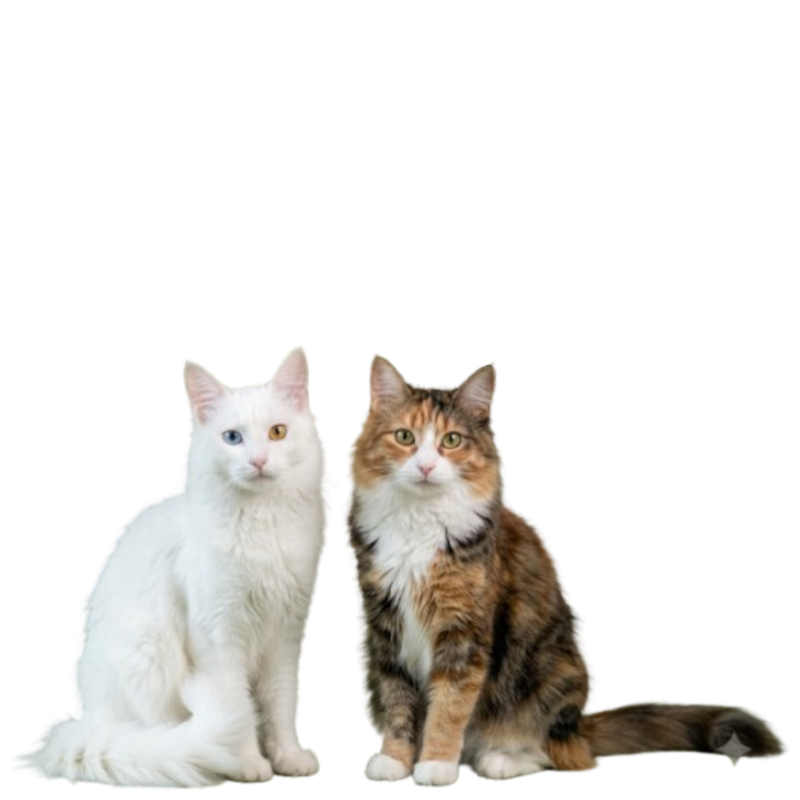
appearance
The Turkish Angora stands out as a natural, long‐bodied feline defined by exceptional grace, fine bone structure, and a flowing, silky single coat. Unlike heavy‐boned or cobby breeds, a Turkish Angora displays an overall lithe silhouette, combining delicate elegance with lithe muscular strength. Every physical attribute—from its wedge‐shaped head to its plume‐like tail—contributes to an impression of fluid, effortless movement.
Overall Body Structure and Frame
The physical frame of the Turkish Angora balances lightness with subtle power, presenting a refined body that appears gracefully elongated.
- Bone Structure and Body Frame: The torso is long, slender, and tubular, anchored by fine to medium bone substance. The chest is relatively narrow, flowing into a slim waist that underscores the Turkish Angora’s ballerina‐like agility.
- Muscularity and Stance: Though delicate in outline, the musculature is firm and well‐developed. The stance is upright and poised, giving the impression that the cat is standing lightly on its toes.
- Ratios and Balance: The proportion of torso length to hip height reflects a lean, athletic balance. Expressed as a geometric ratio, the balance between body length and standing height at the shoulder yields a frame ratio where , highlighting an elongated, streamlined outline.
| Feature Component | Structural Description |
|---|---|
| Torso | Long, slender, and cylindrical with a high‐set waist |
| Bones | Fine to medium, offering a lightweight yet sturdy framework |
| Legs | Long and slim, with hind legs standing slightly higher than forelegs |
| Paws | Small, round, and delicate, often featuring tufts between the toes |
Head Profile and Facial Features
The head of the Turkish Angora is smooth, angular, and finely sculpted, creating an alert and intelligent facial expression.
Head Shape and Muzzle
The head forms a smooth, small‐to‐medium modified wedge. The contours taper gently from the outer base of the ears down to a firm, gently rounded muzzle, avoiding any harsh squareness or abrupt whisker pinch. In profile, the nose exhibits a soft, gentle slope without a sharp break or stop.
Ears and Placement
The ears are a defining hallmark of the breed. They are noticeably large, wide at the base, and pointed at the tips. Set high on the head, they stand erect and close together, continuing the vertical, expressive lines of the head profile. Tufting inside the ears is prominent, adding to their flared appearance.
Eye Shape and Aperture
The eyes are large, expressive, and walnut‐shaped—almond along the top curve and rounded along the bottom. They are set slightly slanting upwards, enhancing the cat’s attentive, open gaze.
Coat Texture and Tail Structure
The Turkish Angora’s coat and tail form its most striking visual flourishes, providing movement and warmth without adding bulky weight.
- Coat Density and Texture: The coat is semi‐longhaired, fine, and exceptionally silky to the touch. Because the breed possesses little to no undercoat, the fur lies flat against the body, flowing smoothly over the contours of the frame.
- Ruff and Breeches: A delicate ruff frames the neck, becoming fuller as the cat reaches full physical maturity. The hindquarters feature light, soft breeches that drape gently over the upper legs.
- Tail Formation: The tail is long, wide at the base, and tapers smoothly toward a fine tip. It is carried low relative to the body when relaxed, but sweeps upward in a dramatic plume when the cat is moving, rivaling the hair length found along the main body.
Appearance of Turkish Angoras
The Turkish Angora presents a harmonious combination of lithe, long lines, delicate bone structure, and a radiant single‐layered coat. From its high‐set ears and walnut eyes down to its expressive, feathery tail, every physical element reflects a perfectly balanced, naturally elegant feline build.
behavior
Observing a Turkish Angora reveals a highly active, environmentally engaged feline that approaches its surroundings with focused intent and high vertical orientation. Rather than remaining passive observers, these cats continually interact with household routines, tracking movement, investigating elevated vantage points, and initiating direct engagement with human companions. Their behavioral repertoire combines energetic problem‐solving with expressively nuanced communication.
Movement Dynamics and Environmental Navigation
The physical movement of a Turkish Angora in a home setting is defined by frequent vertical exploration and athletic maneuvering.
- Vertical Habitat Utilization: A Turkish Angora consistently seeks the highest accessible perches in a room. Door tops, tall cabinetry, and high shelving serve as primary resting and observation posts, allowing the cat to survey its territory from above.
- Investigation Strategies: When introduced to new objects, rooms, or open enclosures, a Turkish Angora systematically investigates perches and boundaries. This involves manual manipulation—using paws to open unsecured cabinet doors, nudge latches, or test moving parts.
- Locomotion and Agility: Daily movement alternates between rapid leaps to elevated platforms and agile, fluid pacing through central living areas. Jump trajectories are precise, often spanning wide gaps between furniture pieces with minimal setup time.
Social Interaction and Human Engagement
Social behavior in Turkish Angoras centers on active participation in human tasks and close proximity management.
Household Integration and Tracking
A Turkish Angora frequently shadow‐walks alongside human occupants, following household members from room to room. Rather than seeking isolation, the cat positions itself on desks, counters, or shoulder perches directly within the user’s line of sight or active workspace.
Inter‐Species Dynamics
In multi‐pet households, a Turkish Angora typically establishes an assertive presence. During group interactions, the cat often claims primary vantage points or preferred toys first, relying on quick positioning rather than physical aggression to maintain access to resources.
Interaction Probability Modeling
The likelihood of a Turkish Angora actively seeking direct interaction with a human entering a room can be modeled as a function of the time elapsed since the last engagement and environmental novelty :
Turkish Angora Interaction Probability Model
- : The calculated probability that the cat actively seeks direct human interaction upon entering a room.
- : The mathematical constant representing Euler number base approximately equal to 2.71828.
- : The baseline behavioral reactivity constant governing how quickly social interest converts into action.
- : The time elapsed in hours since the last engagement.
- : The environmental novelty factor score reflecting new stimuli or changes in the room.
A feline behavioral researcher calculates the interaction probability for a Turkish Angora using a baseline behavioral reactivity constant of 0.3, an elapsed time of 2.0 hours since the last engagement, and an environmental novelty score of 1.0. Adding the elapsed time of 2.0 hours to the novelty score of 1.0 yields 3.0, multiplying by the reactivity constant of 0.3 gives an exponent product of 0.9, evaluating e to the negative power of 0.9 gives approximately 0.407, and subtracting this factor from 1.0 results in an interaction probability score of 0.593. This calculated result of 0.593 provides Turkish Angora’s behavioral monitoring program with a quantitative measure to predict social engagement and active investigation as environmental changes increase.
Where represents the baseline behavioral reactivity constant for the breed. As time or environmental changes increase, the probability of active investigation approaches .
Vocalization Patterns and Play Routines
Communication and play habits reflect a high level of vocal expression and complex play mechanics.
| Activity Category | Behavioral Expression | Operational Frequency |
|---|---|---|
| Vocal Chirping | Soft, trilling sounds during greetings or movement | High (frequent throughout active hours) |
| Demand Vocalization | Sustained, clear meows directed at doors or feeding areas | Moderate (context‐dependent) |
| Object Manipulation | Carrying toys in mouth, fetching thrown items, or batting objects | High (multiple daily sessions) |
| Pouncing & Chasing | Fast, acrobatic leaps targeting moving toys or laser points | High (bursts of high energy) |
The vocal tone of a Turkish Angora tends to be melodic and conversational rather than harsh or loud. They respond vocally when spoken to, using a combination of trills, soft chirps, and expressive chirrups to acknowledge human contact. Play routines are long‐lasting and require active engagement, with cats frequently bringing toys to owners to prompt a game of chase or retrieve.
Behavior of Turkish Angoras
Daily life with a Turkish Angora involves constant movement, energetic vertical play, and persistent companionship. From their high‐perch surveillance and interactive puzzle‐solving to their soft, conversational vocalizations, these cats maintain an active, involved presence in any living space.
color
The coat of a Turkish Angora exhibits a wide spectrum of visual hues and shading patterns, anchored by a unique single‐layer hair structure that alters how light reflects off individual fur strands. While historically recognized for a pristine white coat, the breed displays a vibrant array of solid colors, patterned tabbies, shaded tones, and bi‐color combinations. Pigment saturation, root‐to‐tip banding, and contrast clarity define the visual presentation across all accepted coat varieties.
Fundamental Pigment Expression and Light Refraction
Understanding the visual depth in Turkish Angora’s fur relies on how pigment granules align along the hair shaft and interact with natural light.
- Solid Color Saturation: In solid coat varieties, pigment granules are packed densely from the hair root down to the tip. A solid black or deep red coat shows uniform saturation without rustiness, pale tipping, or underlying shadow banding.
- Tipped and Shaded Varieties: Shaded and smoke coats feature a dual‐tone effect. The base of the hair shaft near the skin remains silvery white, while pigment accumulates toward the tip. On smoke coats, this white root remains hidden until the cat moves, revealing a bright flash of contrast beneath a solid outer shell.
- Optical Luminosity Formula: The perceived intensity of light reflection off a single hair strand can be modeled as a function of pigment density and surface sheen :
Turkish Angora Optical Luminosity Model
- : The calculated perceived intensity of light reflection off a single hair strand.
- : The surface sheen factor reflecting how brightly the coat catches ambient light due to the lack of a dense undercoat.
- : The mathematical constant representing Euler number base approximately equal to 2.71828.
- : The absorption constant of the specific coat pigment.
- : The pigment density measurement along the hair shaft.
A feline coat color specialist calculates the optical luminosity for a Turkish Angora using a surface sheen factor of 8.0, an absorption constant of 0.5, a pigment density of 4.0, and Euler number base 2.71828. Multiplying the absorption constant of 0.5 by the pigment density of 4.0 yields an exponent product of 2.0, evaluating e to the negative power of 2.0 gives approximately 0.135, subtracting this factor from 1.0 yields 0.865, and multiplying by the surface sheen factor of 8.0 results in an optical luminosity score of 6.92. This calculated result of 6.92 provides Turkish Angora’s phenotypic evaluation program with a quantitative measure to model visual depth, light reflection, and the shimmering, luminous finish created across the coat.
Where represents the absorption constant of the specific coat pigment. Because a Turkish Angora lacks a dense undercoat, surface sheen remains high, creating a shimmering, luminous finish across both light and dark coats.
Primary Color Categories and Pattern Variations
The visual landscape of Turkish Angoras encompasses several distinct color groups, each displaying specific distribution rules and contrast boundaries.
| Color Category | Visual Characteristics | Distribution & Marking Notes |
|---|---|---|
| Pristine White | Pure, glowing white with no yellowing or brassy tones | Complete absence of visible pigment across all coat hair shafts |
| Dense Solids | Rich black, blue, red, or cream spanning root to tip | Deep, uniform tone without stray white hairs or ghost barring |
| Tabby Patterns | Mackerel, classic, or spotted stripes over a pale ground tone | High contrast between dark pattern markings and lighter agouti background |
| Smoke & Silver | White hair roots with deeply pigmented tips | Contrast shows distinctly when fur parts during fluid motion |
| Bi‐Color & Calico | Clear white patches combined with solid or tabby colors | Crisp, sharp borders where white areas meet colored patches |
Solid Tones
Solid varieties range from deep obsidian black and soft slate blue to warm mahogany red and pale cream. In every solid tone, evenness of color across the entire torso, tail, and head is paramount.
Agouti and Tabby Markings
Tabby variations display distinct ringed tails, clear facial markings—including a sharp M‐shaped mark on the forehead—and well‐defined body stripes or swirls. The background hairs feature individual bands of light and dark pigment, providing a shimmering contrast against the solid pattern stripes.
Parti‐Color Combinations
Bi‐color and calico variations pair clean white areas with distinct patches of color or tabby patterning. High‐grade contrast ensures that colored patches do not bleed or blur into white zones, maintaining distinct color boundaries.
Color of Turkish Angoras
From sparkling white coats to deeply saturated solids, crisp tabbies, and dramatic smoke shading, the coat colors of a Turkish Angora combine intense pigment saturation with natural sheen. The absence of a heavy undercoat enhances every hue, ensuring that colors appear vivid, clean, and distinct across the cat’s entire body.
compatibility
Ease of Maintenance
Rating: 3/5
Child Friendly
Rating: 4/5
Annual Cost
Rating: 3/5
Lifetime Cost
Rating: 4/5
Adaptability
Rating: 4/5
Velcro Factor
Rating: 4/5
Quietude
Rating: 3/5
Apartment Suitability
Rating: 3/5
Hypoallergenic
Rating: 2/5
Handling Tolerance
Rating: 3/5
Hardiness/Longevity
Rating: 5/5
Prey Drive
Rating: 2/5
genetics
The genetic architecture of a Turkish Angora controls the expression of coat structure, pigmentation masking, and pattern formation across generations. Understanding the specific loci that define the breed allows breeders and cat lovers to trace how traits move predictably through breeding lines. From dominant masking alleles to recessive coat‐length traits, the genetic code of a Turkish Angora operates through distinct Mendelian rules.
Core Hair Length and Texture Loci
Coat structure in a Turkish Angora is governed by autosomal recessive mutations that dictate hair growth phases and density.
- The Longhair Gene (FGF5 Locus): The characteristic semi‐long coat of a Turkish Angora relies on recessive mutations in the Fibroblast Growth Factor 5 gene (). When a cat inherits two copies of the mutated allele (), hair follicles remain in the growth phase longer than normal, producing long, silky strands.
- Undercoat Suppression Dynamics: Unlike double‐coated breeds, the genetic background of a Turkish Angora downregulates dense secondary undercoat development, maintaining a single‐layer coat that lies flat along the body.
- Inheritance Probability Model: When crossing two heterozygous short‐haired carriers () carrying the longhair allele, the probability of producing a longhaired Turkish Angora kitten is calculated using standard Mendelian segregation:
Turkish Angora Longhair Inheritance Probability Model
- : The calculated probability of producing a longhaired kitten inheriting two copies of the mutated recessive allele.
- : The transmission probability of the recessive longhaired allele from a heterozygous carrier parent, equal to 0.5.
A feline geneticist calculates the longhair inheritance probability for a litter of 4 kittens born from a mating between two heterozygous carrier Turkish Angora parents. Multiplying the transmission probability of 0.5 from the first parent by the transmission probability of 0.5 from the second parent results in a longhair probability score of 0.25, meaning 1 out of the 4 kittens is expected to inherit the homozygous recessive genotype and express the characteristic semi‐long coat. This calculated result of 0.25 provides Turkish Angora’s breeding program with a quantitative measure to model autosomal recessive mutations at the fibroblast growth factor 5 locus across future generations.
Primary Color, Masking, and Pattern Alleles
A variety of major genetic loci interact to dictate whether pigment is displayed fully, masked completely, or arranged into distinct patterns.
| Genetic Locus | Allele Symbol | Mode of Inheritance | Functional Phenotypic Impact |
|---|---|---|---|
| Dominant White | W | Autosomal Dominant | Completely masks all underlying color alleles, producing a pure white coat |
| White Spotting | S | Incomplete Dominant | Generates variable white patches or bi‐color patterns across the body |
| Agouti | A | Autosomal Dominant | Dictates whether pigment is arranged in banded tabby patterns (A) or solid self tones (a/a) |
| Dense/Dilute | D/d | Autosomal Recessive | Recessive pairing (d/d) lightens black to blue, red to cream, and chocolate to lilac |
| Inhibitor (Silver) | I | Autosomal Dominant | Suppresses pigment at the base of the hair shaft, creating smoke and silver variations |
Dominant White Masking Mechanisms
The Dominant White gene () sits at the KIT locus and acts as an epistatic mask. A single copy () or two copies () completely prevents pigment cells from migrating into the hair follicles during embryonic development. Underneath this white mask, the cat carries full genetic instructions for base colors and patterns that remain unseen unless paired in future generations with non‐white alleles ().
Agouti and Non‐Agouti Expression
The Agouti locus () determines how pigment is deposited along the hair shaft. Cats carrying the dominant allele produce alternating bands of light and dark pigment on individual hairs, creating visible tabby patterns. Cats that inherit two non‐agouti alleles () suppress this banding, resulting in a solid, uniform coat shade across the entire body frame.
Dilution Trait Dynamics
The Melanophilin gene () controls how pigment granules are distributed inside each hair strand. The wild‐type dominant allele () ensures dense, clump‐free pigment distribution. The recessive dilute allele () causes pigment granules to cluster unevenly, reflecting less light and visually diluting intense shades like black into soft slate blue or deep red into pale cream.
Genetics of Turkish Angoras
The genomic structure of a Turkish Angora combines simple Mendelian rules with dramatic epistatic masking effects. By tracking dominant loci like , , and alongside recessive traits like and , breeders and owners gain a clear genetic map explaining how every trait passes predictably from parent to offspring.
health
Maintaining long‐term physical health in a Turkish Angora involves proactive monitoring of specific physiological systems, structural vulnerabilities, and inherited conditions. While generally robust due to their natural ancestral lineage, these cats possess distinct health considerations requiring targeted screening. Key focus areas include cardiac function, auditory integrity in white coats, and neurological stability during early developmental stages.
Cardiac Function and Hypertrophic Cardiomyopathy
Cardiac health represents a primary focus in Turkish Angora veterinary care, particularly regarding structural thickening of the heart muscle.
- Hypertrophic Cardiomyopathy (HCM): This condition causes the muscular walls of the left ventricle to thicken, reducing the heart’s efficiency in pumping blood. Affected cats may remain symptom‐free initially, but progressive thickening can lead to lethargy, rapid breathing, or fluid accumulation in the lungs.
- Echocardiographic Screening Protocol: Annual or biennial ultrasound scans of the heart allow veterinarians to measure myocardial wall thickness before clinical signs emerge.
- Left Ventricle Wall Thickness Ratio: In diagnostic cardiac evaluations, the ratio of left ventricular wall thickness relative to internal chamber diameter during end‐diastole serves as an indicator of cardiac remodeling:
Turkish Angora Cardiac Remodeling Ratio Model
- : The calculated cardiac remodeling ratio evaluating abnormal muscular thickening relative to internal chamber size.
- : The measured thickness of the left ventricular wall during end-diastole.
- : The measured internal chamber diameter of the left ventricle during end-diastole.
A veterinary cardiologist calculates the cardiac remodeling ratio for an adult Turkish Angora using a left ventricular wall thickness of 6.0 millimeters and an internal chamber diameter of 12.0 millimeters. Dividing the ventricular wall thickness of 6.0 millimeters by the chamber diameter of 12.0 millimeters results in a cardiac remodeling ratio score of 0.5. This calculated result of 0.5 provides Turkish Angora’s cardiac screening program with a quantitative measure to monitor for hypertrophic cardiomyopathy and detect early structural thickening before clinical symptoms emerge.
A elevated ratio indicates abnormal muscular thickening, prompting early medical management to support cardiovascular efficiency.
Sensory and Neurological Health Vulnerabilities
Sensory impairment and specific inherited neurological conditions require specialized monitoring across breeding lines and home environments.
| Condition | Primary System Affected | Clinical Presentation | Diagnostic & Management Approach |
|---|---|---|---|
| Congenital Hereditary Deafness | Auditory Inner Ear | Unilateral or bilateral lack of hearing in white coat varieties | Brainstem Auditory Evoked Response (BAER) testing |
| Hereditary Ataxia | Central Nervous System | Progressive loss of muscular coordination in young kittens | Early developmental gait assessment and screening |
| Patellar Luxation | Hindlimb Joint Structure | Temporary slipping or dislocation of the kneecap | Physical joint palpation and orthopedic monitoring |
Congenital Auditory Impairment
In white Turkish Angoras, particularly those with blue eyes or odd eyes (one blue, one green/amber), the degeneration of inner ear structures can lead to congenital deafness. Unilateral deafness affects one ear, while bilateral deafness affects both. Brainstem Auditory Evoked Response (BAER) testing measures electrical activity in the brain in response to sound waves, providing a definitive, non‐invasive evaluation of hearing status in early life.
Hereditary Ataxia Dynamics
Hereditary ataxia is a rare, severe neurological disorder affecting movement coordination in young kittens. Signs typically manifest in early development as tremors, unsteady gait, and difficulty maintaining balance. Because the condition affects motor planning, affected kittens exhibit pronounced wobbliness when trying to walk or stand.
Orthopedic Considerations
Due to their fine bone structure and high activity levels, Turkish Angoras should be checked periodically for patellar luxation, a condition where the kneecap slips out of its smooth groove. Routine orthopedic checks during annual wellness exams ensure joint alignment remains stable throughout the cat’s life.
Health of Turkish Angoras
By prioritizing regular cardiac ultrasounds, BAER hearing evaluations for white coats, and routine orthopedic assessments, owners and preservation breeders can effectively manage the overall physical health of the Turkish Angora. Proactive clinical tracking ensures these lithe, active cats enjoy long, thriving lives supported by attentive medical oversight.
longevity
The expected lifespan of a Turkish Angora spans from early developmental milestones to a extended senior period, reflecting the robust vitality of a naturally developed breed. With optimal indoor care and supportive life‐stage management, a Turkish Angora routinely reaches its mid‐to‐late teens. Understanding how aging manifests across distinct developmental phases allows breeders and owners to monitor physical vitality, joint flexibility, and energy retention throughout the cat’s natural lifespan.
Life Expectancy Statistics and Survival Dynamics
Turkish Angoras demonstrate strong longevity metrics compared to many domestic feline lines, with a typical lifespan range spanning 12–18 years, though well‐cared‐for individuals frequently surpass 20 years.
- Lifespan Range Metrics: The baseline average life expectancy for the breed settles around 14–16 years.
- Physical Maturation Horizon: Unlike smaller or faster‐developing breeds, a Turkish Angora matures gradually, reaching full physical frame development and coat density between 3–5 years of age.
- Survival Probability Function: Feline survival dynamics across years can be modeled using a modified Weibull survival distribution function :
Turkish Angora Weibull Survival Distribution Model
- : The calculated survival probability that a cat survives up to age .
- : The age of the cat measured in years.
- : The characteristic scale parameter representing the typical life expectancy threshold in years, approximately equal to 15.5.
- : The shape parameter reflecting how mortality acceleration changes as the cat ages, approximately equal to 4.2.
A feline geriatrician calculates the survival probability for a Turkish Angora at age 14.0 years using a characteristic scale parameter of 15.5 and a shape parameter of 4.2. Dividing the age of 14.0 years by the scale parameter of 15.5 yields approximately 0.9032, raising this value to the power of the shape parameter 4.2 gives approximately 0.6406, and evaluating the exponential function of negative 0.6406 results in a survival probability score of 0.527. This calculated result of 0.527 provides Turkish Angora’s life stage management and senior care program with a quantitative measure to model long term survival dynamics and life expectancy across aging populations.
Where represents the characteristic scale parameter (typical life expectancy threshold in years) and represents the shape parameter reflecting the low mortality rate during early‐to‐mid adult years before typical age‐related decline sets in.
Chronological Life Stages and Physical Aging Markers
As a Turkish Angora moves through life, observable shifts occur in coat resilience, activity output, muscle tone, and metabolism.
| Life Stage | Age Range | Physical & Vitality Characteristics |
|---|---|---|
| Kitten & Junior | 0–2 Years | Rapid skeletal elongation, initial coat growth, maximum activity levels |
| Prime Adult | 3–6 Years | Peak muscle tone, full coat volume and ruff density, steady energy output |
| Mature Adult | 7–10 Years | Subtle decrease in jumping frequency, stabilized metabolism, maintained frame |
| Senior | 11–14 Years | Slight reduction in muscle mass, softening coat texture, increased resting times |
| Geriatric | 15+ Years | Visible loss of body padding, reduced joint agility, cloudy lens changes |
Maturation and Prime Years
During the kitten and junior stages, frame growth occurs rapidly while the full adult coat takes significantly longer to develop. By age 3 to 5, the Turkish Angora reaches complete physical maturity, displaying maximum muscle tone, full tail volume, and a dense, luxurious ruff framing the neck.
Senior Transitions and Aging Indicators
As Turkish Angoras transition into their senior years (11+ years), physical indicators of aging gradually emerge. The coat may become slightly thinner or feel softer, and the cat may favor lower jumping platforms over extremely high perches. Seniors often show a modest decrease in lean body mass, requiring closer observation of weight stability to maintain physical conditioning.
Longevity of Turkish Angoras
The overall life journey of a Turkish Angora is characterized by prolonged youthfulness, gradual physical maturation, and sustained vital energy well into the senior years. By recognizing the physical markers of each life stage—from the slow coat maturation of early adulthood to the gentle physical shifts of the geriatric period—owners and breeders can ensure these lithe, active cats enjoy long, thriving lives.
maintenance
Supporting the active lifestyle, fine coat, and metabolic needs of a Turkish Angora requires a well‐structured daily care routine. Although their single‐layer coat lacks a dense undercoat—making grooming significantly simpler than for other semi‐longhaired breeds—consistent coat care, balanced nutrition, and robust environmental enrichment remain essential. Proper management balances precise dietary energy intake with structural home setups designed for high‐energy vertical exploration.
Dietary Needs and Caloric Calculations
A Turkish Angora requires a high‐protein, moderate‐fat diet tailored to maintain lean muscle mass without adding unnecessary weight to fine bones.
- Nutritional Balance: Feeds should feature animal‐based proteins as the primary ingredient to support high physical activity. Essential fatty acids, particularly omega‐3 and omega‐6, are critical for preserving the silkiness and natural sheen of the coat.
- Hydration Protocols: Because felines have a low natural thirst drive, incorporating wet canned food or circulating water fountains helps maintain healthy urinary function.
- Caloric Requirement Calculation: Daily Resting Energy Requirement (RER) in kilocalories is calculated based on body weight in kilograms:
Turkish Angora Resting Energy Requirement Model
- : The calculated daily resting energy requirement measured in kilocalories per day.
- : The standard metabolic body weight constant.
- : The total body weight of the cat measured in kilograms.
A feline nutritionist calculates the daily resting energy requirement for an adult Turkish Angora using a body weight of 4.0 kilograms. Raising the body weight of 4.0 kilograms to the power of 0.75 yields approximately 2.8284, and multiplying this value by the metabolic constant of 70 results in a daily resting energy requirement score of 197.99 kilocalories per day. This calculated result of 197.99 kilocalories per day provides Turkish Angora’s dietary planning program with a quantitative measure to maintain lean muscle mass and ensure proper caloric intake without adding unnecessary weight to fine bones.
To find the Total Daily Energy Requirement (DER) for an active adult Turkish Angora, multiply the RER by an activity multiplier factor :
Turkish Angora Total Daily Energy Requirement Model
- : The calculated total daily energy requirement measured in kilocalories per day.
- : The activity multiplier factor accounting for the lifestyle activity level of an active adult cat.
- : The resting energy requirement measured in kilocalories per day based on metabolic body weight.
A feline nutritionist calculates the total daily energy requirement for an active adult Turkish Angora using an activity multiplier factor of 1.3 and a resting energy requirement of 197.99 kilocalories per day. Multiplying the resting energy requirement of 197.99 by the activity multiplier factor of 1.3 results in a total daily energy requirement score of 257.39 kilocalories per day. This calculated result of 257.39 kilocalories per day provides Turkish Angora’s dietary planning program with a quantitative measure to maintain lean muscle mass and support high physical activity without adding unnecessary weight to fine bones.
| Activity & Life Stage | Daily Feeding Frequency | Primary Nutritional Focus |
|---|---|---|
| Kitten (Under 1 Year) | 3–4 Small Meals | High energy density, elevated protein for structural growth |
| Active Adult | 2 Scheduled Meals | Balanced protein and fats to sustain active muscle tone |
| Senior (11+ Years) | 2–3 Portioned Meals | Highly digestible protein with joint and skin supplements |
Coat Maintenance and Hygiene Schedules
The unique single‐coat texture of the Turkish Angora reduces matting, but regular upkeep keeps fur free of loose hairs and distributes skin oils evenly.
Grooming Routine
Brushing once or twice a week with a stainless‐steel comb or soft slicker brush removes shed fur and prevents small tangles behind the ears or in the tail plume. Seasonal shedding increases during spring and autumn, requiring brief daily combing sessions to control loose fur.
Bathing and Skin Oils
Baths are rarely needed unless the coat becomes visibly soiled. When bathing a Turkish Angora, use gentle, soap‐free feline shampoos that do not strip natural skin oils, followed by thorough towel drying.
Dental and Nail Care
Nails should be trimmed every 2–3 weeks using dedicated claw clippers. Daily or tri‐weekly dental brushing with cat‐safe toothpaste prevents plaque buildup and maintains healthy gum tissue.
Environmental Enrichment and Housing Setup
Creating an indoor environment tailored to Turkish Angora’s high athletic capacity and curious nature prevents boredom and satisfies natural climbing instincts.
- Vertical Territory: Install tall cat trees, wall‐mounted shelves, or sturdy window perches. Access to elevated vantage points is vital for physical exercise and emotional well‐being.
- Scratching Outlets: Provide heavy, stable sisal posts or vertical wooden scratchers near main living areas and sleeping spots to encourage healthy scratching and stretching routines.
- Interactive Play Infrastructure: Rotate puzzle feeders, wand toys, and small fetchable items daily to engage problem‐solving skills and provide outlets for natural chasing behaviors.
Maintenance of Turkish Angoras
Providing a Turkish Angora with high‐protein nutrition, simple weekly coat combing, routine dental care, and ample vertical space ensures the cat remains agile, healthy, and fully engaged. By establishing structured daily schedules and an enriched physical environment, owners and breeders maintain the highest standards of care for this active and elegant breed.
measurements
| Measurement | Female | Male | ||
|---|---|---|---|---|
| Metric | Imperial | Metric | Imperial | |
height | 18 – 23 centimeters | 7 – 9 inches | 20 – 25 centimeters | 8 – 10 inches |
length | 33 – 41 centimeters | 13 – 16 inches | 36 – 46 centimeters | 14 – 18 inches |
weight | 2.3 – 3.6 kilograms | 5 – 8 pounds | 3.2 – 5 kilograms | 7 – 11 pounds |
• Height: Refers to the measurement at the withers (shoulders).
• Length: Measured from the tip of the nose to the base of the tail.
origin
The history of the Turkish Angora traces back to the high plateau region of central Anatolia, centered around the historic city of Angora (modern‐day Ankara, Turkey). Originating as a naturally occurring landrace—a local population of animals shaped naturally by geography, climate, and regional isolation rather than artificial selective breeding—these cats adapted over centuries to harsh winters and hot summers. As one of the earliest documented longhaired felines brought to Western Europe, the Turkish Angora holds a pivotal ancestral position in the history of domestic cat fancy.
Early Migration and European Introduction
Trading routes between the Ottoman Empire and European trading hubs facilitated the initial spread of longhaired cats across the Mediterranean during the late Renaissance period.
- Sixteenth‐Century Trade Routes: Pietro della Valle, an Italian traveler, and Nicolas‐Claude Fabri de Peiresc, a French scholar, documented and imported longhaired cats from Angora and Persia to Italy and France during the 1600s.
- Eighteenth‐Century European Courts: By the 1700s, the silky longhaired cats from Angora became prized treasures in French and British aristocratic circles, frequently appearing in period portraits and natural history treatises.
- Landrace Population Segregation: Natural geographic isolation kept the native Anatolian population distinct, allowing the ancestral gene pool to remain concentrated in its native region even as exported individuals interbred with domestic European stocks.
The Western Decline and Preservation Programs
During the late nineteenth and early twentieth centuries, formal cat fancy developed in Britain and North America. As show trends favored heavier, stockier longhaired cats, exported Turkish Angoras were frequently crossed into other developing longhaired breeds, nearly diluting the original lineage in Western countries.
The Ankara Zoo Conservation Project
Recognizing the decline of native longhaired populations, the Turkish government established a dedicated preservation initiative at the Ankara Zoo in the early twentieth century. The program focused on safeguarding white specimens with blue, amber, or odd eyes, establishing strict breeding records that preserved pure native lineages directly from Anatolian stock.
Reintroduction to Western Feline Registries
During the 1960s, Western breeders visited the Ankara Zoo and obtained permission to export documented foundation stock back to North America and Europe, establishing a modern, fully traceable registry framework.
Historical Lineage Timeline
| Historical Era | Key Heritage Milestone | Regional Impact |
|---|---|---|
| Prior to 1600s | Natural adaptation as an Anatolian landrace | Establishment of native genetic stability in central Turkey |
| 1600s–1700s | Early European importation via trade routes | High status across Italian and French royal courts |
| Late 1800s | Crossbreeding with emerging Western breeds | Sharp decline of distinct pure lines outside Turkey |
| Early 1900s | Launch of the Ankara Zoo preservation program | Formal protection and documentation of foundation stock |
| 1962–1970s | Foundation pairs exported to North America | Official breed recognition by international registries |
Lineage Migration Dynamics
The migration and recovery of foundation individuals from native landrace centers to Western registries can be represented as a multi‐stage population transition model, where the preserved native breeding pool anchors the total registered population over time :
Turkish Angora Population Transition Model
- : The total registered population of cats over time .
- : The preserved native breeding pool size serving as the foundational anchor.
- : The mathematical constant representing Euler number base approximately equal to 2.71828.
- : The population growth rate of registered offspring over time.
- : The time elapsed measured in years.
- : Specific foundation individuals imported directly from native Anatolian breeding programs.
A feline population geneticist calculates the total registered population for a Turkish Angora lineage over 5.0 years using a preserved native breeding pool of 40 individuals, a population growth rate of 0.1, Euler number base 2.71828, and an imported foundation sum of 10 individuals from native Anatolian breeding programs. Multiplying the growth rate of 0.1 by the time of 5.0 years yields an exponent product of 0.5, evaluating e to the power of 0.5 gives approximately 1.6487, multiplying by the native pool of 40 gives approximately 65.95, and adding the imported foundation sum of 10 results in a total registered population score of 76. This calculated result of 76 provides Turkish Angora’s conservation and registry program with a quantitative measure to model population migration, recovery, and growth from native landrace centers to Western registries over time.
Where represents the population growth rate of registered offspring and represents specific foundation individuals imported directly from native Anatolian breeding programs.
Origin of Turkish Angoras
The historical journey of the Turkish Angora moves from native Anatolian roots through European aristocratic favor, early twentieth‐century decline, and meticulous sanctuary preservation in Ankara. Through preserved foundation lines and dedicated registry documentation, modern Turkish Angoras maintain a direct historical bridge to one of the world’s oldest natural longhaired feline landraces.
temperament
The psychological baseline of a Turkish Angora is characterized by high emotional intelligence, deep social engagement, and a confident, assertive disposition. Rather than remaining aloof or timid, these cats establish a commanding yet affectionate presence within their households. Their emotional resilience allows them to process environmental changes with curiosity rather than fear, making them adaptable companions who forge intense, loyal bonds with their human families.
Social Confidence and Environmental Adaptability
The Turkish Angora approaches novel situations and social structures with a balanced mix of self‐assurance and alert curiosity.
- Novelty Response: When confronted with new visitors, unfamiliar rooms, or rearranged furniture, a Turkish Angora typically steps forward to investigate rather than hiding. They assess new stimuli with calm confidence rather than defensive reactivity.
- Household Integration: These cats naturally position themselves at the center of domestic life. They prefer to oversee household activities from prominent vantage points, remaining emotionally attuned to the daily rhythms and moods of their human companions.
- Disposition Index Modeling: The psychological adaptability index of a Turkish Angora facing environmental changes can be expressed as a function of social exposure time and baseline confidence factor :
Turkish Angora Disposition Index Model
- : The calculated psychological adaptability index reflecting how well the cat adjusts to environmental changes.
- : The baseline confidence factor governing initial self-assurance.
- : The mathematical constant representing Euler number base approximately equal to 2.71828.
- : The rate of habituation representing how quickly the cat processes novel stimuli.
- : The social exposure time measured in hours.
A feline behavioral specialist calculates the psychological adaptability index for an adult Turkish Angora using a baseline confidence factor of 1.5, a rate of habituation of 0.4, and a social exposure time of 2.0 hours. Multiplying the habituation rate of 0.4 by the exposure time of 2.0 hours yields an exponent product of 0.8, evaluating e to the negative power of 0.8 gives approximately 0.4493, adding 1.0 yields 1.4493, and multiplying by the baseline confidence factor of 1.5 results in a psychological adaptability index score of 2.174. This calculated result of 2.174 provides Turkish Angora’s household integration program with a quantitative measure to model rapid adjustment to new home layouts, unfamiliar visitors, or incoming pets.
Where represents the rate of habituation. Higher confidence factors ensure rapid adjustment to new home layouts or incoming pets.
Affection Style and Interpersonal Bonding
The emotional attachment style of Turkish Angoras is defined by selective loyalty, persistent companionship, and interactive affection.
| Psychological Trait | Dispositional Expression | Intensity Level |
|---|---|---|
| Bonding Depth | Forms concentrated, primary attachments to core family members | High (deeply devoted) |
| Independence | Balances desire for company with clear self‐directed confidence | Moderate‐High |
| Emotional Sensitivity | Attuned to household stress, tone changes, and human emotions | High (perceptive) |
| Assertiveness | Expresses clear preferences for attention and environmental access | Moderate‐High |
Attachment Dynamics
While affectionate with visitors, a Turkish Angora often singles out a preferred human companion for intense loyalty. They demonstrate affection through close proximity management‐such as resting nearby or supervising daily activities‐rather than constant demand for physical lap contact.
Emotional Empathy and Responsiveness
These cats possess a high degree of emotional sensitivity. They readily detect shifts in human moods or household stress levels, frequently responding with comforting vocalizations or physical closeness when family members experience tension or illness.
Curiosity and Sensory Responsiveness
The internal motivation of Turkish Angoras centers on active mental engagement, problem‐solving desires, and high sensory awareness.
Problem‐Solving Drive
A Turkish Angora displays persistent curiosity regarding closed doors, latches, and containers. Their inner motivation is driven by a strong desire to understand and master their surrounding territory, often leading them to figure out opening mechanisms or explore hidden spaces.
Sensory Thresholds
While keenly observant of subtle environmental sights and sounds, their psychological threshold prevents them from panicking over ordinary household noises. Instead of startling blindly, they pause, evaluate the sound source, and assess whether further investigation is warranted.
Temperament of Turkish Angoras
The temperament of a Turkish Angora combines regal self‐assurance with profound social loyalty. From their confident adaptation to new environments to their intuitive emotional connections with human family members, these cats offer a balanced psychological profile‐independent yet deeply devoted, highly inquisitive yet emotionally stable.