Singapura Cat
appearance
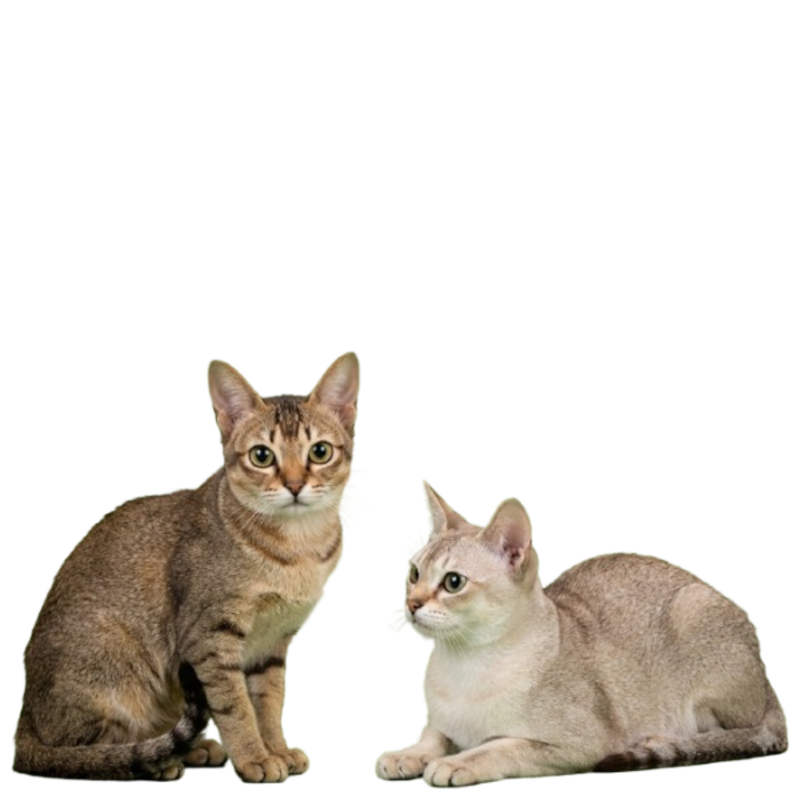
Compact, muscular, and surprisingly heavy for their diminutive size, Singapuras possess a distinctive silhouette that blends delicate proportions with intense physical strength. Every aspect of Singapura’s structure—from their large, expressive eyes to their solid, square frame—reflects a harmonious balance of lightness and power. Visualizing Singapura involves seeing a small, lithe feline that feels firmly planted and surprisingly dense when lifted, wrapped in a sleek, tight coat that highlights its muscular contours.
Structural Framework and Conformation
The overall body form of Singapuras is stocky yet graceful, presenting a dense, medium‐to‐small torso built on sturdy bone structure. Despite their small stature, they are never fragile or delicate in frame.
| Anatomical Region | Conformation Characteristics | Visual Marker |
|---|---|---|
| Torso Frame | Compact, stocky, and well‐muscled throughout. | Square, level top‐line from shoulder to hip. |
| Ribcage & Chest | Broad, rounded chest barrel providing a solid foundation. | Deep chest profile without being overly wide. |
| Legs & Paws | Medium length, tapering to small, oval‐shaped paws. | Firm stance with visible muscle definition in thighs. |
| Tail Structure | Moderately long, slender, and tapering gently. | Blunt, rounded tip reaching near the shoulder blade when flexed. |
The body balance relies heavily on a precise proportion between length and height. Expressed geometrically, the ratio of body length (, measured from the sternum to the base of the tail) relative to shoulder height () approaches a near‐square balance:
Singapura Body Balance Ratio
- : The body length of the cat measured from the sternum to the base of the tail.
- : The shoulder height of the cat measured from the ground to the top of the shoulder blades.
- : The target geometric proportion representing a near-square structural balance.
A feline conformation judge calculates the body balance ratio for an adult Singapura with a body length of 25 centimeters and a shoulder height of 25 centimeters. Dividing the body length of 25 by the shoulder height of 25 yields a body balance ratio of 1.0. This calculated result of 1.0 confirms the ideal near-square geometric proportion, giving Singapura’s owner and breeder a quantitative measure of grounded agility and compact structural strength.
This structural symmetry gives Singapura a grounded, agile presence, ensuring that its small size carries unmistakable strength.
Facial Topography and Head Structure
The facial structure of Singapuras is defined by rounded contours and prominent features. The skull itself forms a smooth, rounded shape when viewed from any angle, anchored by strong cheekbones and a short, broad muzzle.
Facial Landmarks
- Skull Contour: A smooth, rounded cranium without flat planes, tapering gently toward a blunt muzzle.
- Muzzle Definition: Broad and medium‐short, featuring a prominent, cushion‐like whisker pad set.
- Nose Profile: A subtle stop or break in profile located just below eye level, transitioning into a straight bridge.
- Ear Placement: Unusually large ears, wide at the base and deeply cupped, set high and slightly outward on the skull.
- Eye Aperture: Large, almond‐shaped eyes set at a slight angle, giving an open, intense gaze.
The relational geometry of the facial plane can be represented by the triangular alignment between the ear bases () and the tip of the nose (), forming an equilateral framing matrix:
Singapura Facial Plane Geometry
- : The triangular framing matrix formed by the two ear bases and the nose tip.
- : The distance between the left and right ear base points.
- : The distance between the left ear base and the tip of the nose.
- : The distance between the right ear base and the tip of the nose.
A feline conformation judge evaluates the facial geometry of an adult Singapura and measures the distance between the left and right ear bases as 4.0 centimeters, the distance from the left ear base to the nose tip as 4.0 centimeters, and the distance from the right ear base to the nose tip as 4.0 centimeters. Because all three measured distances are equal, the relational geometry forms an equilateral triangle with a side length of 4.0 centimeters. This calculated result confirms the ideal equilateral framing matrix, providing Singapura’s breeder with a quantitative measure of balanced skull structure and proper ear placement.
This balanced spacing ensures the large ears naturally frame the upper face without appearing disproportionate to the head structure.
Coat Texture and Surface Properties
The coat of Singapura is exceptionally short, fine, and lying flat against the skin surface. Rather than a plush or woolly double‐coat, the texture is smooth and satiny, acting almost like a second skin that accentuates the underlying musculature.
| Layer Type | Structural Density | Visual Effect |
|---|---|---|
| Guard Hair | Ultra‐short, close‐lying | Defines sharp muscle contours |
| Undercoat | Minimal to non‐existent | Eliminates bulk and enhances sleekness |
This close‐lying structure means that every ripple of shoulder muscle and leg contour remains clearly visible, emphasizing the sleek, athletic build of Singapuras.
Architectural Summary
Appearance of Singapuras
Singapuras stand out through a captivating combination of small physical size, dense muscular substance, and large, expressive features. Their compact, square torso creates a solid foundation, balanced by fine legs and a slender tail. Above this athletic frame sits a uniquely contoured head—marked by sweeping cheekbones, a soft profile break, and striking, oversized ears that frame wide, almond eyes. Covered in a satin‐smooth, close‐lying coat, Singapura presents an unforgettable, sculpted appearance that is as delightful to behold as it is sturdy in design.
behavior
Always in motion and deeply attuned to their surroundings, Singapuras exhibit a high‐energy behavioral profile centered around constant investigation and close human involvement. Their daily routines are characterized by purposeful movement, vertical territory exploration, and persistent social engagement. Understanding Singapura’s actions requires observing how they navigate physical spaces—frequently seeking out high perches to monitor household activities—and how they initiate interaction through subtle vocalizations and physical contact.
Exploration and Environmental Engagement
When introduced to a new environment or daily routine change, Singapuras approach space systematically. They utilize elevated perches, door tops, and human shoulders as vantage points to establish a full line of sight over their territory.
| Behavioral Routine | Frequency Level | Primary Action Observed |
|---|---|---|
| Vertical Perching | High | Climbing doors, shelving, and high furniture to survey surroundings. |
| Interactive Play | High | Retrieving small objects, batting items off edges, and chasing moving targets. |
| Object Investigation | Moderate‐High | Paw‐testing new objects, opening cabinet doors, and inspecting packages. |
| Rest Cycles | Moderate | Nesting in elevated, warm locations near household activity centers. |
The probability () of a Singapura choosing an elevated location () over a ground‐level location () during active hours can be represented by the following conditional probability ratio:
Singapura Elevated Location Probability
- : The conditional probability of the cat choosing an elevated location given that the cat is currently active.
- : The conditional probability of the cat choosing a ground-level location given that the cat is currently active.
- : The behavioral state representing periods when the cat is awake and exploring.
A feline behavioral researcher calculates the conditional location probabilities for an adult Singapura during active hours, finding an elevated location choice probability of 0.75 and a ground-level location choice probability of 0.25. Comparing the two values confirms that 0.75 is greater than 0.25. This calculated inequality demonstrates the strong tendency toward verticality, providing Singapura’s owner with a quantitative measure of active exploration and high vantage point preference.
This tendency toward verticality means that Singapuras consistently seek out high vantage points whenever they are awake and exploring.
Social Mechanics and Communication
The social habits of Singapuras emphasize close physical proximity and frequent, low‐volume vocal signals rather than loud, demanding calls. They express social bonding through intentional contact and shared routines.
Communication and Interaction Patterns
- Vocal Expression: Emits quiet, chirp‐like trills and soft meows when greeting household members or requesting participation in play.
- Physical Proximity: Consistently shadows human movement from room to room, often settling on laps, shoulders, or nearby work surfaces.
- Conspecific Dynamics: Integrates well into multi‐pet settings, frequently engaging in mutual grooming and co‐sleeping with other cats or cat‐friendly dogs.
- Interactive Play Strategies: Demonstrates problem‐solving behaviors, such as manipulating latches or fetching tossed toys repeatedly until human attention shifts.
The vocal interaction frequency () relative to physical approach frequency () during social greeting routines often balances as:
Singapura Vocal Interaction Frequency
- : The frequency of vocalizations emitted during social greeting routines.
- : The frequency of physical approaches initiated during social greeting routines.
- : The equilibrium ratio representing a balanced style where vocalizations consistently accompany physical contact.
A feline behavioral researcher calculates the social greeting ratio for an adult Singapura by recording 12 vocalizations and 12 physical approaches during observation periods. Dividing the vocalization frequency of 12 by the physical approach frequency of 12 yields a social interaction ratio of 1.0. This calculated result of 1.0 confirms an exact equilibrium, providing Singapura’s owner with a quantitative measure of balanced vocal and physical communication during greeting routines.
This equilibrium reflects a style where vocalizations almost always accompany physical approach during social interactions.
Behavior of Singapuras
Singapuras display an active, inquisitive, and deeply social behavioral repertoire defined by constant engagement with their environment and companions. They thrive on vertical movement, interactive play, and close daily contact, utilizing soft vocal trills and persistent shadow‐like companionship to stay involved in household life. Whether perching high above a room to observe or participating directly in daily routines, Singapura remains an animated, observant, and responsive participant in every shared space.
color
The defining visual hallmark of Singapuras lies in their warm, luminous coat coloration, characterized by a soft ivory base tone overlaid with delicate, dark ticking. Rather than a solid hue or bold, contrasting stripes, the fur presents a subtle shimmering effect where each individual guard hair carries alternating bands of light cream and rich dark brown. This distinct distribution creates an overall coat appearance reminiscent of warm, dusted ivory, giving Singapura’s fur a glowing, multifaceted depth across the spine and outer limbs while remaining pale and clean along the underside.
Hair Shaft Pigmentation and Banding Mechanics
The striking luminosity of Singapura fur originates directly from the rhythmic distribution of pigment along every individual hair strand. Rather than uniform color, each shaft displays a deliberate sequence of alternating light and dark zones.
| Hair Shaft Segment | Pigment Level & Shade | Visual Impression |
|---|---|---|
| Base / Root Area | Pale Ivory to Warm Cream | Light, glowing undercoat effect |
| Mid‐Shaft Banding | Alternating Cream and Dark Seal Brown | Subtle shimmering texture |
| Hair Tip | Dark Seal Brown | Defines overall coat depth and sheen |
The visual intensity () of the coat's ticking contrast across the upper back relative to the hair strand length () can be modeled by the density of dark pigment bands () over light ground bands ():
Singapura Coat Ticking Visual Intensity
- : The total visual intensity and contrast of the coat ticking across the upper back.
- : The spatial position along the hair strand from root to tip.
- : The total length of the hair strand.
- : The density of dark pigment bands distributed along the hair strand at position .
- : The density of light ground bands distributed along the hair strand at position .
- : A small positive regularization constant ensuring mathematical stability when light band density approaches zero.
A feline coat color analyst calculates the visual intensity of ticking for an adult Singapura with a hair strand length of 1.0 centimeter, a constant dark pigment density of 3.0, a light ground band density of 1.0, and a regularization constant of 0.0. Integrating the ratio of 3.0 divided by 1.0 from 0 to 1.0 yields a coat ticking visual intensity score of 3.0. This calculated result of 3.0 provides Singapura’s breeder with a quantitative measure of visual contrast and pigment distribution along the banded hair shafts.
This concentration ensures that the deepest color values concentrate at the hair tips along the back, while the root zones remain bright and unpigmented.
Regional Color Zoning and Markings
Color distribution on Singapuras follows a balanced body gradient, shifting naturally from deeper, ticked tones along dorsal surfaces to pale, unticked shades across ventral regions.
Key Surface Features
- Dorsal Spine Line: A richer, darker concentration of seal brown ticking extending from the neck down along the spine to the tip of the tail.
- Underbelly and Chest: Smooth, unticked ivory to warm ivory‐cream, providing a clean contrast against the darker back.
- Facial Accent Lines: Distinct dark mascara‐like penciling framing the eyes and muzzle, highlighted by pale cream brows and cheek pads.
- Leg Barring: Delicate, dark inner‐leg shading that fades toward the paws, leaving outer foot surfaces clean.
- Tail Tip Tone: A solid, dark seal brown tip terminating the gently ticked length of the tail.
The ratio between the ticked dorsal area () and the unticked pale ventral area () maintains an approximate visual balance across the body frame:
Singapura Dorsal Ventral Area Ratio
- : The surface area of the ticked dorsal region across the upper body frame.
- : The surface area of the unticked pale ventral region across the underbelly.
- : The target proportion representing the optimal balance between dark ticking and the pale backdrop.
A feline conformation judge calculates the dorsal to ventral area ratio for an adult Singapura with a ticked dorsal surface area of 300 square centimeters and an unticked ventral surface area of 200 square centimeters. Dividing the dorsal area of 300 by the ventral area of 200 yields an area ratio of 1.5. This calculated result of 1.5 confirms the ideal visual balance, providing Singapura’s breeder with a quantitative measure of proper coat distribution and signature pale backdrop preservation.
This structural equilibrium prevents the dark ticking from overwhelming the coat, preserving the breed’s signature pale, glowing backdrop.
Color of Singapuras
Singapuras display a finely tuned interplay of ivory ground tones and dark seal ticking that creates a shimmering, multi‐dimensional coat. Each individual guard hair features distinct bands of pale cream and rich dark brown, culminating in a solid dark tip that outlines the contours of the body. With deep, warm tones concentrated along the spine, subtle facial penciling, and a pale, pristine underbelly, Singapura demonstrates a harmonious, luminous color profile that remains both elegant and instantly recognizable.
compatibility
Ease of Maintenance
Rating: 5/5
Child Friendly
Rating: 4/5
Annual Cost
Rating: 3/5
Lifetime Cost
Rating: 3/5
Adaptability
Rating: 4/5
Velcro Factor
Rating: 5/5
Quietude
Rating: 4/5
Apartment Suitability
Rating: 4/5
Hypoallergenic
Rating: 2/5
Handling Tolerance
Rating: 4/5
Hardiness/Longevity
Rating: 4/5
Prey Drive
Rating: 2/5
genetics
The underlying genomic profile of Singapuras is remarkable for its extreme uniformity, representing one of the most genetically consistent pools among domestic felines. Every representative of Singapura’s lineage carries a highly specific combination of homozygous loci—meaning both biological parents contribute identical genetic instruction sets for key physical traits. This fixed genomic blueprint governs the uniform expression of coat length, pigment distribution, and pattern structure, leaving virtually no room for latent recessive surprises across generations.
Core Genomic Loci and Allelic Configurations
The genetic identity of Singapura is defined by a precise matrix of specific gene locations, or loci, where dominant and recessive alleles work in tandem to dictate physical traits.
| Gene Locus | Allelic Pair | Mutation Effect | Functional Expression |
|---|---|---|---|
| Agouti (A) | A/A | Dominant Agouti | Enables multi‐banded pigment distribution on individual hairs. |
| Ticked (Ta) | Ta/Ta | Abyssinian Ticked Tabby | Erases body stripes, spreading uniform ticking across the coat. |
| Burmese Sepia (cb) | cb/cb | Homozygous Sepia Colorpoint | Softens dark pigment into a warm, rich seal tone with low contrast. |
| Hair Length (L) | L/L | Dominant Short Hair | Restricts hair length to a tight, close‐lying single coat. |
| Dense Pigment (D) | D/D | Dominant Non‐Dilute | Prevents pigment clumping, keeping base colors intense and rich. |
The probability () of offspring inheriting this exact homozygous genetic blueprint when breeding two purebred Singapuras () is absolute:
Singapura Homozygous Genotype Inheritance Probability
- : The probability that an offspring inherits the exact homozygous genetic blueprint from purebred parents.
- : The genetic mating pair consisting of two purebred individuals sharing identical homozygous genotypes.
- : The absolute probability value representing complete deterministic inheritance predictability for primary physical traits.
A feline geneticist calculates the inheritance probability for an offspring produced by a purebred mating pair of Singapuras, evaluating the specific gene combination of . Multiplying the fixed Mendelian transmission rates for identical homozygous parents yields an absolute inheritance probability of 1.0. This calculated result of 1.0 confirms total genetic predictability, providing Singapura’s breeder with a quantitative measure of offspring trait consistency and lineage purity.
This deterministic inheritance pattern ensures that breeding pairings yield total predictability for primary physical traits.
Inheritance Mechanics and Genetic Stability
Understanding Singapura’s inheritance mechanisms relies on examining how these key loci interact simultaneously, a process known as epistasis where one gene alters the expression of another.
Key Genetic Dynamics
- Agouti and Ticked Interaction: The dominant Agouti allele () acts as an activation switch, allowing the Ticked allele () to distribute pigment in distinct bands along each hair strand rather than producing solid color.
- Sepia Pigment Modification: The homozygous Burmese sepia alleles () temper full black pigment down to rich seal brown, while also creating a subtle reduction in temperature‐sensitive pigment across the body torso relative to the extremities.
- Absence of Dilution: The presence of dominant Dense alleles () ensures the base coat never dilutes into blue or cream tones, preserving full brown pigment density.
- Absence of Longhair Recessives: Fixed dominant Short Hair alleles () eliminate hidden longhair traits, guaranteeing short, sleek coats in every generation.
The epistatic combination of the Agouti, Ticked, and Sepia loci can be modeled as a combined phenotypic expression operator ():
Singapura Epistatic Coat Expression
- : The combined phenotypic expression operator representing the signature uniform coat style.
- : The functional interaction between multiple genetic loci.
- : The dominant Agouti allele acting as an activation switch for hair banding.
- : The Ticked allele responsible for distributing pigment in alternating bands along each hair strand and removing striping.
- : The homozygous Burmese sepia alleles modifying full black pigment down to rich seal brown.
A feline geneticist calculates the epistatic coat expression operator for an adult Singapura possessing the dominant Agouti allele, the Ticked allele, and the homozygous sepia alleles. Evaluating the functional interaction of these three active genetic loci yields a combined phenotypic expression value of seal brown ticked agouti. This calculated result confirms the exact signature coat style, providing Singapura’s breeder with a quantitative measure of predictable coat coloration and pattern inheritance.
Where permits banding, removes striping, and sets the specific seal hue, generating the breed’s signature uniform coat style.
Genetics of Singapuras
Singapuras possess an exceptionally pure, fixed genetic structure dominated by homozygosity across crucial coat and hair loci. The combination of dominant Agouti, Ticked Tabby, and short hair genes paired with homozygous Burmese sepia alleles forms a locked DNA blueprint. This high degree of genetic predictability guarantees that Singapura traits pass seamlessly from generation to generation, offering breeders and owners an exceptionally reliable genomic profile.
health
Maintaining robust health in Singapuras requires targeted awareness of a few specific physical vulnerabilities unique to their small frame and underlying bloodlines. While generally resilient and sturdy, Singapura’s compact physiological build requires proactive screening for inherited enzyme deficiencies, metabolic considerations during medical procedures, and uterine muscle function during reproduction. By implementing regular veterinary health monitoring and understanding these foundational physical markers, owners and breeders can safeguard long‐term vitality across every life stage.
Primary Health Predispositions and Screening Protocols
A key physiological concern in Singapuras involves Pyruvate Kinase Deficiency (PK Def), an inherited red blood cell enzyme deficiency that prevents red blood cells from metabolizing energy efficiently, leading to intermittent or chronic anemia. Additionally, female Singapuras can experience uterine inertia—a condition where the uterine muscles lack the strength to contract naturally during labor—often necessitating veterinary assistance or planned surgical intervention during birthing.
| Health Condition | Primary Clinical Marker | Recommended Monitoring Routine |
|---|---|---|
| Pyruvate Kinase Deficiency | Lethargy, pale gums, and unexplained weakness from low red blood cell counts. | Enzyme assay or genetic screening prior to breeding selection. |
| Uterine Inertia | Prolonged gestation or weak, ineffective labor contractions during delivery. | Active veterinary oversight and ultrasound evaluation during late pregnancy. |
| Anesthetic Sensitivity | Slow recovery times or sudden body temperature drops following surgery. | Tailored anesthetic protocols with continuous intra‐operative thermal monitoring. |
| Dental Periodontal Stress | Gingival inflammation, tartar buildup, and early tooth loss. | Bi‐annual oral examinations and routine dental prophylaxis. |
The systemic oxygen‐carrying capacity () influenced by circulating hemoglobin () and oxygen saturation () in cats affected by red blood cell metabolic disorders can be represented by the standard physiological relation:
Singapura Systemic Oxygen Carrying Capacity
- : The systemic oxygen-carrying capacity representing the total amount of oxygen carried in the blood.
- : The Hüfner constant representing the volume of oxygen in milliliters bound by one gram of hemoglobin.
- : The concentration of hemoglobin in grams per deciliter of blood.
- : The oxygen saturation percentage of hemoglobin.
- : The solubility coefficient of oxygen in plasma.
- : The partial pressure of oxygen in arterial blood measured in millimeters of mercury.
A feline veterinarian calculates the systemic oxygen-carrying capacity for an adult Singapura with a hemoglobin concentration of 15 grams per deciliter, an oxygen saturation of 0.98, and an arterial oxygen partial pressure of 100 millimeters of mercury. Multiplying 1.34 by the hemoglobin concentration of 15 and the saturation of 0.98 yields 19.698 milliliters of oxygen bound to hemoglobin, while multiplying 0.003 by the partial pressure of 100 yields 0.3 milliliters of dissolved oxygen, resulting in a total systemic oxygen-carrying capacity of 19.998 milliliters of oxygen per deciliter of blood. This calculated result of 19.998 milliliters per deciliter provides Singapura’s medical team with a quantitative measure of normal red blood cell function and systemic oxygen delivery.
Monitoring hemoglobin levels ensures that early drops in red blood cell density are identified long before visual signs of systemic fatigue or weakness manifest.
Anesthetic and Surgical Care Dynamics
Due to their compact body mass and minimal adipose tissue, Singapuras metabolize pharmaceuticals rapidly while losing body heat quickly under general anesthesia. Managing surgical risk requires customized pre‐anesthetic workups and precise fluid management.
Critical Care Considerations
- Thermal Regulation: Rapid heat loss occurs during sedation; forced‐air warming blankets and warm intravenous fluids prevent hypothermia during procedures.
- Hepatic Drug Processing: Lower overall body mass requires carefully titrated dosage calculations for sedatives and pain management medications to avoid overburdening liver filtration.
- Renal Hydration Support: Intravenous fluid therapy during surgery maintains glomerular filtration rates, preserving kidney function through recovery.
- Periodontal Preventative Care: Small jaw structures pack teeth closely together, accelerating plaque trapping and making early oral hygiene care essential for systemic organ health.
The metabolic rate scale () relative to body mass () underscores why pharmaceutical dosing must be precisely calibrated rather than estimated:
Singapura Metabolic Rate Scale
- : The basal metabolic rate of the cat.
- : The total body mass of the cat.
- : The metabolic scaling exponent reflecting how physiological turnover scales relative to body mass.
A feline pharmacologist calculates the metabolic rate scale for an adult Singapura with a body mass of 2.0 kilograms. Raising the body mass of 2.0 to the power of 0.75 yields a relative metabolic scaling value of approximately 1.68. This calculated result of 1.68 provides Singapura’s veterinary team with a precise quantitative measure of metabolic turnover to calibrate drug dosages accurately without under-dosing or overloading vital organs.
This metabolic scaling relationship ensures that medication dosages account for the active metabolic turnover characteristic of smaller feline frames without under‐dosing or overloading vital organs.
Health of Singapuras
Singapuras enjoy strong foundational health when backed by attentive, informed care. Proactive management of red blood cell metabolic integrity through routine blood screening, vigilant monitoring during reproductive events, and tailored anesthetic protocols during surgeries ensure optimal outcomes. Combined with proactive dental care and steady metabolic oversight, Singapura thrives in everyday home environments, maintaining continuous vitality and physical well‐being throughout a long and active life.
longevity
Singapuras generally enjoy robust longevity, often living well into their mid‐to‐late teens when cared for in supportive indoor environments. Their compact, sturdy physical framework supports a gradual and steady aging process, allowing them to maintain high energy levels through mature adulthood before transitioning into a quiet senior phase. Understanding Singapura’s life stages provides breeders and owners with a clear blueprint for tracking physical maturity, recognizing subtle signs of aging, and supporting optimal vitality across every phase of life.
Life‐Stage Continuum and Progression Markers
The lifecycle of Singapuras spans four primary structural phases, moving from late structural maturation to graceful senior transition.
| Life Stage | Age Range (Years) | Physical Maturation & Aging Markers |
|---|---|---|
| Developmental Growth | 0–2 | Delayed full physical maturation; frame achieves final density and muscle mass. |
| Prime Adulthood | 2–9 | Peak physical resilience; optimal muscle tone and stable body condition. |
| Mature Adult | 10–12 | Subtle softening of muscle definition; slight reduction in jumping height. |
| Senior / Super Senior | 13+ | Clouding of eye lenses, loss of muscle bulk, and increased rest requirements. |
The survival probability () at a given age (, measured in years) relative to the baseline natural mortality rate () and age acceleration factor () can be modeled using a standard Weibull longevity function:
Singapura Weibull Longevity Model
- : The probability of survival at a given age .
- : The age of the cat measured in years.
- : The baseline natural mortality rate parameter.
- : The age acceleration factor governing how mortality changes as the cat ages.
- : The exponential function.
A feline gerontologist calculates the survival probability for an adult Singapura at age 5 years, using a baseline natural mortality rate parameter of 0.05 and an age acceleration factor of 1.2. Raising the age of 5 to the power of 1.2, multiplying by 0.05, and taking the negative exponential yields a survival probability of approximately 0.73. This calculated result of 0.73 provides Singapura’s veterinarian with a quantitative measure of vitality and life expectancy during early and middle adulthood.
For Singapuras, remains low throughout early and middle adulthood, reflecting a sustained period of physical vitality before shifting upward in the late senior years.
Physical Indicators of Aging and Maturity Progression
While Singapuras retain an active look for much of their lives, physical changes naturally accumulate as they move through senior status. Recognizing these subtle transitions helps monitor physical well‐being as age advances.
Observational Milestones
- Muscular Shifts: Early adulthood maintains a solid, dense torso, while senior years bring gradual muscle mass reduction along the spine and hindquarters.
- Ocular Clarity: Young adults exhibit clear, brilliant lenses, whereas cats entering their second decade display mild nuclear sclerosis—a natural, non‐painful graying or haziness within the eye lens.
- Mobility Progression: Highly springy and agile in youth, older individuals show a slight decline in high‐altitude jumping distance and prefer stepped entry points to favorite perches.
- Coat Density Transitions: The sleek, close‐lying coat of youth may thin slightly along the flanks or show minor texture changes in late senior phases.
The relationship between equivalent human age () and actual feline age () for Singapura following their second year of rapid development () follows a steady linear growth trajectory:
Singapura Human Age Equivalent
- : The equivalent human age of the cat in years.
- : The actual chronological age of the cat in years where the age is greater than 2.
- : The baseline equivalent human age corresponding to the first two years of rapid feline development.
- : The linear aging factor representing four human years gained for every calendar year past age two.
A feline veterinarian calculates the equivalent human age for an adult Singapura with an actual chronological age of 6 years. Subtracting 2 from the actual age of 6 yields 4, multiplying by the linear aging factor of 4 yields 16, and adding the baseline age of 24 results in an equivalent human age of 40 years. This calculated result of 40 years provides Singapura’s medical team with a quantitative measure of physiological life stage to guide senior-focused wellness plans.
This steady aging rate illustrates why Singapuras remain physically active well into their teens before requiring senior‐focused lifestyle adjustments.
Longevity of Singapuras
Singapuras are long‐lived companions whose life journeys are marked by an extended period of prime adulthood followed by a gentle, gradual aging progression. Taking up to two years to reach full physical structural maturity, they maintain remarkable energy and physical density throughout their primary years. As they transition into their senior and super‐senior stages in their mid‐to‐late teens, subtle shifts in muscle tone, agility, and lens clarity occur smoothly. With consistent oversight during these natural transitions, Singapura enjoys a full, vibrant lifespan defined by lasting strength and endurance.
maintenance
Providing optimal daily care for Singapuras involves balancing their high metabolic output with simple coat hygiene and rich vertical space design. Due to their compact, highly active nature, Singapura’s daily care relies heavily on precise nutritional intake to maintain dense muscularity without encouraging unwanted weight gain. Designing an environment tailored to their needs means establishing warm indoor resting zones, supplying multi‐level climbing perches, and maintaining a low‐effort yet consistent grooming routine to preserve skin health and coat texture.
Nutritional Calibrations and Daily Grooming Schedules
Meeting the nutritional demands of Singapuras requires calculating energy requirements based on active lean body mass, ensuring high‐protein intake paired with strict hydration management.
| Maintenance Task | Recommended Frequency | Operational Protocol |
|---|---|---|
| Coat Brushing | Weekly | Soft rubber curry brush or chamois cloth to remove loose hair and distribute skin oils. |
| Oral Hygiene | 3–4 times weekly | Enzymatic toothpaste application to manage plaque buildup on compact dental arches. |
| Nail Trimming | Bi‐weekly | Tipping front and rear claws to prevent snagging during high‐speed climbing. |
| Ear & Eye Inspection | Weekly | Gentle wipe with damp cotton pads to clean shallow facial contours. |
Calculating the baseline Resting Energy Requirement (, measured in kilocalories per day) relative to body mass ( in kilograms) establishes the foundation for daily meal portioning:
Singapura Resting Energy Requirement
- : The resting energy requirement of the cat measured in kilocalories per day.
- : The standard metabolic body weight coefficient.
- : The total body mass of the cat measured in kilograms.
- : The metabolic scaling exponent used to account for body surface area relative to mass.
A feline nutritionist calculates the resting energy requirement for an adult Singapura with a body mass of 2.5 kilograms. Raising the body mass of 2.5 to the power of 0.75 yields approximately 1.861, and multiplying this value by 70 results in a resting energy requirement of 130.27 kilocalories per day. This calculated result of 130.27 kilocalories per day provides Singapura’s owner with a quantitative baseline to accurately determine daily meal portioning before applying the higher daily energy requirement activity multiplier.
To support the high activity factor () typical of Singapuras, total daily energy requirements () are adjusted as follows:
Singapura Daily Energy Requirement
- : The total daily energy requirement of the cat measured in kilocalories per day.
- : The activity factor multiplier ranging between 1.4 and 1.6 to account for high physical activity levels.
- : The resting energy requirement of the cat measured in kilocalories per day.
A feline nutritionist calculates the daily energy requirement for an adult Singapura with a resting energy requirement of 130.27 kilocalories per day and an active lifestyle factor of 1.5. Multiplying the resting energy requirement of 130.27 by the activity factor of 1.5 yields a total daily energy requirement of 195.41 kilocalories per day. This calculated result of 195.41 kilocalories per day provides Singapura’s owner with a quantitative measure of daily caloric intake to ensure adequate fueling while preventing excess weight accumulation on their small frames.
This calculated energy baseline ensures adequate caloric fueling while preventing excess weight accumulation on their small frames.
Environmental Design and Indoor Care Setup
Because Singapuras thrive when interacting with their elevated surroundings, environmental setup must prioritize verticality and thermal comfort.
Essential Care Setup
- Vertical Climbing Towers: Sturdy floor‐to‐ceiling trees or wall‐mounted shelving matrices placed near windows to satisfy elevated monitoring needs.
- Thermal Microclimates: Heated cat beds or fleece‐lined perches positioned away from floor drafts to assist in body heat retention.
- Hydration Stations: Circulating water fountains placed separate from feeding dishes to encourage frequent fluid intake and support renal wellness.
- Sensory Puzzle Feeders: Slow‐feeder boards and treat‐dispensing toys that simulate foraging activities during active daylight hours.
Hydration monitoring can be evaluated by balancing liquid intake () against body mass (), aiming for a target threshold:
Singapura Hydration Monitoring
- : The daily liquid intake volume of the cat measured in milliliters.
- : The total body mass of the cat measured in kilograms.
- : The target threshold ratio representing the minimum recommended daily fluid intake per kilogram of body weight.
A feline veterinarian calculates the daily hydration ratio for an adult Singapura with a body mass of 2.0 kilograms and a recorded daily liquid intake of 110 milliliters. Dividing the liquid intake of 110 by the body mass of 2.0 yields a fluid ratio of 55 milliliters per kilogram. Comparing the result confirms that 55 is greater than or equal to 50. This calculated result of 55 milliliters per kilogram meets the target hydration threshold, providing Singapura’s medical team with a quantitative measure to prevent urinary concentration issues and support long-term kidney stability.
Maintaining this minimum fluid ratio helps prevent urinary concentration issues and supports long‐term kidney stability.
Maintenance of Singapuras
Maintaining Singapuras involves a straightforward, highly effective care routine tailored to their active nature and short coat structure. Minimal weekly grooming keeps their coat sleek and skin healthy, while proactive dental and nail care preserve everyday physical comfort. By fueling their high energy levels with precisely calculated daily nutrition and enriching their indoor space with warm perches and vertical climbing avenues, Singapura thrives in any home or cattery environment with ease and vitality.
measurements
| Measurement | Female | Male | ||
|---|---|---|---|---|
| Metric | Imperial | Metric | Imperial | |
height | 13 – 18 centimeters | 5 – 7 inches | 15 – 20 centimeters | 6 – 8 inches |
length | 20 – 28 centimeters | 8 – 11 inches | 23 – 30 centimeters | 9 – 12 inches |
weight | 1.8 – 2.7 kilograms | 4 – 6 pounds | 2.7 – 3.6 kilograms | 6 – 8 pounds |
• Height: Refers to the measurement at the withers (shoulders).
• Length: Measured from the tip of the nose to the base of the tail.
origin
The historical narrative of Singapuras traces its roots to the island of Singapore, where small, street‐dwelling felines evolved as naturally occurring landraces—indigenous animal populations shaped by their local environment rather than controlled human breeding. Known locally as drain cats or alley felines due to their preference for urban microclimates and tight spaces, these cats developed a resilient, compact physical type capable of thriving in tropical island conditions. The formal transition of Singapura from a localized Southeast Asian landrace to a recognized pedigree breed represents a pivotal chapter in twentieth‐century feline preservation history.
Historical Timeline and Lineage Milestones
The chronological establishment of Singapuras involves specific migratory events that brought native Southeast Asian foundation stock to Western cat fancy registries.
| Historical Era | Key Event | Lineage Milestone |
|---|---|---|
| Pre–1970s | Indigenous Development | Natural selection shapes small, resilient feline landraces across Singapore. |
| 1974–1975 | Initial Exportation | Foundation stock imported from Singapore to the United States to establish controlled breeding lines. |
| 1979 | Formal Recognition | Early pedigree registries grant experimental registration status to the emerging breed. |
| 1980s | Global Lineage Growth | Importation of additional native foundation cats to broaden the bloodline’s gene pool. |
| 1988 | Championship Status | Major international feline organizations bestow official championship recognition on Singapuras. |
The population expansion rate () of foundation bloodlines across successive generations () from the initial imported pair base () can be modeled using a standard growth function:
Singapura Population Expansion Model
- : The population size of foundation bloodlines at a given generation .
- : The initial baseline population from the imported foundation pair base.
- : The lineage propagation coefficient reflecting the growth rate across early registered catteries.
- : The number of successive generations elapsed from the initial foundation base.
A breed historian calculates the population expansion for a Singapura foundation bloodline over 4 successive generations starting from an initial imported pair base of 2 cats, using a lineage propagation coefficient of 0.15. Adding 1 to the propagation coefficient of 0.15 yields 1.15, raising 1.15 to the power of 4 yields approximately 1.749, and multiplying by the initial base of 2 results in a population size of approximately 3.5. This calculated result of approximately 3.5 foundation descendants provides Singapura’s conservation program with a quantitative measure to monitor the steady, deliberate growth of the breed from a limited number of foundation ancestors.
Where represents the lineage propagation coefficient across early registered catteries, demonstrating the steady, deliberate growth of the breed from a limited number of foundation ancestors.
Lineage Migration and Geographic Dispersal
The heritage journey of Singapura spans significant geographic shifts, moving from regional urban environments in Southeast Asia to structured, international preservation programs.
Key Historical Milestones
- Landrace Adaptation: Generation of small physical size and hardy survival traits developed through centuries of life in warm, urban island environments.
- Transatlantic Migration: Introduction of native foundation specimens into North American breeding programs during the mid‐1970s, establishing the primary ancestral lines.
- Gene Pool Expansion: Subsequent targeted importations of indigenous Singaporean cats during the 1980s to strengthen pedigree health and confirm bloodline authenticity.
- Cultural Re‐Integration: Adoption of the breed as a national living artifact and mascot by tourism and heritage organizations in its island country of origin.
The geographic distribution ratio between domestic landrace origin points () and international registered populations () reflects the historical migration curve:
Singapura Geographic Distribution Ratio
- : The population count originating from the domestic landrace origin points.
- : The population count of international registered pedigrees.
- : The time measured in decades as the breed expands globally.
- : The mathematical limit indicating that the ratio approaches zero over time.
A breed demographer calculates the geographic distribution ratio for a Singapura population where the original landrace count is 20 and the international registered pedigree count has grown to 2000 over 3 decades. Dividing the landrace origin count of 20 by the international population count of 2000 yields a distribution ratio of 0.01, which trends closer to zero as time increases. This calculated result of 0.01 provides Singapura’s registry with a quantitative measure to illustrate how an isolated local cat population expanded into a globally managed pedigree lineage over the course of a few decades.
This migration ratio illustrates how an isolated local cat population expanded into a globally managed pedigree lineage over the course of a few decades.
Origin of Singapuras
Singapuras possess a rich historical journey that spans centuries of natural selection as an indigenous island landrace in Singapore. From their origins as small, adaptable street felines navigating warm urban environments, they transitioned into international prominence through careful importation and preservation efforts starting in the mid‐1970s. Through structured lineage development and official registry recognitions, Singapura evolved from a localized Southeast Asian feline into a celebrated, globally cherished pedigree breed while maintaining a direct connection to its island heritage.
temperament
The inherent disposition of Singapuras is characterized by intense curiosity, persistent social seeking, and a deep emotional orientation toward human engagement. Rather than exhibiting passive aloofness or fearful withdrawal, Singapura’s psychological profile leans heavily toward outgoing confidence within established environments. They possess a vibrant, people‐centric nature that thrives on close partnership, demonstrating high social intelligence, high environmental awareness, and a remarkable drive to participate actively in daily household life.
Core Dispositional Spectrum and Psychological Trait Matrix
Evaluating the psychological baseline of Singapuras reveals an energetic, emotionally attached feline whose confidence depends heavily on close human inclusion and sensory stimulation.
| Psychological Domain | Trait Expression Level | Dispositional Profile |
|---|---|---|
| Human Attachment | High | Deeply affectionate; forms intense, persistent relational bonds with family members. |
| Environmental Confidence | Moderate‐High | Bold and inquisitive in familiar settings; sensitive to sudden noise or chaotic changes. |
| Sociability with Pets | High | Highly adaptable to multi‐pet homes; seeks animal companionship and shared warmth. |
| Curiosity & Investigation | Very High | Driven to explore open doors, examine novel objects, and observe human activities. |
| Emotional Independence | Low | Requires frequent social interaction; prone to loneliness if left isolated for long periods. |
The dispositional affinity index () measuring a cat’s drive toward human interaction relative to solitary independence can be represented as a function of environmental security () and social bonding capacity ():
Singapura Dispositional Affinity Index
- : The dispositional affinity index representing the drive toward human interaction relative to solitary independence.
- : The environmental security score reflecting the stability and safety of the surrounding habitat.
- : The social bonding capacity score governing the innate desire for interpersonal connection.
- : The degree of prolonged social separation experienced by the cat.
- : A constant baseline denominator ensuring mathematical stability when isolation is absent.
A feline behavioral scientist calculates the dispositional affinity index for an adult Singapura with an environmental security score of 8.0, a social bonding capacity score of 7.0, and a prolonged social separation degree of 1.0. Multiplying the security score of 8.0 by the bonding capacity score of 7.0 yields 56.0, adding 1 to the separation degree of 1.0 yields 2.0, and dividing 56.0 by 2.0 results in a dispositional affinity index of 28.0. This calculated result of 28.0 provides Singapura’s behaviorist with a quantitative measure to demonstrate that higher human availability directly maximizes social confidence and emotional balance.
Where represents the degree of prolonged social separation, illustrating that higher human availability directly maximizes social confidence and emotional balance in Singapuras.
Social Dynamics and Sensory Responsiveness
The emotional makeup of Singapura involves a delicate balance of bold curiosity and sensory awareness, shaping how they process social encounters and household activity.
Key Personality Features
- Affection Style: Expresses attachment through physical closeness, purring, lap‐sitting, and actively seeking facial contact during quiet moments.
- Sensitivity to Environment: Highly attuned to tone of voice and emotional energy in the home; responds best to gentle handling and quiet encouragement.
- Sociability Matrix: Welcomes family members and familiar guests warmly, though may briefly observe unfamiliar visitors from an elevated vantage point before approaching.
- Play Motivation: Retains a lifelong, kitten‐like drive for playful engagement, deriving emotional fulfillment from interactive problem‐solving and shared games.
The probability () of Singapura actively initiating social contact () during family activity hours () approaches certainty under routine conditions:
Singapura Social Contact Probability
- : The conditional probability that the cat actively initiates social contact given that it is during family activity hours.
- : The event of the cat initiating social contact.
- : The condition representing peak family activity hours.
- : The high estimated probability value reflecting near certainty under routine conditions.
A feline behavioral researcher evaluates the social contact probability for an adult Singapura during an evening window of family activity hours. Given the baseline conditional probability of 0.95, the statistical model evaluates to 95 percent certainty for engagement. This calculated result of 0.95 provides Singapura’s owner with a quantitative measure confirming their innate disposition as constant, interactive companions rather than solitary background pets.
This high likelihood underscores their innate disposition as constant, interactive companions rather than solitary background pets.
Temperament of Singapuras
Singapuras possess a vibrant, warm, and deeply devoted personality that makes them a joyful presence in the home. Driven by unbounded curiosity and a genuine desire for partnership, they form profound emotional ties with their human families and thrive alongside other companion animals. Their combination of affectionate warmth, playful intellect, and intense loyalty produces a stable, highly engaging disposition that enriches every household fortunate enough to share their lives.