Siberian Cat
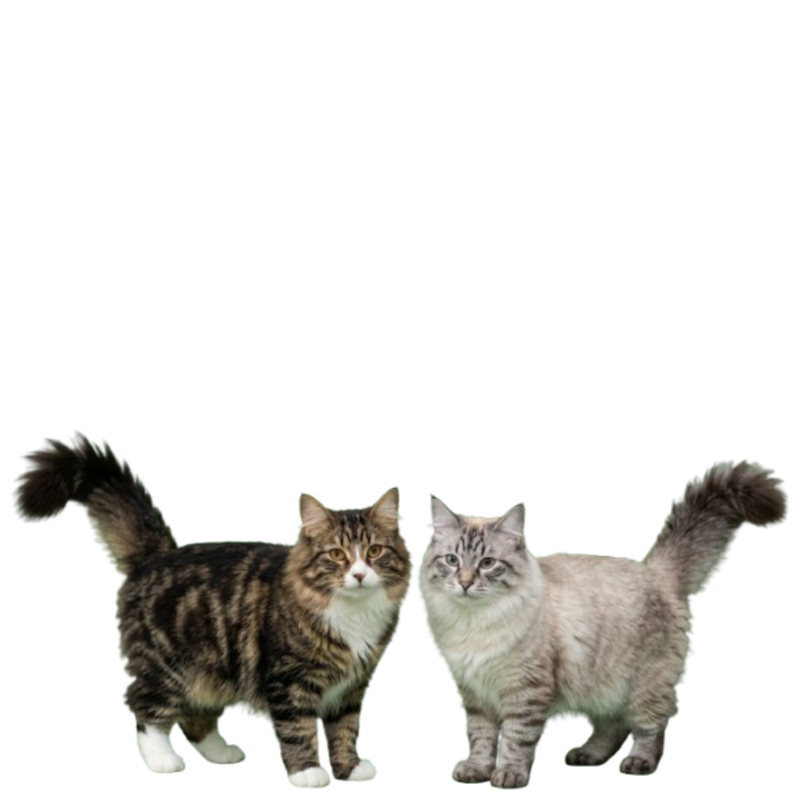
appearance
Siberian domestic cats represent a masterful study in natural power and cold‐climate adaptation. Built like dense, heavily boned tanks wrapped in luxurious triple‐layered fur, these felines exhibit a powerful barrel‐shaped torso and seamless curves that avoid sharp angles. Every aspect of Siberian domestic cat anatomy—from their massive paws to their wide‐set, expressive eyes—serves a functional purpose, balancing substantial muscular weight with agility and grace.
Frame and Body Architecture
The overall torso of Siberian domestic cats is rectangular yet softly rounded, featuring a firm, barrel‐like chest and a broad rump. Their structural weight sits low, anchored by exceptionally heavy bone density and compact muscle mass.
| Structural Component | Anatomical Feature | Visual Description |
|---|---|---|
| Torso | Barrel‐shaped core | Broad chest with a well‐sprung ribcage creating a sturdy, substantial middle. |
| Musculature | High density | Firm, solid muscle layering along the back, flanks, and thighs. |
| Bone Density | Substantial framework | Heavy, thick limb bones that provide immense stability and strength. |
| Backline | Gentle rise | Slightly arched backline where the rump sits slightly higher than the shoulders. |
Facial Geometry and Head Structure
The head of Siberian domestic cats is a broad wedge with rounded contours, presenting a harmonious balance where width and length are almost equal.
Siberian Head Aspect Ratio
- : The calculated proportional measure comparing skull width to skull length to evaluate structural balance.
- : The lateral measurement across the widest points of the head and cheekbones.
- : The longitudinal measurement from the crown of the head to the tip of the muzzle.
A feline conformation judge evaluates the head aspect ratio of an adult Siberian with a wedge width of 12 centimeters and a wedge length of 12 centimeters. Dividing the wedge width of 12 by the wedge length of 12 yields a head aspect ratio of exactly 1.0. This calculated result confirms a harmonious balance where width and length are equal, adhering precisely to Siberian’s structural standard.
The muzzle is short and full, transitioning smoothly into broad, gently cushioned whisker pads without sharp indentations or pinch.
- Cheekbones: Prominent and rounded, creating a full facial width that blends naturally into the neck.
- Profile: A subtle concave dip between the eyes when viewed in profile, leading to a straight nose line.
- Chin: Broad and firm, forming a vertical line directly aligned with the upper lip.
- Eyes: Large, almost round on the bottom curve with an almond inclination along the top, set slightly far apart.
- Ears: Medium‐to‐large with rounded tips, tilting slightly forward and set wide on the skull. Deep internal tufting guards the ear canals.
Coat Structure and Protective Elements
The coat of Siberian domestic cats is a dense, weatherproof triple‐layered shield engineered for extreme thermal insulation. It varies seasonally, becoming noticeably thicker, longer, and fluffier during colder periods.
| Coat Layer | Texture & Composition | Functional Role |
|---|---|---|
| Guard Hair | Firm, coarse, glossy outer layer | Repels water, ice, and debris along the back, sides, and tail. |
| Awning Hair | Medium‐textured middle coat | Traps warm air and adds body to the coat texture. |
| Undercoat | Thick, soft, dense insulation | Fine fur lying close to the skin for core heat retention. |
A prominent, full ruff encircles the neck, framing the heavy head and transitioning into a well‐furnished chest apron. The fur on the lower belly and hind leg britches is long and dense, while the tail is covered in long, flowing guard hairs that fan out evenly.
Extremities and Balance Mechanics
The limbs and tail of Siberian domestic cats act as critical balancing tools and weight distribution supports for their heavy frames.
- Legs: Medium length with exceptional bone mass. The hind legs are slightly longer than the forelegs, giving Siberian domestic cats tremendous spring and leaping ability.
- Paws: Large, round, and heavily tufted with long fur sprouting between the toe pads to insulate against freezing surfaces.
- Tail: Broad at the base, tapering gradually to a blunt, rounded tip. Its length typically extends to the shoulder blade when laid along the back.
Appearance of Siberians
The physical presence of Siberian domestic cats is defined by power, soft curves, and robust structural mass. From their substantial barrel‐chested frames and heavy bone substance to their weather‐resistant triple coats and plushly tufted paws, these felines carry an unmistakable look of wild endurance wrapped in a soft, rounded, and wonderfully balanced domestic form.
behavior
Siberian domestic cats exhibit an active, deeply observant routine characterized by methodical physical problem‐solving and persistent environmental exploration. Rather than remaining passive observers in a household, these felines regularly track human routines, invent complex interactive games, and seek out high vantage points to monitor activity. Their daily behavioral patterns balance athletic bursts with calm, attentive social proximity, creating a distinct rhythm of interaction and independent investigation.
Daily Activity Cycles and Problem‐Solving Actions
Throughout the day, Siberian domestic cats divide their energy into structured phases of active patrolling, vertical exploration, and focused object manipulation.
| Behavioral Category | Daily Manifestation | Observable Mechanics |
|---|---|---|
| Environmental Patrol | Frequent perimeter checks | Walking room‐to‐room, sniffing entry points, and investigating modified spaces. |
| Vertical Ascent | Seeking high perches | Leaping onto high shelving, doors, and cabinets to oversee surroundings from above. |
| Tactile Manipulation | Paws‐on interaction | Using front paws to open cabinets, turn handles, or fetch submerged or hidden items. |
| Play Engagement | Heavy object retrieval | Batting, carrying, and retrieving toys with mouth or paws across living spaces. |
Social Mechanics and Interaction Dynamics
The social engagement of Siberian domestic cats centers around steady proximity and participation rather than vocal demands. They follow household members between spaces, positioning themselves nearby to observe daily tasks.
- Tracking Movements: Walking closely alongside humans, sitting near active workspaces, or resting directly beside entryways during household transitions.
- Greeting Rituals: Approaching returning family members with an upright, vibrating tail pose, accompanied by soft head rubbing against ankles or legs.
- Inquisitive Play: Engaging readily with other household pets through mutual chasing, paw tapping, and co‐occupying sleeping areas without territorial friction.
We can model the probability of a Siberian domestic cat initiating physical interaction based on environmental novelty and human proximity using the following function:
Siberian Engagement Probability
- : The statistical probability of the cat initiating physical interaction or social engagement.
- : The base of the natural logarithm used in logistic probability modeling.
- : The environmental novelty factor representing new stimuli or changes in surroundings.
- : The human proximity factor representing the closeness and availability of the primary companion.
A feline behavioral researcher calculates the engagement probability for an adult Siberian experiencing an environmental novelty score of 1.5 and a human proximity score of 0.5. Summing the novelty score of 1.5 and proximity score of 0.5 yields 2.0. Evaluating the negative exponential of 2.0 produces an exponential term of approximately 0.1353, resulting in a denominator of 1.1353. Dividing 1 by 1.1353 yields an engagement probability of approximately 0.8808. This calculated result of 88.08 percent indicates a very high likelihood of social interaction, providing Siberian’s owner with a quantitative measure of active participation and relational responsiveness.
Vocalization Habits and Sonic Communication
In vocal communication, Siberian domestic cats favor quiet, varied sounds over persistent loud meowing. Their acoustic repertoire focuses on soft trills, chirps, and purrs used in specific social contexts.
| Vocalization Type | Acoustic Character | Functional Context |
|---|---|---|
| Chirp / Trill | High‐pitched, rolling sound | Initiating greeting, inviting play, or directing attention to a toy. |
| Soft Meow | Quiet, low‐volume vocal | Requesting door opening or indicating mealtime interest. |
| Purr | Heavy, resonant vibration | Accompanying close physical contact, grooming, or resting near companions. |
Water Interaction and Curiosity
A distinctive observable behavior in Siberian domestic cats is their persistent attraction to moving water and wet surfaces.
- Faucet Inspection: Watching running water, dipping paws beneath streams, and flicking water droplets around sinks or tubs.
- Water Bowl Swirling: Pawing at the surface or edge of water dishes before drinking to create ripples or test depth.
- Aquatic Curiosity: Investigating filled bathtubs, stepping into damp showers, or retrieving toys dropped into water containers.
Behavior of Siberians
The behavioral habits of Siberian domestic cats are rooted in curious, hands‐on engagement with their surroundings. From their methodical exploration and penchant for high perches to their soft trilling greetings and unique fascination with running water, these cats maintain an active, involved presence in any living space.
color
The fur of Siberian domestic cats displays a rich tapestry of pigment depth, gradient banding, and striking contrast across their dense triple coat. Because their coat is built in three distinct layers, color presentation varies dramatically from the pale, warm roots of the undercoat to the deep, weather‐shielded tips of the guard hairs. Whether showcasing traditional dark tabby striping or pointed color contrast, pigment distribution across Siberian domestic cats creates a vivid, shimmering depth that changes as the cat moves through light.
Primary Pigment Categories and Visual Expression
Pigment in Siberian domestic cats presents in two primary forms: rich dark tones (eumelanin) and warm red tones (phaeomelanin), alongside softened or diluted expressions of each.
| Color Family | Visual Hue & Depth | Hair Shaft Pigment Distribution |
|---|---|---|
| Traditional Black / Brown | Deep charcoal black to warm mahogany brown | Solid dark pigment extending to the tip, often banded in agouti areas. |
| Red / Cream | Flame orange to soft ivory cream | Warm pigment distributed evenly along guard hairs, often showing underlying tabby shading. |
| Blue / Soft Gray | Cool slate gray to pale silver‐blue | Evenly dispersed, softened dark pigment creating a muted, velvety tone. |
| Pointed / Colorpoint | Pale cream body with deep contrast on ears, mask, and tail | Temperature‐sensitive pigment concentration restricted primarily to cool extremities. |
Hair Shaft Pigment Banding and Light Refraction
In striped and shaded Siberian domestic cats, individual hair shafts feature alternating bands of dark and light pigment. This creates a shimmering effect as light strikes the coat surface at varying angles.
- Base and Root Segment: Pale, warm buff or cream tone near the skin where hair growth originates.
- Mid‐Shaft Region: Concentrated dark pigment ring providing defined contrast along the strand.
- Tip Extension: Dense, fully saturated dark tip that defines the overall surface coloration.
We can express the perceived color intensity as a ratio of dark pigment density to light refraction through the hair shaft using the following relationship:
Siberian Coat Color Intensity
- : The perceived color intensity and visual richness of the cat coat surface.
- : The concentration and density of dark pigment granules distributed along the hair shaft.
- : The light refraction factor through the banded hair shaft determining how light scatters across the coat.
A feline coat color analyst calculates the perceived color intensity for an adult Siberian with a dark pigment density score of 7.2 and a light refraction factor of 1.5. Dividing the pigment density of 7.2 by the refraction factor of 1.5 yields a coat color intensity score of 4.8. This calculated result of 4.8 provides Siberian’s breeder with a quantitative measure of visual richness and shimmering contrast across the banded hair shafts.
Agouti Banding and Pattern Contrast Mechanics
The visual impact of patterns on Siberian domestic cats depends heavily on the contrast between dark pattern lines and lighter background fur.
- Agouti Banding: Individual hair shafts display 2–3 alternating rings of dark pigment and pale golden or silver background color.
- Pattern Definition: Solid dark hair shafts form distinct stripes, swirls, or spots against the multi‐banded background ground coat.
- Silver Inversion: In silver variants, the warm ground pigment at the root is replaced by a stark, icy white base that amplifies pattern contrast.
- White Patching: Clean, unpigmented white areas can overlay any color pattern, ranging from small chest medallions to wide abdominal overlays.
Extremity Contrast in Pointed Patterns
In pointed Siberian domestic cats, pigment concentration is heavily focused on cooler body areas such as the face, ears, paws, and tail.
| Body Region | Pigment Density | Visual Appearance |
|---|---|---|
| Facial Mask & Ears | Maximum density | Rich, saturated color framing the eyes and muzzle. |
| Limbs & Paws | Medium‐to‐high density | Darker shading extending up the legs, fading gently toward the torso. |
| Central Torso | Minimum density | Soft off‐white, cream, or pale ivory with subtle warm undertones. |
Color of Siberians
The coloration of Siberian domestic cats is defined by rich depth, multi‐layered pigment distribution, and intense contrast. From the warm, multi‐banded strands of classic tabbies to the crisp, cool boundaries of silver and pointed varieties, their coats present a dynamic visual shield where light and shade interweave continuously across every layer of fur.
compatibility
Ease of Maintenance
Rating: 2/5
Child Friendly
Rating: 5/5
Annual Cost
Rating: 3/5
Lifetime Cost
Rating: 3/5
Adaptability
Rating: 4/5
Velcro Factor
Rating: 4/5
Quietude
Rating: 4/5
Apartment Suitability
Rating: 3/5
Hypoallergenic
Rating: 4/5
Handling Tolerance
Rating: 4/5
Hardiness/Longevity
Rating: 5/5
Prey Drive
Rating: 2/5
genetics
The genomic profile of Siberian domestic cats is defined by a diverse assortment of ancestral traits and specific genetic mutations that govern coat structure, length, and pattern distribution. Understanding the underlying loci—the specific physical locations of genes on a chromosome—reveals how dominant and recessive alleles interact to produce predictable physical expressions across generations. From hair length and agouti pattern switches to color dilution and pointed traits, these hereditary blueprints serve as the foundation for breeding strategies and trait selection in Siberian domestic cats.
Primary Loci and Genotypic Expressions
The inheritance of coat length, pattern, and color distribution in Siberian domestic cats follows fundamental Mendelian principles governed by key genetic loci.
| Gene Locus | Gene Symbol | Allele Variations | Observed Trait Expression |
|---|---|---|---|
| FGF5 (Longhair Locus) | L / l | L (Short, dominant) l (Long, recessive) | Homozygous recessive (l/l) produces the long, dense triple coat. |
| Agouti Locus | A / a | A (Agouti, dominant) a (Non‐agouti, recessive) | A enables banded hair shafts and tabby patterns; a/a suppresses banding for solid traits. |
| Dense / Dilute Locus | D / d | D (Dense, dominant) d (Dilute, recessive) | D maintains full pigment density; d/d clumping creates softened slate or cream shades. |
| Color / Point Locus | C / cs | C (Full color, dominant) c (Pointed, recessive) | cs/cs restricts pigment synthesis to cooler extremities (neva masquerade variation). |
Mendelian Inheritance Dynamics and Probability Modeling
When predicting offspring traits from carrier parents, standard Mendelian probabilities apply. For instance, pairing two heterozygous carriers for the recessive colorpoint allele (C/cs) yields a predictable ratio of non‐pointed to pointed offspring.
We can calculate the probability of two carrier parents producing a pointed kitten using the standard single‐locus Punnett square ratio:
Siberian Pointed Offspring Probability
- : The statistical probability of carrier parents producing a pointed offspring with the homozygous recessive genotype.
- : The probability of each individual carrier parent passing down the recessive colorpoint allele.
- : The Mendelian transmission probability for a heterozygous parent contributing the recessive allele.
- : The combined statistical probability of both parents contributing the recessive allele simultaneously.
A feline geneticist calculates the probability of producing a pointed kitten when pairing two heterozygous carriers of the colorpoint allele. Multiplying the maternal transmission probability of 0.5 by the paternal transmission probability of 0.5 yields a pointed offspring probability of 0.25. This calculated result of 25 percent indicates the exact statistical expectation for Siberian’s breeding program when tracking single-locus recessive inheritance patterns.
| Parental Genotypes | Offspring Genotype Ratio | Offspring Phenotype Ratio |
|---|---|---|
| C/cs × C/cs | 1 C/C : 2 C/cs : 1 cs/cs | 3 Full Color (1 Non‐carrier, 2 Carriers) : 1 Pointed |
| C/cs × cs/cs | 1 C/cs : 1 cs/cs | 1 Full Color (Carrier) : 1 Pointed |
| cs/cs × cs/cs | 4 cs/cs | 4 Pointed (100% True‐Breeding) |
Epistatic Interactions and Inhibitor Factors
Epistasis occurs when one gene masks or modifies the physical expression of a completely separate gene locus. In Siberian domestic cats, several key epistatic interactions shape the coat:
- Inhibitor Gene (I / i): A dominant mutation (I) suppresses pigment development along the basal portion of the hair shaft, converting the warm undercoat to silver or white without altering the dark tip pigment.
- Non‐Agouti Masking (a/a): Homozygous recessive non‐agouti (a/a) masks tabby background striping on black and blue coats, converting the coat to a solid shade, though underlying ghost patterns may remain visible in kittens.
- Red Epistasis (O / o): The sex‐linked Red gene (O) located on the X chromosome overrides the non‐agouti gene (a/a), causing red pigment to express underlying tabby patterning even in genetically solid individuals.
Genetics of Siberians
The genetic architecture of Siberian domestic cats combines recessive longhair foundations with dynamic dominant and epistatic modifiers. By mapping primary loci like FGF5, Agouti, and Colorpoint alongside inhibitor factors, breeders and owners gain a precise understanding of how hidden carrier genes combine to shape every generation of Siberian domestic cats.
health
Siberian domestic cats are generally robust and resilient felines, but their substantial muscular frame and heavy bone density require proactive veterinary monitoring. Primary clinical priorities center around cardiac health, renal function, joint integrity, and body weight management. Early screening and consistent preventative care allow both preservation breeders and owners to identify subtle physiological changes before they impact long‐term health and vitality.
Primary Health Concerns and Clinical Markers
Specific physiological vulnerabilities require regular clinical evaluation in Siberian domestic cats to ensure early intervention and optimal care.
| Medical Condition | Affected Body System | Clinical Presentation & Monitoring |
|---|---|---|
| Hypertrophic Cardiomyopathy (HCM) | Cardiovascular System | Progressive thickening of the heart muscle walls; monitored via echocardiography to assess blood pumping capacity. |
| Polycystic Kidney Disease (PKD) | Renal System | Formation of fluid‐filled cysts in kidney tissue; tracked through ultrasound imaging to preserve kidney filtration function. |
| Osteoarthritis & Joint Wear | Musculoskeletal System | Stress on lower limb joints from heavy frame mass; identified by subtle changes in jumping height or stair navigation. |
| Feline Lower Urinary Tract Disease (FLUTD) | Urinary System | Inflammation or mineral crystallization in the bladder; monitored through daily hydration and urine output tracking. |
Cardiovascular Health and Cardiac Output Ratios
Cardiovascular monitoring focuses primarily on detecting early heart muscle thickening. An echocardiogram measures the left ventricular wall thickness during heart contraction to ensure healthy blood circulation throughout the body.
We can express the functional stroke volume of the heart as the difference between the end‐diastolic volume (the amount of blood in the heart prior to contraction) and the end‐systolic volume (the amount remaining after contraction):
Siberian Stroke Volume
- : The functional stroke volume representing the volume of blood pumped from the left ventricle per heartbeat.
- : The end-diastolic volume measuring the total volume of blood in the heart ventricle prior to contraction.
- : The end-systolic volume measuring the residual volume of blood remaining in the ventricle after contraction.
A veterinary cardiologist calculates the stroke volume for an adult Siberian with an end-diastolic volume of 22 milliliters and an end-systolic volume of 9 milliliters. Subtracting the end-systolic volume of 9 from the end-diastolic volume of 22 yields a stroke volume of 13 milliliters per heartbeat. This calculated result gives Siberian’s veterinarian a quantitative assessment of cardiac efficiency and healthy blood circulation.
Regular cardiac scans ensure that heart chamber volumes remain balanced, preventing fluid accumulation in the chest or lungs as cats mature.
Structural Weight Distribution and Joint Integrity
Because Siberian domestic cats possess a heavy, dense skeleton, maintaining an ideal body condition score is critical to protecting joint cartilage from accelerated wear.
- Weight Management: Extra weight adds excessive stress to the hips and stifle (knee) joints, increasing the likelihood of early‐onset joint stiffness.
- Mobility Monitoring: Changes in leaping confidence, hesitation before jumping, or altered gait patterns serve as primary indicators of joint discomfort.
- Nutritional Support: Incorporating targeted joint supplements, such as omega‐3 fatty acids and glucosamine, helps maintain smooth cartilage buffering between bones.
Recommended Preventative Screening Schedule
Proactive health screening protocols assist in maintaining bloodline health and household wellness across all life stages.
| Age Stage | Recommended Screening | Clinical Purpose |
|---|---|---|
| Young Adult (1–3 Years) | Baseline echocardiogram & renal ultrasound | Establishes organ health baselines and verifies early structural integrity. |
| Mature Adult (4–6 Years) | Biennial cardiac scans & routine blood panel | Detects progressive heart changes and monitors kidney filtration values. |
| Senior (7+ Years) | Annual full cardiac, renal, and joint workups | Evaluates joint comfort, thyroid function, and organ filtration efficiency. |
Health of Siberians
Maintaining the health of Siberian domestic cats relies on routine cardiac ultrasounds, kidney evaluations, and vigilant weight management. By proactively monitoring joint mobility and cardiovascular health throughout every stage of life, owners and breeders ensure these heavy‐boned, athletic cats maintain exceptional physical well‐being.
longevity
Siberian domestic cats are a hardy, long‐lived breed with typical lifespans spanning 12–18 years, with exceptional individuals frequently reaching their late teens or early twenties. A defining hallmark of Siberian domestic cat aging is their slow physical development, taking up to five years to reach full physical maturity. Understanding their physical transitions across each distinct phase of life allows breeders and owners to track structural aging signs and maintain vitality into senior years.
Lifespan Expectations and Life‐Stage Milestones
The physical progression of Siberian domestic cats follows a distinct timeline from extended growth to gradual senior aging.
| Life Stage | Age Range | Physical Aging Indicators |
|---|---|---|
| Developmental Phase | 0‐12 Months | Rapid skeletal elongation and frame development. |
| Extended Growth Phase | 1‐5 Years | Continued density accumulation, coat filling, and muscle mass development. |
| Prime Adult Phase | 5‐10 Years | Peak body substance, stabilized coat density, and robust metabolic output. |
| Mature Senior Phase | 10‐14 Years | Gradual loss of muscle mass, slight coat thinning, and subtle reduction in jumping height. |
| Geriatric Phase | 15+ Years | Softening of muscle tone, increased resting time, and altered resting posture. |
Aging Mechanics and Survival Probability Modeling
The probability of a Siberian domestic cat remaining active and robust through senior life stages can be analyzed through survival metrics.
We can model the probability of maintaining prime physical vitality at age (measured in years) using a modified survival curve function:
Siberian Vitality Survival Probability
- : The statistical probability of the cat maintaining prime physical vitality and robustness at age .
- : The base of the natural logarithm used in logistic survival modeling.
- : The age of the cat measured in years.
- : The characteristic longevity threshold parameter representing the age of median physical transition.
- : The scale parameter governing the rate of decline around the threshold.
A feline longevity researcher calculates the vitality survival probability for an adult Siberian at age 14 years. Subtracting the threshold parameter of 14 from the age of 14 yields 0, which divided by 2 gives 0. Evaluating the exponential of 0 produces 1, resulting in a denominator of 2. Dividing 1 by 2 yields a vitality survival probability of 0.5. This calculated result of 50 percent indicates the exact statistical probability of maintaining prime physical vitality at age 14, providing Siberian’s owner with a quantitative baseline for senior health management.
In practice, this indicates that the majority of Siberian domestic cats maintain high vitality well past 12 years of age, with physical decline occurring slowly rather than sharply.
Physical Manifestations of the Aging Process
As Siberian domestic cats move into their senior years, observable structural changes mark the transition into geriatric life.
- Coat Density Shift: The dense triple coat gradually softens in texture and loses some undercoat thickness during seasonal sheds.
- Metabolic Rate Progression: Energy balance shifts, requiring close observation as muscle volume naturally decreases while abdominal fat storage may increase.
- Sensory Changes: Subtle reductions in visual acuity and auditory response begin appearing around 12–14 years of age.
- Postural Adaptation: Older felines adopt wider stance angles while resting or sitting to comfortably distribute body mass across joints.
Longevity of Siberians
The life expectancy pattern of Siberian domestic cats is characterized by an extended five‐year maturation period followed by a long, robust adulthood. With lifespans routinely reaching into the mid‐to‐late teens, these resilient felines experience a smooth, gradual aging progression that allows them to remain physically active companions through every stage of life.
maintenance
Maintaining Siberians requires a structured routine that addresses their dense coat maintenance, high energy demands, and environmental enrichment needs. Because Siberian’s double coat and heavy structure require specific dietary and grooming attention, daily husbandry must balance proper caloric intake with proactive skin and fur care. A well‐planned environmental strategy ensures that Siberians remain physically stimulated and comfortable in any home or cattery environment.
Nutritional Guidelines and Caloric Formulas
Proper dietary management for Siberians relies on high‐protein, moisture‐rich nutrition to support muscle mass and coat health. Energy requirements vary based on weight, activity levels, and age.
We can calculate the Resting Energy Requirement () in kilocalories per day based on ideal body mass ( in kilograms) using the standard metabolic formula:
Siberian Resting Energy Requirement Metabolic Model
- : The resting energy requirement expressed in kilocalories per day required to maintain basic physiological function at rest.
- : The standard feline metabolic scalar constant used for body weight scaling.
- : The ideal body mass or weight of the cat measured in kilograms.
- : The metabolic body size exponent accounting for non-linear metabolic scaling relative to mass.
A feline nutritionist calculates the resting energy requirement for an adult Siberian with an ideal body mass of 4 kilograms. Raising 4 to the power of 0.75 yields approximately 2.8284. Multiplying this result by the metabolic scalar constant of 70 produces a resting energy requirement of approximately 197.99 kilocalories per day. This calculated baseline gives Siberian’s caregiver an exact foundation for determining daily feeding requirements and managing high-protein nutrition to support muscle mass and overall health.
To determine the Total Daily Energy Requirement (), multiply by an activity factor (where for active adult cats):
Siberian Total Daily Energy Requirement Model
- : The total daily energy requirement expressed in kilocalories per day required to sustain overall daily activity and metabolic functions.
- : The resting energy requirement calculated from body mass in kilocalories per day.
- : The activity factor representing the energy multiplier for active adult maintenance and daily movement.
A feline nutritionist calculates the total daily energy requirement for an adult Siberian with a resting energy requirement of 197.99 kilocalories per day and an active life stage activity factor of 1.3. Multiplying the resting energy requirement of 197.99 by the activity factor of 1.3 yields a total daily energy requirement of approximately 257.39 kilocalories per day. This calculated result gives Siberian’s caregiver an exact target for structuring balanced daily feeding regimens and managing caloric intake effectively.
| Life Stage | Dietary Focus | Daily Feeding Structure |
|---|---|---|
| Kitten Growth | High‐calorie, nutrient‐dense wet food with elevated protein and fat | 3–4 small meals daily; free‐access fresh water |
| Active Adult | Balanced animal protein with essential fatty acids for coat oils | 2 structured meals daily; controlled caloric intake |
| Senior Maintenance | Easily digestible proteins with joint‐support nutrients and moderate fat | 2–3 smaller meals daily; high water integration |
Coat Care and Grooming Schedules
Managing the weather‐resistant coat of Siberians requires systematic grooming to prevent matting and distribute natural skin oils throughout the fur.
- Comb Selection: Use a long‐toothed steel greyhound comb to reach the dense undercoat without breaking guard hairs.
- Brushing Frequency: Perform thorough grooming sessions 2–3 times per week during standard months, increasing to daily sessions during seasonal shedding periods.
- Bathing Routine: Bathing is rarely required due to natural coat water repellency, but when necessary, use a gentle degreasing shampoo followed by thorough drying.
- Sanitary Trimming: Keep the fur around the hindquarters neatly trimmed to maintain hygiene during litter box use.
Environmental Setup and Enrichment Standards
An optimal environment for Siberians integrates vertical territory, durable scratching surfaces, and adequate hydration stations.
| Care Component | Environmental Requirement | Operational Standard |
|---|---|---|
| Vertical Space | Heavy‐duty cat trees or wall perches | Solid platforms capable of supporting substantial weight without wobbling |
| Hydration Access | Recirculating water fountains | Placed away from feeding areas to encourage frequent drinking |
| Litter Facilities | Oversized, open or covered litter pans | Pan length should equal 1.5 times the length of {breed} from nose to tail base |
| Scratching Outlets | Thick sisal posts or wooden scratching pads | Tall vertical posts allowing full bodily extension during scratching |
Maintenance of Siberians
Effective care for Siberians centers on protein‐focused nutrition, regular coat combing, and a robust indoor environment. By meeting these core nutritional, grooming, and structural needs, owners and breeders ensure that every Siberian remains healthy, comfortable, and well‐conditioned throughout its life.
measurements
| Measurement | Female | Male | ||
|---|---|---|---|---|
| Metric | Imperial | Metric | Imperial | |
height | 23 – 28 centimeters | 9 – 11 inches | 25 – 33 centimeters | 10 – 13 inches |
length | 38 – 46 centimeters | 15 – 18 inches | 43 – 51 centimeters | 17 – 20 inches |
weight | 4.5 – 6.8 kilograms | 10 – 15 pounds | 6.8 – 9.1 kilograms | 15 – 20 pounds |
• Height: Refers to the measurement at the withers (shoulders).
• Length: Measured from the tip of the nose to the base of the tail.
origin
The history of Siberians is deeply rooted in the vast taiga regions and subarctic landscapes of Russia and Northern Asia. Originating as a naturally developed landrace—a population of domestic animals that adapted naturally over centuries to their local geography without deliberate human breeding—these cats emerged from centuries of natural selection. From early mentions in historical trade records along Siberian trade routes to formal recognition in international registries, the historical lineage of Siberians reflects a journey from rugged wilderness companions to globally preserved pedigree lines.
Native Regional Development and Trade Migration Routes
The migration and spread of landrace cats across Eurasia followed human trade routes, riverways, and agricultural settlements.
| Historical Era | Migration Region | Key Development Milestones |
|---|---|---|
| Early Landrace Emergence | Siberian Taiga & Ural Mountains | Natural selection shapes the ancestral population to survive extreme subarctic conditions. |
| Merchant Trade Expansion | Volga River & Northern Asian Routes | Cats serve as working pest control on merchant vessels and caravan storehouses. |
| Urban Integration | Saint Petersburg & Moscow | Landrace cats enter Russian urban centers, establishing foundational municipal bloodlines. |
| International Export | Western Europe & North America | Initial importations establish official pedigree registries and structured cattery foundations. |
Chronological Timeline of Lineage Establishment
The formalization of Siberian’s heritage transitioned from unrecorded working cats to systematically documented pedigrees during the late 20th century.
- 16th–19th Centuries: Early documentation notes native longhaired cats living alongside rural households and urban markets across Russia.
- 1889: Harrison Weir includes early descriptions of Russian longhaired cats in pioneer feline exhibition literature.
- 1987: The Kotofei Cat Club in Saint Petersburg drafts the first official breed standard for Siberians.
- 1990: The first foundation pairs arrive in North America, establishing the initial breeding stock outside of Eurasia.
- 1992–2006: Major global registries, including TICA and CFA, grant full championship status to Siberians.
Historical Population Dispersion Modeling
We can model the expansion rate of early pedigree foundation populations at year relative to the initial foundation stock using a standard exponential dispersion model:
Siberian Foundation Population Expansion
- : The projected population size of the breed at a given future year .
- : The initial population size of the foundation stock at establishment year .
- : The base of the natural logarithm used in exponential growth modeling.
- : The lineage growth rate parameter governing the annual expansion speed of the population.
- : The target year for the population projection.
- : The baseline establishment year when the initial foundation stock was registered.
A feline demographic researcher calculates the population expansion for a Siberian foundation stock starting with an initial population of 50 cats at year zero, a growth rate parameter of 0.05, and an elapsed time of 10 years. Multiplying the growth rate of 0.05 by 10 yields 0.5. Evaluating the exponential of 0.5 produces approximately 1.6487. Multiplying the initial population of 50 by this exponential factor yields a projected population of approximately 82.44 cats. This calculated result of 82 cats gives Siberian’s breed registry a quantitative measure of population retention and growth over a decade.
Where represents the lineage growth rate parameter and represents the number of elapsed years since initial breed registry establishment.
Origin of Siberians
The origin of Siberians is a story of natural resilience and historical adaptation. From their unrefined landrace roots in the Russian taiga to their structured development as a world‐recognized pedigree breed, Siberians carry a rich heritage shaped by trade routes, rural working partnerships, and dedicated international preservation breeders.
temperament
The dispositional profile of Siberians is characterized by exceptional emotional stability, high social intelligence, and a balanced, observant nature. Because Siberians possess a grounded psychological baseline, they navigate multi‐pet households and changing family environments with remarkable calm and confidence. Rather than displaying high‐strung reactivity or aloof distance, Siberian’s psychological makeup combines deep human attachment with an inquisitive, problem‐solving mindset.
Core Personality Spectrum and Behavioral Metrics
The inherent psychological tendencies of Siberians fall into predictable ranges across key dispositional dimensions.
| Personality Dimension | Expressed Trait Level | Psychological Manifestation |
|---|---|---|
| Social Confidence | High | Unfazed by household visitors; approaches new human arrivals with relaxed curiosity. |
| Environmental Adaptability | Moderate‐to‐High | Recovers rapidly from temporary environmental changes or household relocations. |
| Affection Bonding | High (Proximity‐Seeking) | Prefers staying in the same room as primary caretakers without demanding constant handling. |
| Frustration Tolerance | Exceptional | Displays high patience during handling, gentle play, or interactions with children. |
Social Attachment and Proximity Preferences
The affection style of Siberians emphasizes presence and participation over needy attachment.
- Companion Tracking: Siberians routinely position themselves within line of sight of human family members, engaging in quiet observation.
- Vocal Communication: Vocalizations are generally soft, consisting of chirps, trills, and quiet purrs used to acknowledge human interactions rather than demand attention.
- Multi‐Pet Dynamics: Possessing low innate intra‐species aggression, a Siberian integrates smoothly with other household cats and respectful dogs.
- Handling Sensitivity: While tolerant of being held, they prefer grounded interactions where they maintain physical control over their posture.
Social Stress Recovery and Adaptability Index
A cat’s ability to process novel sensory stimuli and return to a peaceful resting state can be represented by a stress recovery index .
We can express the recovery rate as a function of environmental novelty and baseline confidence :
Siberian Social Recovery Rate
- : The social recovery rate representing how quickly the cat returns to a calm baseline after encountering a stressor.
- : The baseline confidence score reflecting the inherent composure and stability of the cat.
- : The environmental novelty or stressor factor representing the intensity of unfamiliar stimuli or loud noises.
- : The baseline constant ensuring mathematical stability when environmental novelty is zero.
A feline behavioral researcher calculates the social recovery rate for an adult Siberian with a baseline confidence score of 8.0 experiencing an environmental novelty stressor score of 1.0. Adding 1 to the novelty score of 1.0 yields a denominator of 2.0. Dividing the baseline confidence score of 8.0 by the denominator of 2.0 yields a social recovery rate of 4.0. This calculated result of 4.0 provides Siberian’s owner with a quantitative measure of swift composure and resilience when encountering strange environments or loud noises.
Because Siberians maintain a high , their time to return to a calm baseline after encountering loud noises or strange environments is significantly shorter than in more timid feline breeds.
Temperament of Siberians
The temperament of Siberians is centered on social warmth, resilience, and steady composure. Their balanced combination of peaceful affection and confident adaptability makes them exceptionally steady companions, giving breeders and owners a dependable psychological foundation across every stage of life.