Himalayan Cat
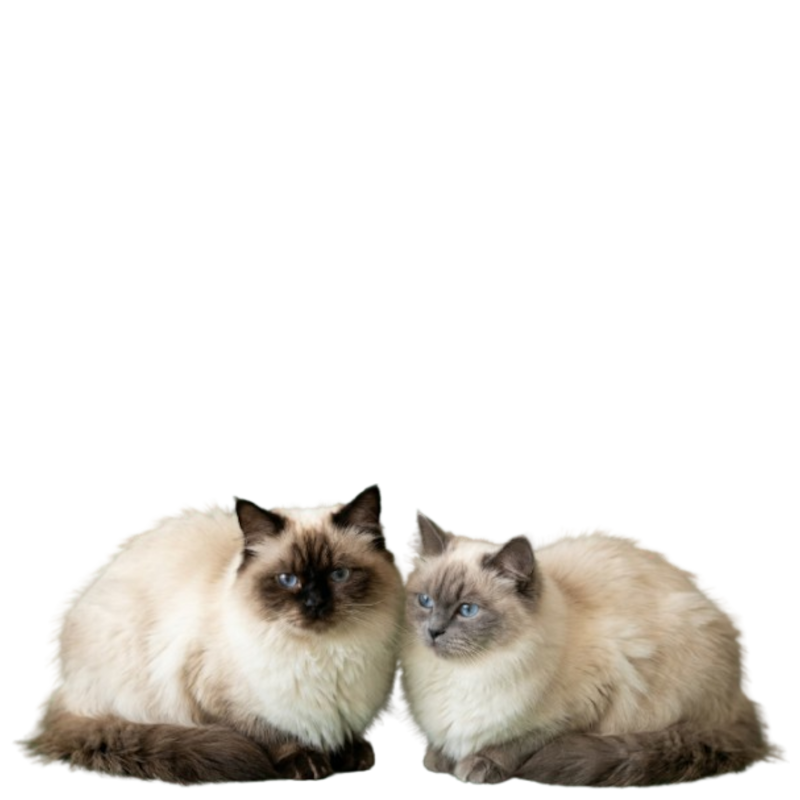
appearance
The structural composition of Himalayan is defined by a “cobby” build, resulting in a softened, curved profile. The overall aesthetic emphasizes substance and grace, characterized by heavy bone density and a voluminous, dense coat.
Facial Features and Cranial Structure
The head of Himalayan is notably large, spherical, and massive, supported by a short, thick neck. The skull maintains an exceptional breadth, which serves as the base for several defining features:
The Nose
Broad, snub, and abbreviated in length. A distinct indentation—often called a “break”—is positioned directly between the eyes.
The Eyes
These are full, large, and circular. Their wide placement on the face helps create an expression that is perceived as gentle and open.
The Ears
Small with rounded tips. They are set low and wide apart on the skull, tilting slightly forward to integrate with the head’s rounded boundary.
The Cheeks and Jaws
The cheeks are prominent and fully developed, while the jaws are robust and broad, ending in a well-defined, firm chin.
Body Morphology
The torso of Himalayan is compact and deep through the chest area, showing a consistent width from the shoulder blades down to the hindquarters.
| Feature | Description |
|---|---|
| Back | Short and maintaining a level topline. |
| Abdomen | Firm and rounded in appearance. |
| Legs | Short in stature, thick, and possessing heavy bone structure. The front legs appear straight. |
| Paws | Large, circular, and closely knit. |
The Tail
The tail of Himalayan’s is short, staying in proportion to the total body length. It is typically carried straight and held at an angle lower than the line of the back.
Coat and Fur Texture
The most prominent tactile attribute of Himalayans is the coat. The fur is long across the entire frame, standing out from the body due to its extreme thickness.
- Texture: Soft, fine to the touch, and possessing a natural gloss.
- The Ruff: A significant collar of fur that transitions into a deep fringe between the front limbs.
- Ear and Toe Tufts: Long decorative fringes of hair that grow from the interior of the ears and visible clumps of fur situated between the toes.
- The Tail: Encased in dense, long fur that gives it the appearance of a thick plume.
Geometric Symmetry
The physical proportions of Himalayan can be modeled as a collection of intersecting circles. If the ratio of the head’s diameter is compared to the body length , the standard emphasizes a low ratio to highlight a square-like, compact frame:
The “Cobby” Square-Body Shape Rule
- : “Compactness Factor,” the number that shows how “square” or “sturdy” the cat’s body is.
- : “Body Length,” the distance from the cat’s chest to the base of its tail.
- : “Shoulder Height,” how tall the cat stands from the floor to the top of its shoulder blades.
For a show-quality Himalayan with a shoulder height () of cm and a body length () of cm, the Compactness Factor is . This value near mathematically represents the “cobby,” square-like silhouette required by the breed standard.
In this context, represents the height at the shoulder. For Himalayans, and are frequently nearly identical—which produces the characteristic “cobby” look.
behavior
The behavioral patterns of Himalayan are defined by a low-intensity approach to environmental interaction and a preference for consistent, grounded activity. Unlike many high-energy domestic breeds, Himalayan’s actions are typically characterized by deliberate movements and a high threshold for external sensory stimuli.
Activity Levels and Locomotion
While Himalayans engage in physical play, their style of locomotion is predominantly terrestrial. They are less inclined to seek vertical heights—such as the tops of refrigerators or high shelving—compared to more athletic breeds.
Ground-Level Engagement
Himalayan typically prefers to interact with objects located on the floor or at low elevations.
Burst Activity
Periodic high-speed runs may occur, but these are generally short-lived and followed by extended periods of stationary rest.
Play Style
Interaction with toys often involves batting or pawing at objects rather than high-jumping or mid-air acrobatics.
Vocalization Patterns
The vocal behavior of Himalayan is notably subdued. When communication is initiated, it is typically directed toward a human companion to signal a specific need.
| Communication Type | Frequency | Intensity |
|---|---|---|
| Mewing/Meowing | Infrequent | Soft, melodic, and low-volume |
| Purring | High | Deep and resonant, often occurring during proximity to humans |
| Distress Calls | Rare | Typically only occurring during significant environmental changes |
Social Interaction and Environmental Response
Himalayan’s behavior in a household setting is marked by a “shadowing” instinct. Rather than demanding constant active engagement, Himalayan often chooses to exist in the same room as its owners, maintaining a passive but observant presence.
Proximity Seeking
Himalayans frequently exhibit “lap-sitting” behavior or will choose to lie down on nearby surfaces—such as keyboards, books, or papers—that their owners are currently using. This is a form of passive social participation.
Reaction to Noise and Change
In the presence of loud noises or chaotic environments, the typical behavioral response of Himalayan is to calmly retreat to a known “safe spot” rather than reacting with visible agitation or aggression. They tend to observe new visitors from a distance before deciding to approach.
Sleep and Rest Cycles
The rest patterns of Himalayan occupy a significant portion of their twenty-four-hour cycle. The efficiency of their rest can be represented by the ratio of sleep to total time :
The “Daily Nap” Efficiency Score
- : “Rest Efficiency,” the percentage of the day the cat spends relaxing or sleeping.
- : “Sleep Time,” the total number of hours the cat spends napping or sitting still.
- : “Total Time,” the full 24-hour window being measured.
If a Himalayan spends hours out of a -hour period sleeping or resting, the Rest Efficiency is . This value falls directly within the expected “breed standard” of to , reflecting the calm and sedentary temperament of Himalayans.
This high ratio of indicates that Himalayan spends roughly 16 to 18 hours per day in various states of sleep or localized inactivity.
Use of Paws and Manipulation
Himalayans are known for using their paws in a “hand-like” fashion to investigate the texture of water, move small pieces of kibble, or gently tap a human to gain attention. This tactile investigation is a primary method for Himalayan to process information about its immediate surroundings.
color
The defining chromatic feature of Himalayan is the point-restricted pattern. This manifests as a significant contrast between a pale body color and a darker, more saturated pigment concentrated on the “points” of the body.
The Point System
In Himalayans, the darker coloration is restricted to five specific areas:
The Mask
This covers the central facial region, including the nose and whisker pads.
The Ears
The ears are fully pigmented from the base to the tip.
The Limbs
Pigmentation on the forelegs extends from the paws toward the elbows, while on the hind legs, it extends from the paws toward the hocks.
The Tail
The tail is deeply colored throughout its entire length.
Primary Color Classifications
Himalayan’s coloration is categorized based on the specific hue of the points. The torso remains a significantly lighter shade—often described as creamy white, ivory, or pale fawn.
| Point Variety | Point Hue | Body Contrast |
|---|---|---|
| Seal Point | Deep, warm seal brown | Pale fawn to cream |
| Blue Point | Cool, slate blue-gray | Cold glacial white |
| Chocolate Point | Warm, milk-chocolate brown | Ivory |
| Lilac Point | Frosty, pinkish-gray | Glacial white |
| Flame (Red) Point | Bright apricot to deep orange | Creamy white |
| Cream Point | Pale, soft apricot | Clear white |
Secondary and Patterned Coloration
In addition to solid points, Himalayans may exhibit complex patterns within the pigmented zones.
Lynx Points
These exhibit clear “M” shaped markings on the forehead and distinct horizontal stripes on the legs and tail. The inner ear is typically paler, creating a “thumbprint” effect.
Tortie Points
This pattern features mottling or patches of red or cream interspersed with the primary point color—such as seal or chocolate. The distribution is asymmetrical and unique to each Himalayan.
Ocular Pigmentation
A fundamental requirement for Himalayan is the presence of specific iris pigmentation. The eyes must exhibit a deep, vivid blue hue. The intensity of this blue is often correlated with the depth of the point color:
The “Deep Blue” Eye Color Match
- : “Blue Depth,” how dark and vivid the blue color of the eyes appears.
- : “Scales With,” meaning as the point color gets darker, the eye color usually gets deeper.
- : “Point Darkness,” how saturated the color is on the ears, face, and paws (like Seal vs. Lilac).
In a “Seal Point” Himalayan, the high melanin concentration in the points () is typically mirrored by a “vivid, deep blue” eye color (), whereas a “Lilac Point” may exhibit a softer, more “dilute” blue.
Thermal Influence on Pigment Distribution
The distribution of pigment in Himalayans is biochemically linked to surface temperature. Pigment production is active only in the cooler extremities of the body. If the ambient temperature remains consistently high, the body color may darken over time:
The “Cold Spot” Color Density Model
- : “Fur Darkness,” the amount of dark color produced in each hair.
- : “Temperature Connection,” the rule that determines color based on skin heat.
- : “Skin Temperature,” how warm the skin is (ears are cooler; the belly is warmer).
Because the enzyme tyrosinase is “thermolabile,” it only produces pigment at temperatures below the cat’s core heat. If a Himalayan’s ear (°C) is cooler than its torso (°C), the will be significantly higher on the ear, creating the “point” effect.
where is lower at the points and higher at the core torso.
compatibility
Ease of Maintenance
Rating: 1/5
Child Friendly
Rating: 4/5
Annual Cost
Rating: 2/5
Lifetime Cost
Rating: 2/5
Adaptability
Rating: 3/5
Velcro Factor
Rating: 5/5
Quietude
Rating: 4/5
Apartment Suitability
Rating: 5/5
Hypoallergenic
Rating: 1/5
Handling Tolerance
Rating: 5/5
Hardiness/Longevity
Rating: 3/5
Prey Drive
Rating: 5/5
genetics
The genetic profile of Himalayan is defined by specific autosomal recessive mutations that regulate follicular development and enzymatic pigment restriction. Within the feline genome, Himalayans are characterized by their homozygosity at several key loci.
The Long-Hair Locus (L-Locus)
The characteristic hair length of Himalayan is governed by the FGF5 (Fibroblast Growth Factor 5) gene. This gene is responsible for signaling the transition of the hair follicle from the anagen (growth) phase to the catagen (regression) phase.
Allelic Variation of FGF5
In Himalayans, a specific mutation in the FGF5 gene prevents the “stop” signal from being sent prematurely, resulting in an extended anagen phase. This trait follows a Mendelian autosomal recessive inheritance pattern.
| Genotype | Phenotypic Expression | Genetic Status |
|---|---|---|
| LL | Short hair | Homozygous Dominant |
| Ll | Short hair | Heterozygous (Carrier) |
| ll | Long hair | Homozygous Recessive |
Himalayan’s genotype at this locus is consistently .
The Color Restriction Locus (C-Locus)
The most technically distinct aspect of Himalayan’s genetics is the “Himalayan” mutation found on the Tyrosinase (TYR) gene. This locus manages the production of the tyrosinase enzyme, which is a precursor to melanin synthesis.
Temperature-Sensitive Tyrosinase
The mutation in Himalayan () results in a thermolabile enzyme. This enzyme is functional only at temperatures below the standard feline core body temperature. The biochemical activity of the enzyme in Himalayans can be modeled based on the temperature :
The “Heat-Switch” Color Enzyme Rule
- : “The Color Factory,” whether the body is actively making dark pigment or not.
- : “Skin Heat,” the temperature of the cat’s skin at a specific spot.
- : “The Magic Number,” the temperature threshold where the color-maker turns on or off.
- : “On Mode,” the enzyme creates dark color because the area is cool.
- : “Off Mode,” the enzyme stops working because the area is too warm.
A Himalayan kitten in the womb is kept at a constant , so and the enzyme is “denatured,” causing the kitten to be born white. After birth, the ears cool to (), making the enzyme “functional” and allowing dark “points” to develop.
Zygosity and Dominance Hierarchy
The allele is recessive to the wild-type full-color allele (). For the trait to be expressed, Himalayan must be homozygous recessive ().
Modifier Genes and Epistasis
While the L and C loci provide the primary framework, Himalayan’s genetic expression is influenced by various secondary modifiers.
The Dense/Dilute Locus (D-Locus)
The MLPH (Melanophilin) gene dictates the distribution of pigment granules.
- Dense (): Granules are distributed evenly.
- Dilute (): Granules clump together, altering light refraction through the hair shaft.
The Agouti Locus (A-Locus)
The ASIP (Agouti Signaling Protein) gene determines if hairs are solid-colored or banded. Himalayans may carry either the dominant Agouti () allele or the recessive non-agouti () allele, which determines the interaction with the TYR gene products at the extremities.
Chromosomal Structure
Like all domestic cats, Himalayan possesses 38 chromosomes organized into 19 pairs. The inheritance of traits follows standard feline chromosomal segregation:
- Autosomes: 18 pairs that carry the majority of morphological instructions.
- Sex Chromosomes: 1 pair ( for female, for male) which carries sex-linked genes, such as the Orange locus (O), which can show unique epistatic interactions with the allele in Himalayans.
health
The physiological profile of Himalayan involves several systemic vulnerabilities, primarily centered on renal, cardiac, and ocular pathologies. These conditions are often characterized by progressive cellular degeneration or structural abnormalities that require rigorous clinical monitoring.
Polycystic Kidney Disease (PKD)
A primary concern in Himalayan’s health is the development of fluid-filled cysts within the renal parenchyma. These cysts are present from birth and gradually expand, eventually displacing functional nephrons and leading to chronic renal insufficiency.
Progression of Renal Dysfunction
As the cysts increase in volume, the glomerular filtration rate (GFR) decreases. The clinical progression can be monitored via the concentration of serum creatinine () and symmetric dimethylarginine (SDMA). The relationship between functional nephron mass () and renal clearance () can be modeled as:
The Healthy Kidney Cleaning Power
- : “Cleaning Power,” how well the kidneys filter waste out of the blood.
- : “Depends On,” meaning health goes up when the next two factors are high.
- : “Healthy Tissue,” the amount of working, non-cyst kidney mass remaining.
- : “Filter Speed,” the actual rate at which fluid flows through the kidney filters.
In a Himalayan with Polycystic Kidney Disease (PKD), as cysts expand, they replace healthy tissue, causing a decrease in . If drops by , the renal clearance () will decrease proportionally, leading to a “measurable rise” in toxins like creatinine in the bloodstream.
Clinical Stages of Renal Failure
| Stage | Pathophysiological Indicators | Clinical Status |
|---|---|---|
| I | Non-azotemic; presence of cortical cysts | Compensated |
| II | Mild azotemia; concentrated or dilute urine | Early Insufficiency |
| III | Moderate azotemia; systemic hypertension | Uremic Crisis Risk |
| IV | Severe azotemia; metabolic acidosis | End-stage Renal Failure |
Hypertrophic Cardiomyopathy (HCM)
Himalayans are susceptible to the idiopathic thickening of the left ventricular myocardium. This structural change reduces the volume of the ventricular chamber and impairs diastolic filling—the heart's ability to relax and receive blood.
Hemodynamic Consequences
The thickening of the muscular walls leads to increased intracardiac pressure. This can result in left atrial enlargement and the formation of thrombi. The ejection fraction () may remain deceptively normal or high despite a significant decrease in stroke volume ():
The Heart Squeeze Efficiency Score
- : “Squeeze Percentage,” the fraction of blood the heart successfully pumps out with each beat.
- : “Amount Pumped,” the actual volume of blood (in mL) pushed out to the body.
- : “Total Fill,” the total amount of blood that was inside the heart right before the squeeze.
In a healthy Himalayan, an of mL and a of mL results in an of . However, in a cat with Hypertrophic Cardiomyopathy (HCM), the might be restricted to only mL due to “thickened walls.” Even if the drops to mL, the appears “deceptively high” at (), despite the heart pumping less total blood to the body.
Where represents the end-diastolic volume, which is severely restricted in affected Himalayans.
Ocular and Adnexal Pathologies
The ocular health of Himalayan is frequently compromised by structural predispositions. These issues range from drainage abnormalities to corneal degeneration.
Cornea Nigra (Corneal Sequestrum)
This condition involves the development of a necrotic area of the corneal stroma, appearing as a dark brown to black plaque. It is often secondary to chronic irritation or feline herpesvirus-1 (FHV-1) keratitis.
Epiphora and Nasolacrimal Drainage
Due to the anatomical structure of the facial bones in Himalayans, the nasolacrimal ducts are often kinked or compressed. This prevents the normal drainage of the precorneal tear film, leading to chronic overflow (epiphora) and subsequent dacryocystitis—inflammation of the lacrimal sac.
Respiratory Vulnerabilities
The upper airway of Himalayan may exhibit increased resistance to airflow. This is characterized by stenotic nares (narrowed nostrils) and an elongated soft palate, which can obstruct the glottis during inspiration.
Airway Resistance Modeling
According to Poiseuille's Law, resistance () to laminar flow is inversely proportional to the fourth power of the radius () of the airway:
The “Small-Nose” Breathing Effort Rule
- : “Breathing Effort,” how hard it is for the cat to pull air through its nose.
- : “Exponential Link,” showing that a tiny change in size makes a massive change in effort.
- : “Nose Radius,” the width of the nasal passage.
- : “The Power of Four,” the math rule that turns a small narrowing into a huge breathing struggle.
If a Himalayan has a nasal passage radius of units, the resistance is proportional to (). If “brachycephalic” features reduce that radius by just half to unit, the resistance becomes (). In this scenario, a reduction in airway size leads to a -fold () increase in “breathing effort.”
Small decreases in the diameter of the nasal passages in Himalayan result in a profound increase in the effort required for pulmonary ventilation.
longevity
The chronological trajectory of Himalayan is characterized by a standardized aging curve typical of high-density domestic populations, yet influenced by specific biological variables. From a biostatistical perspective, the life expectancy of Himalayans is modeled through longitudinal survival analysis and the identification of distinct geriatric transitions.
Statistical Life Expectancy and Survival Probability
The median lifespan of Himalayan typically falls within a specific cohort range, with variance dictated by environmental optimization and medical intervention. Survival probability, denoted as , represents the likelihood that a specific Himalayan will survive from birth to age .
The Gompertz–Makeham Law of Mortality
The mortality rate of Himalayans generally follows the Gompertz–Makeham distribution, where the risk of death increases exponentially after the cessation of the developmental phase. This can be expressed as:
The Aging Risk and Vulnerability Model
- : “Total Risk,” the chance of health failure at a specific age.
- : “Starting Health,” the cat’s natural baseline biological strength.
- : “Natural Growth,” a math constant used to show how risks grow over time.
- : “Aging Speed,” how quickly the cat’s body systems wear down.
- : “Current Age,” the cat’s age in years.
- : “Outside Factors,” risks from the environment, like accidents or infections.
For a -year-old Himalayan, if the baseline risk is and the aging rate is , the exponential part of the formula () grows significantly. Even with a low “extrinsic risk” (due to an indoor lifestyle), the “force of mortality” becomes much higher than it was at age , showing why “senior health screenings” are vital.
In this model, is the force of mortality at age , represents the initial vulnerability, represents the rate of senescence (biological aging), and represents age-independent extrinsic mortality factors.
Life Stage Categorization and Senescence
Biostatisticians categorize Himalayan’s lifespan into functional stages to better analyze the onset of age-related physiological decline.
| Life Stage | Chronological Age (Years) | Biological Classification |
|---|---|---|
| Mature Adult | 7–10 | Early Senescence Onset |
| Senior | 11–14 | Accelerated Senescence |
| Geriatric | 15+ | Advanced Frailty Cohort |
Geriatric Transition and Physiological Decline
The transition into the geriatric phase for Himalayan is marked by a measurable decrease in cellular repair mechanisms and metabolic efficiency. This period is the primary focus of feline gerontology due to the non-linear increase in mortality risk.
The Rate of Biological Aging
The rate of senescence in Himalayans is not constant. While the chronological age increases linearly, the biological age—determined by telomere attrition and oxidative stress—often follows a logarithmic progression during the final quintile of the lifespan.
Cumulative Survival Curves
The Kaplan–Meier estimator is frequently utilized to calculate the survival function from life-table data for Himalayans. For a population of Himalayans, the probability of surviving past age is calculated as:
The “Group Survival” Success Tracker
- : “Survival Odds,” the estimated chance a cat will live past a certain age.
- : “Combined Multiplier,” the symbol for multiplying all survival chances together over time.
- : “Age Milestones,” the specific points in time we are checking.
- : “Losses,” the number of cats that passed away at that specific age.
- : “Cats at Risk,” the total number of cats still healthy and alive right before that age.
In a study of senior Himalayans, if cats pass away at age (), the interval survival is . If at age , more cats pass away out of the remaining (), the new cumulative survival is .
Variables Influencing Mortality Rates
The mortality kinetics of Himalayan are sensitive to the “Indoor Effect”—a statistical phenomenon where the extrinsic mortality coefficient () is significantly reduced compared to free-roaming populations. This reduction in environmental hazards shifts the primary cause of mortality from acute trauma to chronic age-related organ failure and cellular senescence.
As Himalayans reach the upper limit of their survival curve—often exceeding 15 years—the probability of mortality approaches unity as the biological systems reach their thermodynamic limits of entropy.
maintenance
The management of Himalayan requires a specialized approach to nutritional intake and mechanical hygiene to compensate for specific physiological demands. Maintaining homeostasis in Himalayans involves regulating metabolic energy requirements alongside intensive integumentary care.
Nutritional Bioengineering and Energy Requirements
To maintain an ideal body condition score, the caloric intake for Himalayan must be precisely calculated based on the Resting Energy Requirement (RER). This calculation accounts for the metabolic demands of maintaining lean tissue mass in a sedentary domestic environment.
Caloric Calculation Formulas
The baseline RER for a mature Himalayan is determined using the following power function, where represents body mass in kilograms:
The “Resting” Daily Calorie Minimum (RER)
- : “Base Calories,” the energy needed just to keep the heart beating and lungs breathing at rest.
- : “The Energy Multiplier,” a standard number used for all mammals to start the calorie count.
- : “Weight in Kilos,” how heavy the cat is in kilograms.
- : “The Efficiency Factor,” a math adjustment because larger bodies use energy more efficiently.
For a “sturdy” Himalayan weighing kg (), the calculation is . Since , the is kcal per day. This is the “baseline energy expenditure” before accounting for any physical activity.
To determine the Total Daily Energy Requirement (DER) for a neutered adult Himalayan, a maintenance coefficient (typically 1.2 for sedentary indoor felines) is applied:
The “Total Day” Fuel Requirement (DER)
- : “Daily Total Calories,” the amount of food energy needed for the whole day.
- : “Activity Multiplier,” an adjustment for a typical indoor cat that has been fixed (neutered).
- : “The Energy Multiplier,” the standard baseline for calorie counting.
- : “Weight,” the cat’s mass in kilograms.
- : “Metabolic Scaling,” the rule that scales energy needs based on body size.
For a mature Himalayan weighing kg (), the RER is kcal. Applying the coefficient for a “neutered adult” results in a of kcal per day to maintain their current weight.
Macronutrient Distribution and Periodontal Prophylaxis
Dietary formulation for Himalayans should prioritize high-biological-value proteins while incorporating specific kibble geometries designed for mechanical plaque reduction—a critical component of periodontal prophylaxis.
| Nutrient Component | Recommended % (Dry Matter) | Functional Objective |
|---|---|---|
| Crude Protein | 35% – 45% | Amino acid signaling and muscle maintenance |
| Crude Fat | 12% – 16% | Lipid-soluble vitamin transport and sebum quality |
| Crude Fiber | 3% – 5% | Trichobezoar (hairball) transit management |
Integumentary Maintenance and Sebum Management
Due to the high density of the undercoat in Himalayans, mechanical intervention is required to prevent the accumulation of lipids and dead follicular material. Failure to maintain these levels leads to the formation of restrictive mats that can compromise cutaneous thermoregulation.
Grooming Protocols
A standardized maintenance cycle for Himalayan involves a multi-stage mechanical process:
- Daily De-shedding: Utilization of a high-tine-count comb to reach the secondary hair follicles.
- Degreasing: Monthly aqueous baths using pH-balanced surfactants to manage excessive sebum production levels.
- Hygroscopic Management: Application of specialized powders in high-friction areas (axilla and inguinal regions) to reduce moisture-induced matting.
Environmental Enrichment and Hydration Science
The environment for Himalayan must be engineered to promote voluntary movement and optimal hydration levels, particularly to support renal health in sedentary individuals.
Hydration Kinetics
Himalayans often exhibit low thirst drives. To ensure adequate cellular hydration and urinary dilution, the moisture content of the diet should be maximized. The target water intake () in milliliters should ideally match the caloric intake in kilocalories:
The “Water-to-Food” Hydration Rule
- : “Target Water,” the amount of liquid (in milliliters) the cat should consume daily.
- : “Should Equal,” the goal for balancing water with food.
- : “Daily Calories,” the total amount of energy the cat eats in a day.
If a Himalayan has a calculated of kcal per day, its “target water intake” () should be approximately ml. If the cat eats “dry kibble” containing only ml of moisture, it must drink an additional ml of water to maintain “urinary dilution.”
Environmental Enrichment Standards
Mechanical enrichment should focus on horizontal and low-verticality structures. Because Himalayan may have reduced cooling efficiency due to coat density, the ambient environment should maintain a strict temperature range (typically 18°C to 22°C) with low relative humidity to prevent heat stress and fungal proliferation within the coat.
Sanitary Maintenance
Litter substrate for Himalayans should be selected based on non-tracking and low-dust properties. Fine-particle clays can adhere to the perianal and digital hair tufts of Himalayan, necessitating frequent sanitary clipping to maintain aseptic conditions in the hindquarters.
measurements
| Measurement | Female | Male | ||
|---|---|---|---|---|
| Metric | Imperial | Metric | Imperial | |
height | 23 – 28 centimeters | 9 – 11 inches | 25 – 30 centimeters | 10 – 12 inches |
length | 33 – 43 centimeters | 13 – 17 inches | 36 – 46 centimeters | 14 – 18 inches |
weight | 3.2 – 5.4 kilograms | 7 – 12 pounds | 4.1 – 6.8 kilograms | 9 – 15 pounds |
• Height: Refers to the measurement at the withers (shoulders).
• Length: Measured from the tip of the nose to the base of the tail.
origin
The historical emergence of Himalayan represents a specific point of divergence within the broader Felis catus lineage. Unlike ancient landrace populations that evolved through geographic isolation, Himalayans are the product of deliberate anthropogenic selection aimed at merging two distinct ancestral clades.
Ancestral Clades and Geographic Convergence
The lineage of Himalayan is rooted in the intersection of two geographically disparate populations: the long-haired felines of the Iranian plateau and the point-restricted felines of Southeast Asia.
The Western Long-Haired Landrace
Historically, the ancestral stock contributing to the dense follicular structure of Himalayan migrated via trade routes from High Asia and the Near East. These populations adapted to high-altitude climates through natural selection, favoring a thick undercoat to mitigate thermal loss.
The Southeast Asian Pointed Clade
Conversely, the source of the temperature-sensitive pigment restriction in Himalayans is found in the “Tamra Maew”—a collection of manuscripts from the Ayutthaya Kingdom—which documents felines with specific enzymatic mutations.
The Timeline of Lineage Establishment
| Period | Milestone in Himalayan Lineage | Evolutionary Context |
|---|---|---|
| 1920s | Initial cross-clade hybridization | Early anthropogenic intervention |
| 1930s | Establishment of the “Newton’s Debutante” line | Successful fusion of disparate phenotypes |
| 1950s | Formal recognition by Western registries | Stabilized phylogenetic identity |
| 1960s | Secondary refinement via backcrossing | Enhancement of ancestral characteristics |
Anthropogenic Selection and Population Modeling
The development of Himalayan can be analyzed through the lens of selective sweeps. In this process, human intervention artificially increases the frequency of specific alleles, reducing the genetic variance () within the population to lock in specific traits.
Selection Coefficient Analysis
The intensity of selection () for the Himalayan lineage can be modeled using the change in allele frequency () over successive generations ():
The Breeding Selection Speed Tracker
- : “Trait Growth,” how much faster a specific look appears in each new generation.
- : “Breeding Pressure,” how strictly breeders choose only cats with the “point” look for mating.
- : “Trait Frequency,” how common the “point” gene is in the current population.
- : “Opposite Frequency,” how common the non-pointed genes are.
In the early development of the Himalayan, if the “recessive point-color allele” had a frequency () of , and breeders applied a high “selection coefficient” () of (favoring only those with the desired look), the would be approximately . This indicates a “rapid shift” toward the fixation of the Himalayan’s signature appearance within a few generations.
In the case of Himalayans, was maintained at a high value to ensure the rapid fixation of the recessive traits necessary to distinguish the lineage from its parent clades.
Migratory Routes and Global Expansion
The transition of Himalayan from an experimental hybridization to a global population followed established 20th-century biological exchange routes.
Transatlantic Dissemination
Following the stabilization of the lineage in the United Kingdom and the United States, Himalayans underwent a secondary phase of expansion. This period saw the transition from a highly localized population to a globally distributed one, facilitated by the standardization of feline pedigrees and the formalization of international breed registries.
Founder Effect Dynamics
Because the contemporary Himalayan population originated from a relatively small number of individuals, the lineage exhibits a distinct “founder effect.” This statistical phenomenon occurs when a new population is established by a very small number of individuals from a larger population, leading to a loss of genetic variation:
The “Small Group” Genetic Diversity Map
- : “Remaining Variety,” the amount of genetic diversity left after several generations.
- : “Starting Variety,” the original amount of genetic health in the first group of cats.
- : “Active Parents,” the number of cats actually having kittens and passing on genes.
- : “Generations Passed,” how many “steps” of kittens have been born since the start.
If a new “colorpoint” line of Himalayans starts with an initial diversity () of and an of only cats, after generations (), the remaining diversity would be . This shows a “significant loss” of of the original genetic variation due to the “founder effect.”
In Himalayans, the was historically constricted to ensure the purity of the lineage.
temperament
The dispositional architecture of Himalayan is characterized by a specific set of emotional thresholds and social valences. From a psychobiological perspective, Himalayans exhibit a distinct placement on the feline temperament spectrum, marked by high levels of gregariousness and significantly dampened emotional reactivity.
Emotional Reactivity and Sensory Thresholds
The emotional reactivity of Himalayan—defined as the intensity and duration of an affective response to a stimulus—is notably attenuated compared to more basal feline lineages. This low-arousal state is a primary component of Himalayan’s psychological profile.
Environmental Neophobia
Himalayans demonstrate a moderate to low degree of environmental neophobia (the fear of new things). While they are observant of changes in their ecological niche, their physiological response to novel stimuli usually lacks the acute sympathetic nervous system activation seen in more high-arousal breeds.
Auditory and Tactile Thresholds
The sensory gating mechanisms in Himalayan appear to favor a higher threshold for arousal. Using a simplified arousal model () as a function of stimulus intensity () and the innate sensitivity coefficient ():
The Sensitivity and Reaction Rule
- : “Reaction Level,” how excited or bothered the cat gets by its environment.
- : “Sensitivity Setting,” the cat’s natural personality (reactive vs. calm).
- : “Natural Scaling,” a math way to show that reactions don’t always jump in a straight line.
- : “Stimulus Power,” the strength of a sound, touch, or sight.
If a “highly reactive” breed has a sensitivity coefficient () of and hears a noise at an intensity () of units, their arousal () is . In contrast, a “placid” Himalayan with a lower of experiencing the same noise would have an arousal of only , remaining significantly “calmer” in the same environment.
In Himalayans, is relatively low, meaning that higher levels of environmental noise or physical interaction are required to trigger a defensive or avoidant psychological state.
Dimensions of Sociability and Affective Attachment
The social structure of Himalayan is centered on high-density intra-species and inter-species sociability. Their temperament is characterized by “affiliative motivation”—the psychological drive to seek and maintain proximity to social partners.
Gregariousness and Human-Directed Attachment
Himalayans exhibit an “A-type” or secure attachment style within a domestic framework. This is categorized by a consistent seeking of social contact and a high tolerance for handling, which indicates a robust psychological resilience during physical proximity.
| Temperament Dimension | Trait Level | Psychological Manifestation |
|---|---|---|
| Gregariousness | High | Persistent seeking of social proximity. |
| Assertiveness | Low | Minimal agonistic tendencies in social hierarchy. |
| Emotional Lability | Low | Consistent and predictable mood states. |
| Playfulness | Moderate | Sustained engagement with low-intensity stimuli. |
Intra-species Dynamics and Agonistic Thresholds
The intra-species temperament of Himalayan is largely non-confrontational. Their psychological makeup lacks the heightened territorial drive found in many other domestic felines, facilitating a higher degree of tolerance in multi-cat environments.
Agonistic Buffering
Himalayan’s psychological profile includes a high threshold for agonistic (aggressive or defensive) triggers. In social conflict modeling, Himalayans are more likely to employ “avoidance” or “passive displacement” strategies rather than active “offense” or “defense.” This is attributed to a temperament that prioritizes social cohesion over hierarchical dominance.
The Sedentary Temperament Index (STI)
The psychological nature of Himalayan is strongly associated with a high Sedentary Temperament Index. Unlike high-energy active temperaments that require high levels of cognitive and motor stimulation to prevent boredom-induced stress, Himalayans maintain psychological homeostasis through passive environmental engagement.
Cognitive Appraisal of Stimuli
When faced with a stimulus, the cognitive appraisal process in Himalayan typically results in a “low-threat” or “neutral” classification. This cognitive bias toward calmness underpins the entire dispositional profile of Himalayan, making them psychologically predisposed to stability in confined domestic settings.