Egyptian Mau Cat
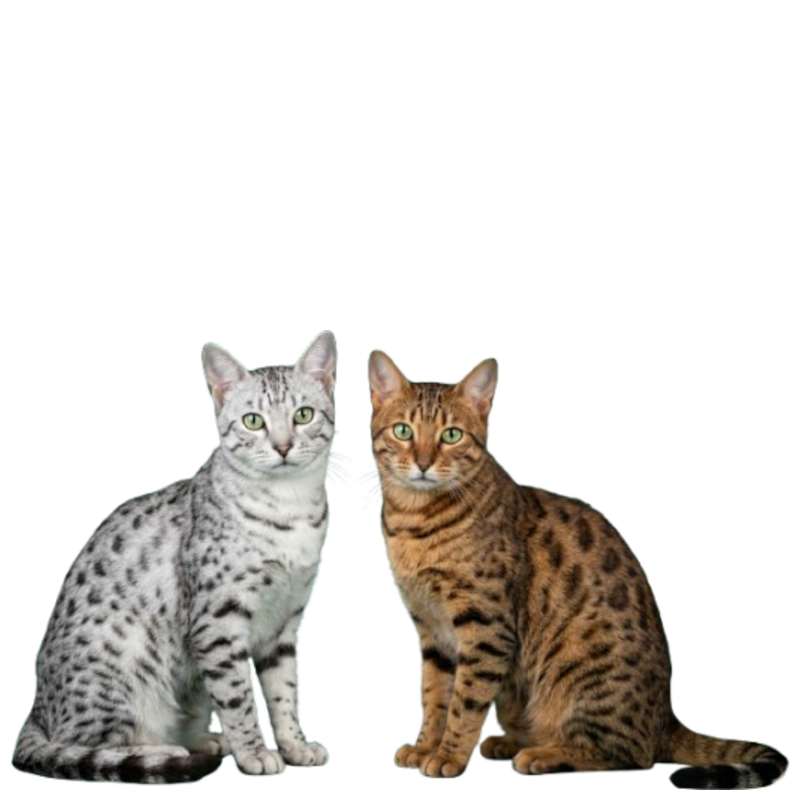
appearance
The Egyptian Mau displays a distinctive, athletic silhouette that separates it from other domestic felines. This morphology is defined by a balanced combination of a graceful, oriental frame and a powerful, muscular substructure.
Cranial and Facial Architecture
Head Contour and Profile
The head of the Egyptian Mau is shaped as a modified, slightly rounded wedge. Avoiding the sharp angles found in some breeds, Egyptian Maus exhibit a fluid transition from the bridge of the nose through the forehead without any flat planes.
- Muzzle: The muzzle of the Egyptian Mau is medium in length and blends seamlessly into the cheekbones, avoiding both a pinched and a square appearance.
- Ocular Features: Egyptian Maus are noted for large, almond-shaped eyes that exhibit a distinct “gooseberry green” hue. The setting of the eyes on the face of the Egyptian Mau creates an inquisitive and perpetually alert expression.
- Auricular Placement: The ears are medium to large and broad at the base, following the natural upward planes of the skull to a moderately pointed tip.
Body and Limb Configuration
Torso and Muscle Tone
The torso of the Egyptian Mau is medium in length, exhibiting a graceful yet sturdy build.
- The Primordial Flap: A unique skin fold located on the flank of the Egyptian Mau facilitates greater limb extension. This allows Egyptian Maus to achieve a greater stride length during rapid movement.
- Limb Proportion: The hind legs of the Egyptian Mau are notably longer than the front legs. This structural asymmetry gives the Egyptian Mau a characteristic “tiptoe” stance when stationary.
- Paw Shape: Paws are small, refined, and nearly oval in shape.
- Tail Structure: The tail is thick at the base and tapers uniformly toward the tip.
Coat Texture and Marking Distribution
Pattern Geometry and Surface Markings
The coat of the Egyptian Mau is medium-short and possesses a lustrous, silky sheen. The most identifying visual trait of Egyptian Mau’s appearance is the random distribution of spots. Unlike the structured stripes of a tabby, the markings on the Egyptian Mau are non-linear and vary in both size and shape across the torso.
| Region | Physical Characteristic |
|---|---|
| Forehead | A distinct “M” shape, frequently associated with the “mark of the scarab.” |
| Cheeks | Parallel “mascara” lines that extend from the outer and lower corners of the eyes. |
| Torso | Randomly dispersed spots that do not follow a fixed row or columnar pattern. |
| Shoulders | Transition from spots to “broken” bars or stripes. |
| Limbs | Heavy horizontal banding on the upper legs. |
| Tail | Concentric rings culminating in a solid, dark tip. |
Mathematical Modeling of Pigmentation
The spotted pattern of the Egyptian Mau can be viewed as a biological reaction-diffusion system. The density of pigment at a given point on the epidermis can be represented by the following partial differential equation:
The “Invisible Ink” Spot Formation Model
- (Rho): “Pigment Density,” the concentration of color-making chemicals in the skin.
- : “Coloring Speed,” how fast the pigment density changes over time.
- : “Spread Rate,” how quickly the pigment leaks into the surrounding skin area.
- : “The 2D Map,” a math tool that looks at how the pigment is spread out across the cat’s body.
- : “Growth Boost,” the local reaction that either creates more color or shuts it down.
In the development of a kitten’s coat, the spots form when the local production of pigment () exceeds the rate at which the substance spreads (). For a diffusion rate () of and a specific reaction threshold, the pigment “clusters” into discrete spots rather than a uniform wash, resulting in the breed’s signature random spotting pattern.
NOTE: represents the diffusion coefficient of the pigment-forming cells, ensuring the spots remain isolated rather than merging into a uniform coat.
behavior
The Egyptian Mau demonstrates a specific suite of physical actions and locomotive capabilities. These patterns of movement and interaction are characterized by extreme velocity, specialized vocal mechanics, and distinct environmental engagement.
Mechanics of Motion and Physical Agility
High-Speed Locomotion
Egyptian Maus are capable of achieving remarkable terrestrial speeds. This physical output is supported by a unique skeletal alignment and a specialized skin fold that maximizes the extension of the rear limbs during a stride.
- Rotary Gallop: When moving at peak velocity, the Egyptian Mau employs a specific four-beat gait sequence where the feet touch the ground in a circular pattern.
- Elastic Potential: The muscular transition from a crouch to a sprint in Egyptian Maus functions similarly to a sudden kinetic release, providing nearly instantaneous acceleration.
Vertical Displacement
The Egyptian Mau frequently performs vertical leaps, often reaching elevations significantly higher than its own standing height. This behavior is typically executed from a stationary start using the concentrated power of the posterior muscle groups.
Communication and Auditory Signaling
Specialized Vocalizations
Beyond the standard meow, the Egyptian Mau utilizes an array of distinct sounds during various states of arousal or social exchange.
- Chortling: A melodic, vibratory sound generated in the throat, often associated with recognition or engagement.
- Chirping and Chatting: Short, high-pitched staccato notes emitted when the Egyptian Mau observes movement or visual stimuli it cannot immediately reach.
Visual Tail Signaling
A characteristic behavior of the Egyptian Mau involves a rapid, rhythmic quivering of the tail while the body remains otherwise still. This “quivering tail” motion serves as a clear indicator of high physiological stimulation.
Interactive and Environmental Engagement
Manual Dexterity and Object Handling
Egyptian Maus exhibit refined use of their forepaws for environmental manipulation. They often use their digits to probe water surfaces or to grasp and relocate items.
- Retrieval Patterns: The Egyptian Mau will frequently transport objects in its mouth, moving items across the domestic environment to specific preferred locations.
- Treading Behavior: Rhythmic paw manipulation of soft substrates, known as kneading, is a common physical action for the Egyptian Mau.
| Behavioral Category | Observed Manifestation |
|---|---|
| Hydraulic Interaction | Using a paw to splash, stir, or test the depth of water before drinking. |
| Tactile Exploration | Reaching out with a single paw to investigate the texture or movement of new objects. |
| Aerial Monitoring | Seeking the highest available point in a room to observe environmental activity from above. |
Physics of Vertical Trajectory
The vertical leap of the Egyptian Mau can be calculated by modeling the force of the initial jump. The maximum height is determined by the vertical component of the takeoff velocity and the constant of gravitational acceleration :
The High-Jump Height Formula
- : “Jump Height,” the maximum vertical distance the cat reaches.
- : “Takeoff Speed,” how fast the cat is moving upward the moment its paws leave the floor.
- : “Gravity’s Pull,” the natural force pulling the cat back down (about ).
- : “The Gravity Constant,” a fixed number used to calculate the fight against the earth’s pull.
A takeoff velocity of m/s results in a maximum height of meters.
Because Egyptian Maus possess a high power-to-weight ratio in their hindquarters, the resulting allows for a vertical displacement that exceeds the domestic average.
color
The Egyptian Mau is defined by a specific range of recognized colorations and the distinct contrast between its ground color and its markings. The pigmentation is distributed in a manner that ensures every spot and band is clearly delineated against the lighter base.
Primary Color Varieties
Silver
The silver variety of the Egyptian Mau features a pale silver ground color across the head, shoulders, outer legs, back, and tail. The underside is a brilliant fader white. All markings on a silver Egyptian Mau are charcoal black, providing the highest degree of visual contrast.
Bronze
The bronze Egyptian Mau displays a warm, coppery brown ground color. This base transitions into a lighter, buff-colored tone on the undercarriage. The markings for this variety are dark brown or black.
- Glitter: Some bronze Egyptian Maus exhibit a high degree of “glitter,” which is a structural hair phenomenon that reflects light.
- Ticking: The ground color is often enhanced by dark brown ticking in the lighter areas.
Smoke
The smoke variety of the Egyptian Mau presents a non-agouti appearance. The ground color is a pale silver, but the hair tips are heavily pigmented with black. In a stationary position, the smoke Egyptian Mau may appear almost solid black, but the silver undercoat and charcoal spots become visible during movement.
Accessory Pigmentation Features
Ocular Coloration
The eyes of the Egyptian Mau are strictly limited to a specific shade.
- Gooseberry Green: This is a light, translucent green.
- Transition: Young Egyptian Maus may undergo a shift from amber to green as they mature, but the final required hue is the distinctive green of a gooseberry.
Cutaneous and Extremity Pigmentation
The color of the Egyptian Mau extends to the skin and peripheral points.
| Feature | Silver | Bronze | Smoke |
|---|---|---|---|
| Nose Leather | Brick red | Brick red | Black |
| Paw Pads | Black | Black or dark brown | Black |
| Markings | Charcoal black | Dark brown/Black | Jet black |
Optical Physics of Coat Reflectance
The visual perception of the Egyptian Mau’s coat color is influenced by the way light interacts with the hair shaft. The reflectance can be modeled as a function of the pigment concentration and the refractive index of the hair cuticle:
The Metallic Glow and Light Shine Model
- : “The Seen Color,” the specific wavelength of light that bounces off the fur and hits our eyes.
- : “Light Power,” the strength of the light as it travels deep into the hair.
- : “Hair Thickness,” the total depth of the outer clear layer of the hair.
- : “The Fade Factor,” a math way to show how light gets weaker as it goes deeper.
- : “Color Grabbing,” how much the internal pigment “soaks up” the light.
- : “Step-by-Step Depth,” measuring the light’s journey through every tiny layer of the hair.
For a silver-coated cat with a thin cuticle ( mm) and low absorption (), the reflectance for visible light ( nm) is calculated by integrating the light intensity as it passes through the hair, resulting in the signature ‘metallic’ sheen.
In the smoke Egyptian Mau, the absorption coefficient is significantly higher at the distal end of the hair shaft, creating the “shimmer” effect as the silver proximal end is revealed during kinesis.
compatibility
Ease of Maintenance
Rating: 5/5
Child Friendly
Rating: 4/5
Annual Cost
Rating: 4/5
Lifetime Cost
Rating: 4/5
Adaptability
Rating: 2/5
Velcro Factor
Rating: 4/5
Quietude
Rating: 3/5
Apartment Suitability
Rating: 2/5
Hypoallergenic
Rating: 2/5
Handling Tolerance
Rating: 3/5
Hardiness/Longevity
Rating: 4/5
Prey Drive
Rating: 1/5
genetics
The genetic blueprint of the Egyptian Mau is defined by a specific arrangement of alleles that govern pattern expression and hair shaft structure. Unlike many other spotted cats which result from interspecies hybridization, the genomic profile of the Egyptian Mau is that of a naturally occurring, fixed-type population.
The Agouti Gene Complex
The primary driver of the Egyptian Mau’s distinct surface pattern is the Agouti (ASIP) gene. This locus controls the distribution of pigment along individual hair shafts.
Dominant Agouti ()
In the silver and bronze varieties, the dominant allele is present. This allows for the expression of the tabby pattern by restricting dark pigment to specific bands, revealing the lighter ground color between them.
Recessive Non-Agouti ()
The smoke Egyptian Mau is genetically solid or “self” due to the homozygous recessive () genotype. However, the underlying tabby pattern remains genetically present; it is simply suppressed by the heavy deposition of eumelanin. This creates “ghost spotting” that becomes visible under specific lighting conditions.
Pattern Loci and Tabby Morphotypes
The specific spotting seen in the Egyptian Mau is governed by the Tabby () locus. While the ancestral feline pattern is the “mackerel” stripe, the Egyptian Mau possesses a modified version of this locus.
Spotted Modifier
The Egyptian Mau carries genes that act as modifiers on the mackerel tabby () pattern. These modifiers effectively “break” the vertical stripes into individual, randomly dispersed spots. Unlike the “blotched” or “classic” tabby (), the Egyptian Mau genotype maintains a high degree of pattern fragmentation.
Inhibitor and Rufous Polygenes
The Inhibitor Gene ()
The silver and smoke varieties of the Egyptian Mau are influenced by the dominant Inhibitor gene (). This gene suppresses the production of phaeomelanin (yellow/red pigment), leaving the base of the hair shaft a clear silver-white.
- Silver Genotype:
- Smoke Genotype:
- Bronze Genotype:
Rufous Polygenes
The intensity of the bronze ground color is determined by “rufous” polygenes. These are not a single Mendelian locus but a collection of minor genes that accumulate to increase the saturation of warm tones in the bronze Egyptian Mau.
Population Genetics and Heterozygosity
The Egyptian Mau maintains a unique position in feline population genetics. Studies of the Egyptian Mau’s DNA indicate a high degree of genetic isolation from Western European breeds, showing a closer phylogenetic relationship to other Mediterranean and Near Eastern populations.
| Locus | Allele | Impact on Egyptian Mau |
|---|---|---|
| Agouti | A | Enables ground color/pattern contrast. |
| Inhibitor | I | Removes yellow pigment for Silver/Smoke. |
| Tabby | Tm | Provides the base for spotted patterning. |
| Wide Band | Wb | Increases the space between pigment bands. |
Probability of Genotypic Inheritance
If two Egyptian Maus heterozygous for the Inhibitor gene () are bred, the probability of producing a bronze offspring () follows Mendelian inheritance:
The Hidden Color Chance (Bronze vs. Silver)
- : “The Bronze Chance,” the probability that a kitten will be born with a bronze coat.
- : “The Bronze Gene,” the recessive instruction for non-silver coloring.
- : “The Parent’s Flip,” the 50/50 chance that one parent passes on their “hidden” bronze gene.
- : “The One-in-Four Rule,” the total 25% chance that a kitten gets the bronze gene from both parents.
In a cross between two heterozygous silver parents (), the probability of producing a bronze kitten () is calculated by multiplying the chance of the father passing by the chance of the mother passing , totaling .
This probability assumes both parents are silver carriers of the non-inhibitor allele, highlighting the recessive nature of the bronze ground color in silver-to-silver pairings.
health
The biological constitution of the Egyptian Mau is generally robust, characterized by a lack of the extensive breed-specific infirmities found in many highly engineered lineages. However, specific physiological sensitivities and hereditary conditions remain relevant to the clinical monitoring of Egyptian Maus.
Hypertrophic Cardiomyopathy (HCM)
Hypertrophic Cardiomyopathy is the primary cardiac concern within the Egyptian Mau population. This condition involves the pathological thickening of the left ventricular myocardium, which can lead to impaired diastolic function and potential heart failure.
- Diagnostic Monitoring: Routine echocardiographic screenings are utilized to measure the thickness of the ventricular walls.
- Clinical Progression: In the Egyptian Mau, the condition can remain asymptomatic for extended periods before manifesting as lethargy or respiratory distress.
Pyruvate Kinase Deficiency (PKD)
The Egyptian Mau is susceptible to Pyruvate Kinase Deficiency, an enzymatic disorder affecting the anaerobic glycolysis of erythrocytes. This deficiency leads to the premature destruction of red blood cells, resulting in chronic anemia.
- Pathophysiology: A lack of the pyruvate kinase enzyme prevents red blood cells from maintaining metabolic homeostasis.
- Systemic Impact: Egyptian Maus suffering from this condition may exhibit splenomegaly or intermittent jaundice.
Metabolic and Chemical Sensitivities
Anesthetic Reactivity
The Egyptian Mau often exhibits an atypical response to anesthetic agents. Due to their specific lean-to-fat body mass ratio and metabolic rate, Egyptian Maus may require adjusted dosages and specialized monitoring during surgical procedures to prevent hypothermia or delayed recovery.
Nutritional Sensitivity
The gastrointestinal system of the Egyptian Mau can be sensitive to rapid dietary shifts or high-grain formulations. Ensuring a high-protein, moisture-rich nutritional intake is vital for maintaining renal and digestive health.
Dermatological and Dental Health
| Area | Potential Condition | Clinical Presentation |
|---|---|---|
| Oral Cavity | Periodontal Disease | Gingival inflammation and calculus accumulation on the molars. |
| Epidermis | Eosinophilic Granuloma | Raised, sensitive lesions on the skin or labial margins. |
| Eyes | Distichiasis | Abnormal eyelash growth that can cause corneal irritation. |
Pharmacokinetic Modeling
The clearance of certain pharmaceutical compounds in the Egyptian Mau can be modeled to account for their high metabolic rate. The plasma concentration over time for a given dosage is expressed by:
Medicine Strength and Body Clearing Model
- : “Medicine Level,” how much of the drug is still in the cat’s blood at a specific time ().
- : “The Dose,” the amount of medicine given to the cat.
- : “The Spreading Space,” how much room the cat’s body has to distribute the medicine.
- : “Natural Change Base,” a math constant used to track things that fade away naturally.
- : “Clearing Speed,” how fast the cat’s kidneys or liver remove the medicine.
- : “Time Since Dose,” how many hours have passed since the cat took the medicine.
If a dosage () of mg is administered to a cat with a volume of distribution () of L and an elimination rate () of per hour, the concentration after hours is calculated as: mg/L.
Clinical observations suggest that may be higher in the Egyptian Mau than in more sedentary domestic breeds, necessitating precise dosing intervals.
longevity
The life expectancy of the Egyptian Mau reflects its biological resilience and the influence of various environmental factors. Statistical analysis indicates that Egyptian Maus generally reach ages that are consistent with, or occasionally surpass, the typical longevity markers for domestic feline populations.
Statistical Life Expectancy Ranges
The chronological lifespan of the Egyptian Mau is categorized into specific developmental and senior stages. When maintained in a controlled indoor environment, the duration of survival is frequently extensive.
| Demographic Category | Age Range (Years) |
|---|---|
| Typical Lifespan | 12-15 |
| Extended Lifespan | 16-20 |
| Exceptional Longevity | 20+ |
Mathematical Modeling of Survival Probability
The likelihood of a Egyptian Mau’s survival past a certain age can be described by a survival function, . This function calculates the probability that the biological age of the Egyptian Mau exceeds time . The Gompertz-Makeham law is a standard formula used to interpret feline mortality data:
The “Golden Years” Survival Map
- : “Survival Odds,” the chance that a cat will live past a certain age ().
- : “Starting Risk,” the basic health risk for a young cat.
- : “Aging Speed,” how much the risk of health problems grows as the cat gets older.
- : “Bad Luck Factor,” the risk of things that have nothing to do with age, like accidents.
- : “Growth Constant,” a number used to model the exponential nature of aging.
- : “Target Age,” the specific birthday in years we are calculating for.
For a population with an initial mortality () of , a senescence rate () of , and an environmental risk () of , the probability of surviving to age years is calculated using the exponential decay of both age-dependent and age-independent factors.
Factors Influencing Chronological Aging
Environmental Impact on Life Duration
The most significant variable affecting the longevity of the Egyptian Mau is the nature of its habitat. Data reveals a notable difference in the (median life expectancy) between different living conditions.
- Indoor Optimization: Egyptian Maus that live exclusively indoors experience a sharp decline in ; this often leads to a lifespan increase of 40%-60% compared to those with outdoor access.
- Biological Preservation: Minimizing exposure to external pathogens and physical dangers allows the Egyptian Mau to maximize its natural life potential.
Cellular Senescence and Biological Aging
Aging within the Egyptian Mau involves the progressive buildup of cellular degradation. Upon entering the geriatric phase—typically recognized around the 11th year—the effectiveness of metabolic regulation and DNA repair processes begins to diminish.
Comparative Longevity Matrix
The table below illustrates the survival benchmarks for the Egyptian Mau in comparison to broader feline statistics.
| Metric | Generalized Feline Population | Egyptian Mau Specific Data |
|---|---|---|
| Median Survival (L50) | 13.1 years | 14.2 years |
| Geriatric Threshold | 10 years | 11 years |
| Maximum Documented Age | ~30 years | ~22 years |
maintenance
Effective management of the Egyptian Mau involves a structured regimen of physical care and environmental enrichment. While the biological needs of Egyptian Maus are streamlined, specific procedural tasks are necessary to maintain physiological homeostasis.
Integumentary Care and Grooming
The coat of the Egyptian Mau requires minimal mechanical intervention, yet regular sessions are vital for removing dead keratinized cells and distributing sebaceous secretions.
- Brushing Frequency: A weekly session using a soft-bristle brush or a rubber curry comb is sufficient.
- Sanitization: Bathing is rarely required unless the Egyptian Mau encounters significant external contaminants. If necessary, only pH-balanced feline surfactants should be utilized to avoid disrupting the lipid barrier.
Dental and Periodontal Hygiene
To prevent the accumulation of biofilm and subsequent calculus, active oral care must be implemented.
Mechanical Cleaning
Daily brushing with enzymatic toothpaste designed for felines is the gold standard for preventing oral decay.
Oral Rinses
Use of water additives containing chlorhexidine gluconate is recommended if mechanical brushing is not feasible.
Clinical Assessment
Annual professional prophylaxis is necessary to address subgingival plaque that cannot be reached through home care.
Ungual and Aural Management
Nail Maintenance
The distal phalanx of the Egyptian Mau houses rapidly growing claws that require trimming every 10-14 days. This prevents overgrowth and accidental snagging on textile surfaces.
Ear Cleaning
The pinnae and external auditory canal of the Egyptian Mau should be inspected weekly. If cerumen (earwax) accumulation is observed, a non-ototoxic cleaning solution should be applied with a soft cotton medium.
Nutritional Logistics and Hydration
The dietary requirements of the Egyptian Mau focus on high-protein, low-carbohydrate intake to support its metabolic demands.
Caloric Calculation
The Resting Energy Requirement (RER) for a Egyptian Mau can be calculated using the following formula:
Daily “Couch Potato” Calorie Guide
- : “Base Calories,” the number of calories the cat burns just by existing and resting.
- : “The Energy Multiplier,” a standard number used for all mammals to start the calorie count.
- : “Weight in Kilos,” how heavy the cat is in kilograms.
- : “The Efficiency Factor,” a math adjustment because larger bodies use energy more efficiently than tiny ones.
For an athletic cat weighing kg, the RER is calculated by raising the weight to the power of and multiplying by : kcal/day.
The base value () is adjusted by a factor (typically 1.2 to 1.4) to determine the Total Daily Energy Requirement (DER).
Hydration Management
Egyptian Maus often have a low thirst drive. To ensure adequate renal perfusion, the following methods are recommended:
- Provision of recirculating water fountains to encourage drinking through movement.
- Incorporation of wet food to increase the total moisture percentage of the diet.
Environmental and Waste Management
| Category | Maintenance Requirement | Frequency |
|---|---|---|
| Sanitation | Removal of waste from litter substrate | Daily |
| Substrate Refresh | Complete replacement of litter medium | Bi-weekly / Monthly |
| Tool Disinfection | Cleaning of food and water receptacles | Daily |
| Climbing Infrastructure | Inspection of vertical perches and scratching posts | Monthly |
Pediatric and Geriatric Maintenance Adjustments
The maintenance intensity for the Egyptian Mau shifts throughout its life stages. Kittens require more frequent ungual trimming due to rapid growth, while senior Egyptian Maus may require assistance with grooming in areas of reduced flexibility.
measurements
| Measurement | Female | Male | ||
|---|---|---|---|---|
| Metric | Imperial | Metric | Imperial | |
height | 18 – 25 centimeters | 7 – 10 inches | 20 – 28 centimeters | 8 – 11 inches |
length | 28 – 35 centimeters | 11 – 14 inches | 30 – 38 centimeters | 12 – 15 inches |
weight | 2.7 – 4.5 kilograms | 6 – 10 pounds | 3.6 – 5.9 kilograms | 8 – 13 pounds |
• Height: Refers to the measurement at the withers (shoulders).
• Length: Measured from the tip of the nose to the base of the tail.
origin
The historical trajectory of the Egyptian Mau is rooted in the Nile River Valley, where the intersection of feline biology and human civilization occurred thousands of years ago. The transition from wild predator to domestic partner is documented through substantial archaeological findings and artistic representations.
Antiquity and Nilotic Heritage
The primary ancestor of the Egyptian Mau is the African Wildcat (Felis lybica). In Ancient Egypt, the domestication process was accelerated by the agricultural revolution, as felines protected vital grain stores from rodents.
Iconographic Records
Wall paintings and papyri from the New Kingdom (approximately 1550-1070 BCE) portray Egyptian Maus in roles ranging from efficient pest control to sacred ritualistic companions.
Veneration and Law
By the Late Period, the Egyptian Mau attained a sanctified status. Legislation protected these animals, and the intentional killing of a Egyptian Mau’s life was considered a capital crime.
The Journey to Western Recognition
The modern history of the Egyptian Mau in the Western world began in the mid-20th century, following a period of near extinction during the Second World War.
The Role of Princess Natalie Troubetskoy
The re-establishment of the Egyptian Mau as a recognized lineage is largely credited to the efforts of Princess Natalie Troubetskoy. While living in Italy, she acquired several specimens—reportedly through diplomatic interactions involving the Egyptian embassy.
- Initial Stock: The foundation of the modern Egyptian Mau registry began with three specific individuals: Baba, Jojo, and Liza.
- Immigration to the United States: In 1956, Troubetskoy moved to the U.S., bringing her Egyptian Maus and founding the Fatima cattery to preserve the lineage.
Chronology of Formal Recognition
The formalization of the Egyptian Mau’s status within feline registries followed a structured path of accreditation and acceptance.
| Year | Registry / Milestone | Significance |
|---|---|---|
| 1968 | CFF Recognition | Initial formal acceptance by a major cat fancy organization. |
| 1977 | CFA Recognition | Achievement of championship status within the Cat Fanciers’ Association. |
| 1992 | European Integration | Expanded recognition by FIFe, solidifying the global presence of the Egyptian Mau. |
Geographic Distribution Modeling
The expansion of the Egyptian Mau from a localized Egyptian population to a worldwide presence can be modeled as a spatial spread function , where represents the distance from the Nile delta and represents time in centuries. For the pre-modern era, the density of the Egyptian Mau followed a decay model:
The History of Ancient Migration Model
- : “Population Density,” how many cats are living in a specific area at a specific time.
- : “Original Group,” the number of cats that first started in Ancient Egypt.
- : “Wander Rate,” how fast the cats traveled along human trade routes each century.
- : “Distance from Home,” how many miles or units the cat moved away from the Nile.
- : “Time in Centuries,” how many hundreds of years have passed since the origin.
- : “Expansion Number,” a math constant used to show how populations spread out from a center point.
For an initial population () of cats and a diffusion rate () of units per century, the density at a distance () of units after () centuries is calculated as: cats per unit area.
Archaeological Evidence and Mummification
Extensive feline necropolises found at archaeological sites such as Bubastis and Beni Hassan offer physical proof of the Egyptian Mau’s prevalence in ancient society. X-ray analysis of mummified remains indicates that the skeletal framework of these ancient cats aligns closely with the modern Egyptian Mau—establishing a continuous biological link across three millennia.
temperament
The temperament of the Egyptian Mau is defined by a sophisticated emotional intelligence and a distinct hierarchical approach to social bonding. Unlike more universally social feline varieties, Egyptian Maus exhibit a curated internal disposition that prioritizes the depth of a connection over its breadth.
Emotional Valence and Social Orientation
The emotional landscape of the Egyptian Mau’s is characterized by a high degree of fidelity. Their temperamental matrix is constructed upon a foundation of focused devotion, which frequently manifests as a preference for a specific individual or a small family circle.
Discernment
Egyptian Maus possess a cautious temperament regarding unfamiliar stimuli or new people. This stems not from fear, but from an innate analytical reserve.
Affective Depth
Once a bond is solidified, the Egyptian Mau displays an intense emotional proximity, characterized by a stable and unwavering disposition toward their chosen social anchors.
Cognitive Intensity and Alertness
The Egyptian Mau maintains a high baseline of psychological engagement with its surroundings. This mental state is defined by a “ready-state” awareness.
Sensitivity to Environmental Stimuli
The temperament of the Egyptian Mau’s is notably reactive to shifts in the domestic atmosphere. They are psychologically sensitive to specific categories of input.
Acoustic Fluctuations
Sudden or loud auditory inputs can quickly shift the internal state of the Egyptian Mau’s from calm to hyper-vigilant.
Emotional Ambience
Substantial evidence suggests that Egyptian Maus are temperamentally attuned to the emotional states of their human counterparts—often mirroring the prevailing mood of the household.
Confidence and Assertiveness
Despite an initial reserve with strangers, the Egyptian Mau is temperamentally assertive within its established territory.
| Temperamental Trait | Expression in the Egyptian Mau |
|---|---|
| Self-Assurance | High; Egyptian Maus are psychologically confident in familiar settings. |
| Possessiveness | Strong; they often develop a protective disposition toward specific objects or people. |
| Adaptability | Moderate; while intelligent, their temperament favors consistency over rapid environmental flux. |
Modeling Temperamental Stability
The psychological stability of the Egyptian Mau can be viewed through the lens of a “Threshold of Activation” model. The probability of a temperamental shift in response to an external stressor can be represented as:
The “Spook Factor” Reactivity Model
- : “Reaction Chance,” the probability (0 to 1) that the cat will jump or run.
- : “The Noise Level,” the strength of the outside stressor, like a vacuum or a stranger.
- : “The Patience Limit,” the cat’s personal threshold before it feels it has to react.
- : “The Hair-Trigger Factor,” how fast the cat goes from “calm” to “flight” once pushed.
- : “The Natural Curve,” a constant that makes the math follow a smooth S-curve of behavior.
For a sensitive cat with an activation threshold () of units and a reactivity constant () of , an external stressor () of units results in a probability of shift: , indicating a high likelihood of a reactive response.
Inter-species Disposition
The Egyptian Mau’s temperament toward other biological entities is largely dependent on the stability of the social hierarchy.
Intra-feline Relations
Egyptian Maus generally maintain a dominant but fair temperament within a multi-cat dynamic, provided their status is not constantly challenged.
Interspecific Compatibility
Their disposition toward non-feline companions is marked by a polite indifference unless the other entity disrupts the established psychological comfort zone of the Egyptian Mau’s.