Donskoy Cat
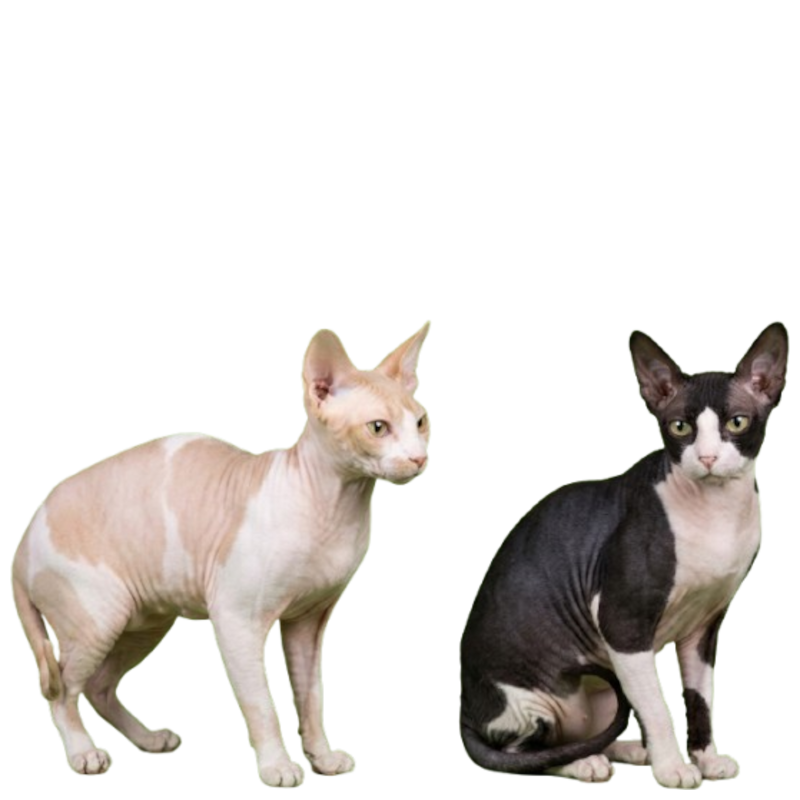
appearance
The Donskoy is a medium-sized feline distinguished by a unique muscularity and a skin-centric morphology. The overall silhouette of Donskoys conveys a balance of sturdy bone structure and elegant, flowing lines, characterized primarily by the absence of a traditional fur coat.
Cranial Structure and Facial Features
The head of the Donskoy presents as a modified wedge with prominent, high-set cheekbones and a distinctively flat forehead. In profile, the transition from the forehead to the nose is marked by a slight indentation.
- Muzzle: The muzzle is short and well-defined, featuring a noticeable pinch and a strong, well-developed chin.
- Whiskers: If present, whiskers appear curly and fragile, often appearing shortened or broken.
- Ears: The ears are remarkably large and set high, tilting slightly forward. They feature rounded tips, and their outer margins align with the vertical wedge of the face.
- Eyes: Set at a subtle slant, the eyes are medium-sized and almond-shaped.
Body Conformation and Limbs
The physical build of the Donskoy is defined by a dense, firm muscularity. Donskoy’s bodies are notably solid to the touch.
Torso and Neck
The neck is of moderate length and carries heavy musculature. The torso is elongated with a broad chest and a characteristically rounded abdomen, which gives the Donskoy a well-fed appearance regardless of diet.
Extremities
The legs are proportional to the frame, though the hind legs are slightly longer than the forelegs. Donskoy’s paws are oval with exceptionally long, mobile toes — often compared to those of primates — joined by visible webbing.
Tail
The tail is elongated and straight, originating from a wide base and tapering gradually toward a rounded extremity.
Skin and Texture
The most essential trait of the Donskoy is the abundance of elastic skin, which creates a highly wrinkled appearance across the entire body.
Wrinkling Patterns
Significant skin folds are a hallmark of Donskoys, with the highest density located in the following regions:
- Cranial: Concentrated between the ears and across the forehead.
- Cervical: Folds that wrap around the throat and neck.
- Thoracic: Along the chest and extending down the flanks.
- Appendicular: Significant wrinkling where the limbs meet the body and along the length of the legs.
Skin Varieties
The tactile experience of Donskoy’s skin varies based on the specific degree of hairlessness:
| Skin Category | Surface Description |
|---|---|
| Rubber | Totally hairless with a slightly tacky, “anti-slip” texture. |
| Flock | A surface covered in microscopic down, providing a texture similar to suede. |
| Velour | Short, fine hairs that often diminish as the cat matures, leaving a soft feel. |
| Brush | Sparsely distributed wiry or wavy hair, often appearing in irregular patches. |
Anatomical Proportions
The relationship between the length of the body () and the height at the shoulder () can be expressed as a ratio:
The Body Shape Balance (Rectangular vs. Square)
- : “The Shape Score,” the number that tells us if the cat looks like a rectangle.
- : “Body Length,” the distance from the chest to the base of the tail.
- : “Shoulder Height,” how tall the cat stands from the floor to its shoulders.
To confirm the rectangular frame of a show-quality Donskoy, a breeder measures a mature male. If the cat stands at a shoulder height of and has a body length of , the ratio is . Because , this confirms the cat meets the “rectangular” breed standard rather than the “square” profile () seen in some other hairless breeds. This specific ratio mathematically accounts for the Donskoy’s deep chest and powerful musculature, ensuring a stable, ground-hugging gait.
For the Donskoy, this value typically indicates a rectangular frame where is greater than , providing the cat with a low, powerful center of gravity and a stable gait.
behavior
The behavioral repertoire of the Donskoy is defined by high levels of physical activity, complex social engagement, and a distinct reliance on tactile environmental interaction.
Locomotion and Physical Activity
Donskoys exhibit a high degree of athletic capability, frequently engaging in vertical exploration. Their movement patterns are characterized by:
- Verticality: A strong tendency to seek out the highest accessible points in a given environment, utilizing their muscular hind legs for significant jumping reach.
- Object Manipulation: Due to the unique structure of Donskoy’s paws, they often use their front limbs to grasp, pull, or carry objects, displaying a level of manual dexterity that exceeds many other feline varieties.
- Energy Cycles: They typically follow a pattern of intense, “high-octane” bursts of play followed by deep periods of recovery — often seeking out external heat sources during the latter.
Social Interaction and Communication
The social behavior of the Donskoy is notably gregarious, often involving a continuous seeking of proximity to other inhabitants of the household.
Interspecies and Intraspecies Engagement
Donskoys tend to integrate quickly into multi-animal environments. They frequently initiate social grooming sessions and “piling” behaviors, where they sleep in direct physical contact with other animals to conserve body heat.
Vocalization Patterns
The vocal behavior of the Donskoy can be categorized by its frequency and variety. They use a broad range of acoustic signals to communicate needs, including:
- Chirping and Trilling: Often used during greeting or when initiating play.
- Extended Meowing: Used primarily to direct human attention toward specific goals — such as food or access to a restricted area.
Tactile and Thermal-Seeking Behaviors
Because of their unique physiology, Donskoy’s behaviors are heavily influenced by thermoregulation and tactile feedback.
| Behavior Type | Specific Action | Purpose |
|---|---|---|
| Heat-Seeking | Nesting in blankets, sitting on electronic equipment, or seeking direct sunlight. | Maintaining a stable core body temperature. |
| Tactile Greeting | Rubbing the head and body firmly against surfaces or individuals. | Scent marking and social bonding. |
| Kneading | Rhythmic pushing of the paws (“making biscuits”) on soft surfaces. | Comfort seeking and marking territory through paw pad glands. |
Cognitive Engagement and Play
The Donskoy demonstrates a high requirement for mental stimulation. Behavioral issues can arise if the environment lacks complexity.
Problem Solving
It is common for the Donskoy to observe human actions and attempt to replicate them to reach a goal — such as opening cabinet doors or manipulating lever-style door handles.
Play Styles
Donskoy’s play often mimics hunting sequences:
- The Stalk: Low-profile approach toward a toy or companion.
- The Pounce: A high-velocity strike using the front paws to secure the “prey.”
- The Fetch: Many Donskoys naturally engage in retrieving behaviors, bringing toys back to a human to re-initiate the play cycle.
Foraging and Dietary Interaction
The Donskoy displays a distinctive intensity regarding food-seeking behaviors. Due to a high metabolic rate, they often:
- Investigate any human food preparation with persistence.
- Use their paws to “hook” food items from bowls or plates.
- Engage in frequent, small-scale foraging throughout the day.
The metabolic activity () relative to environmental temperature () can be simplified as an inverse relationship where lower results in increased foraging activity ():
The “Hungry When Cold” Connection
- : “Food-Seeking Drive,” how hard the cat works to find and beg for snacks.
- : “Changes With,” showing that as one number goes down, the other goes up.
- : “The Chill Factor,” the opposite of the room temperature.
- : “Room Temperature,” the actual heat of the house in degrees Celsius.
To predict the behavioral shift in a Donskoy during a power outage, an owner observes the cat’s kitchen-prowling habits. If the usual comfortable drops to , the value doubles. Consequently, the Donskoy’s (Foraging Activity) doubles to compensate for the massive caloric loss required to maintain core body heat without a coat. Instead of daily “investigations” of the food bowl, the cat may now engage in or more persistent “hooking” attempts on human plates, mathematically demonstrating that the colder the room, the more “food-obsessed” the Donskoy will appear.
color
The chromatic presentation of the Donskoy is determined by dermal pigmentation rather than fur color. Because Donskoys lack a traditional coat, the visible hues are a direct reflection of the skin’s melanin distribution, which can manifest in a wide array of solid, patterned, and dilute forms.
Solid Pigmentation Categories
Solid colors in the Donskoy appear as a uniform wash of pigment across the entire body. The absence of hair often makes these colors appear more muted or matte compared to haired feline varieties.
- Black: Appears as a deep, dark charcoal or slate grey on the skin.
- Blue: A dilute form of black, presenting as a soft, cool-toned medium grey.
- Red: Manifests as a warm apricot or deep terra cotta hue.
- Cream: A pale, sandy beige representing the dilute version of red.
- White: A complete absence of visible pigmentation, resulting in a pale pinkish-white skin tone.
Complex Patterns and Bi-Colors
The Donskoy can display intricate dermal patterns that would typically be found in a feline coat. These markings are embedded directly into the epidermis.
Tabby Patterns
Tabby markings on Donskoys are visible as darker pigmented lines or spots against a lighter ground color. Common variations include:
- Mackerel: Narrow vertical stripes resembling a fish skeleton.
- Spotted: Distinct oval or round pigmented lesions.
- Classic: Swirled or “marbled” patterns, often most visible on the torso and flanks.
Parti-color and Tortoiseshell
Parti-color Donskoys exhibit areas of white (unpigmented skin) alongside patches of solid or tabby pigment.
- Tortoiseshell: An irregular mingling of black and red pigments — or their dilute versions, blue and cream.
- Calico: Large, distinct patches of black and red on a predominantly white/unpigmented base.
Pointed Chromatic Distribution
The Donskoy may express “pointed” coloration, where pigmentation is thermally sensitive, concentrating in the cooler extremities of the body.
| Point Location | Pigment Concentration |
|---|---|
| Facial Mask | Darker shading around the nose, eyes, and whisker pads. |
| Aural Region | Deeper pigment on the leather of the ears. |
| Extremities | Increased saturation on the lower limbs and paws. |
| Caudal | Darker pigment along the length of the tail. |
Quantifying Chromatic Saturation
In technical feline colorimetry, the perceived saturation () of a Donskoy’s skin color can be affected by the degree of residual “down” or “flock” present on the epidermis. If we consider the density of fine hair as :
How Skin Color Looks Under Fine Fuzz
- : “Visual Brightness,” the color intensity our eyes actually see.
- : “Real Skin Pigment,” the true biological color of the cat’s skin.
- (Delta): “The Fuzz Factor,” the density of tiny “peach fuzz” hairs (0 is bald, 1 is furry).
- : “The View Window,” the amount of skin visible through the fuzz.
To determine why a “Blue” Donskoy looks paler than expected, a judge evaluates the coat type. If the cat has a “Velour” texture with a hair density and a true skin pigment , the perceived saturation is . This reduction in clarity is caused by light refracting off the fine downy hairs. In contrast, a “Rubber Bald” Donskoy with would yield , resulting in a much deeper, more “saturated” blue appearance because there is almost no hair to obscure the dermal pigment.
As approaches zero — in “Rubber Bald” individuals — the actual dermal pigment () is observed at its highest clarity.
Eye Color Coordination
While not a dermal trait, the ocular pigment of the Donskoy often corresponds with the primary skin tone, though the breed standard generally allows for all eye colors.
- Deep Blue: Frequently associated with pointed patterns.
- Gold/Copper: Common in solid black or red individuals.
- Green/Aqua: Often found in dilute or tabby-patterned Donskoys.
compatibility
Ease of Maintenance
Rating: 1/5
Child Friendly
Rating: 5/5
Annual Cost
Rating: 2/5
Lifetime Cost
Rating: 3/5
Adaptability
Rating: 5/5
Velcro Factor
Rating: 5/5
Quietude
Rating: 3/5
Apartment Suitability
Rating: 5/5
Hypoallergenic
Rating: 4/5
Handling Tolerance
Rating: 5/5
Hardiness/Longevity
Rating: 4/5
Prey Drive
Rating: 4/5
genetics
The genetic blueprint of the Donskoy is distinguished by a specific mode of inheritance regarding hairlessness that diverges significantly from other hairless feline varieties.
The Dominant Hairless Mutation
The primary genetic driver in the Donskoy is a dominant autosomal mutation. Unlike the recessive gene found in the Sphynx, the Donskoy’s hairlessness is governed by a gene typically symbolized as .
Inheritance Patterns and Zygosity
Because the mutation is dominant, a Donskoy only requires a single copy of the allele to express the hairless phenotype.
- Heterozygous (): These individuals possess one hairless allele and one normal coat allele. They express the hairless phenotype but can pass the normal coat gene to offspring.
- Homozygous (): These individuals possess two copies of the dominant hairless allele. When bred to any cat, 100% of the resulting generation will carry the mutation and express hairlessness.
Comparative Feline Genetics
The Donskoy’s genetic structure is distinct due to the location and behavior of its hairless allele. In feline genomics, this is often contrasted with the KRT71 gene mutation associated with other breeds.
| Feature | Donskoy Mutation (Hp) | Sphynx Mutation (hr) |
|---|---|---|
| Inheritance Mode | Autosomal Dominant | Autosomal Recessive |
| Allele Interaction | Dominant over wild-type | Recessive to wild-type |
| Genomic Location | Distinct from KRT71 | Located on KRT71 |
Genetic Variability in Integumentary Expression
While the gene is the primary determinant, polygenetic modifiers influence the specific degree of hairlessness seen in Donskoys. These modifiers dictate whether an individual expresses the “Rubber Bald,” “Flock,” “Velour,” or “Brush” variations.
Probability of Phenotype Distribution
The probability () of an offspring expressing hairlessness in a mating between a heterozygous Donskoy () and a non-hairless cat () is expressed as:
Odds of Having Hairless Kittens (Outcrossing)
- : “The Coin-Flip Chance,” the 50% probability of a kitten being hairless.
- : “The Hairless Instruction,” the strong gene that makes the cat bald.
- : “The Furry Instruction,” the hidden gene for a normal coat.
- : “Carrier Parent,” a hairless cat that carries one of each gene.
- : “Furry Parent,” a standard cat with two furry genes.
To expand a breeding program’s genetic diversity, a breeder crosses a heterozygous Donskoy () with a straight-coated outcross (). According to the formula , each kitten in the resulting litter has a chance of inheriting the dominant allele. In a litter of kittens, this mathematically predicts that kittens will be phenotypically hairless (carrying ) and kittens will be born with standard coats (). Unlike the recessive hairlessness of the Sphynx, the presence of just one allele from the Donskoy parent is sufficient to trigger the hair-loss trait.
In a mating between two heterozygous Donskoys ():
The 75% Rule for Hairless Pairs
- : “The High Probability,” the 75% chance of a hairless kitten.
- : “The Bald Gene,” the dominant instruction for hairlessness.
- : “The Coat Gene,” the recessive instruction for fur.
- : “The Typical Parent,” a hairless cat carrying both instructions.
- : “Three-out-of-Four,” the odds that a kitten gets at least one “Bald Gene.”
In a mating between two heterozygous Donskoys (both ), the breeder uses this formula to predict the frequency of hairless kittens. Out of a theoretical litter of kittens, the Punnett square predicts homozygous dominant (), heterozygous (), and homozygous recessive (). Since is dominant, both the and individuals will be hairless. Therefore, out of kittens, or , will exhibit the breed’s signature hairless appearance, while kitten will be born with a full, normal coat.
The Odds of a Surprise Furry Kitten
- : “The Minority Chance,” the 25% probability of a kitten having fur.
- : “The Normal Coat Gene,” the recessive gene for fur.
- : “The Furry Pair,” the two hidden genes needed to make a kitten have hair.
- : “One-out-of-Four,” the odds of a kitten inheriting the furry gene from both parents.
In a breeding pair where both Donskoys are heterozygous (), the breeder uses this formula to manage the expected frequency of “variants.” If the litter consists of kittens, the probability predicts that kittens () will be born with a full, normal coat (). These kittens have inherited the recessive “normal coat” allele from both parents. While they are genetically purebred Donskoys, they will never lose their hair because they lack the dominant mutation entirely, making them valuable for outcrossing but ineligible for hairless show classes.
Genomic Compatibility and Outcrossing
To maintain genetic diversity within Donskoy’s lineages, outcrossing is occasionally utilized. The dominant nature of the gene allows for the immediate expression of the desired trait in the first generation of an outcross — provided the Donskoy parent carries the dominant allele.
Impact on the Gene Pool
- Allelic Frequency: The frequency of the allele is managed to prevent the loss of secondary polygenetic traits.
- Hybrid Vigor: Selective outcrossing strategies aim to increase heterozygosity within the Donskoys population without losing the defining dominant mutation.
health
The biological health of the Donskoy is defined by its unique integumentary system and the secondary physiological adjustments required to maintain homeostasis in the absence of a traditional coat.
Thermoregulation and Metabolic Efficiency
Due to the lack of insulating fur, Donskoys exhibit a significantly higher basal metabolic rate () compared to feline breeds with standard coats. This increased energy expenditure is necessary to generate sufficient internal heat.
Caloric Consumption and Heat Production
The relationship between ambient temperature () and the energy required for thermogenesis () in Donskoys can be modeled by the necessity to maintain a stable core temperature ():
Extra Food Needed to Stay Warm
- : “Heating Calories,” the extra energy burned just to make body heat.
- : “Grows With,” showing that a bigger temperature gap means more hunger.
- : “Cat Temperature,” the cat’s steady internal heat (about 39°C).
- : “Air Temperature,” the current temperature of the room.
- : “The Cold Gap,” the difference between the warm cat and the cool air.
To calculate the dietary adjustment for a Donskoy during a cold snap, an owner compares two environments. In a warm room where , the thermal gradient is . If the power goes out and drops to , the gradient becomes . Because , the energy required for the cat to stay warm has increased by a factor of (). This mathematically proves that the Donskoy will need approximately more caloric intake or a significant external heat source (like a heated bed) to prevent systemic lethargy and maintain its .
Consequently, a Donskoy requires a calorie-dense diet to fuel this constant metabolic demand. Failure to meet these nutritional requirements can lead to systemic lethargy or an inability to maintain body temperature.
Dermatological Health and Surface Integrity
The epidermis of the Donskoy serves as the primary barrier against environmental pathogens, but its exposure makes it susceptible to specific clinical conditions.
Cutaneous Secretions and Pore Health
Donskoys produce sebaceous oils that would normally be distributed along hair shafts. Without hair, these oils accumulate on the skin surface.
- Seborrhea: Excessive oil buildup can lead to localized skin irritation or comedones — commonly known as blackheads.
- Malassezia Overgrowth: The warm, oily environment of the skin folds in a Donskoy can encourage the proliferation of yeast, necessitating regular clinical monitoring of the axillary and inguinal regions.
Environmental Vulnerabilities
Without a protective coat, the Donskoy’s skin is highly sensitive to external factors:
- Photosensitivity: Direct exposure to ultraviolet (UV) radiation can result in solar dermatitis or increased risk of squamous cell carcinoma.
- Thermal Injury: Vulnerability to both contact burns from heat sources and hypothermia in low-temperature environments.
Odontological and Oral Health
A notable clinical observation in Donskoys, particularly those with the more extreme hairless alleles, involves the development and retention of dentition.
| Condition | Clinical Manifestation | Impact on Health |
|---|---|---|
| Enamel Hypoplasia | Thin or missing enamel on permanent teeth. | Increased risk of decay and sensitivity. |
| Anodontia/Hypodontia | Congenitally missing teeth. | Potential difficulties with mastication. |
| Early Periodontal Disease | Inflammation of the gingiva and supporting structures. | Requires frequent prophylactic dental cleanings. |
Systemic and Internal Pathophysiology
Beyond the skin and teeth, Donskoys are subject to standard feline health screenings, with particular emphasis on cardiovascular integrity.
Hypertrophic Cardiomyopathy (HCM)
Like many pedigreed feline populations, the Donskoy is monitored for HCM — a condition where the muscular walls of the heart thicken, reducing cardiac efficiency.
Neonatal Vitality
In Donskoy’s breeding programs, neonatal health is closely tied to environmental temperature control. Kittens are highly susceptible to respiratory infections if the nesting area is not kept consistently warm, as their internal thermoregulatory mechanisms are not fully developed at birth.
longevity
The temporal lifespan of the Donskoy is a critical metric for understanding the long-term biological viability of the population. Statistical data indicates that Donskoys generally occupy a standard duration within the domestic feline life cycle.
Average Lifespan Statistics
The life expectancy of a Donskoy is typically measured from the neonatal stage through the geriatric phase. When environmental and physiological requirements are met, Donskoys demonstrate a robust capacity for reaching advanced maturity.
| Demographic Category | Expected Age Range (Years) |
|---|---|
| Typical Life Expectancy | 12–15 |
| Upper Decile Survivors | 16–18+ |
| Juvenile Phase Duration | 0–1 |
Factors Influencing Temporal Durability
The progression through the Donskoy’s life stages is influenced by the interaction between internal biological efficiency and external environmental stability.
Survival Probability Modeling
The probability of a Donskoy reaching a specific age can be conceptually represented by a survival function . For Donskoys maintained in optimal conditions, the curve typically shows a high plateau before a gradual decline in the geriatric years:
The Lifespan Survival Map
- : “Survival Probability,” the chance of the cat living to a certain age ().
- : A math constant used for tracking natural fading or aging over time.
- : “The Accumulator,” a sum of all the health risks the cat has faced from birth to now.
- : “Daily Risk,” the chance of health trouble at any specific moment in time.
- : “Time Passage,” the steady ticking of the clock as the cat gets older.
To estimate the probability of a Donskoy reaching age , we look at the accumulated hazard. If the average force of mortality is low () for the first years and increases to for the next years, the cumulative hazard is . Plugging this into the formula gives . This indicates a probability of a Donskoy reaching age under these specific environmental conditions. If the owner reduces by providing a temperature-controlled environment and high-calorie nutrition, the cumulative hazard decreases, mathematically raising the value of .
For Donskoys, minimizing environmental stressors is key to maintaining a low during the middle years of the life cycle.
Life Cycle Stages
The progression of the Donskoy through time is categorized into distinct biological periods, each with differing impacts on the remaining life expectancy.
Early and Middle Maturity
During the first decade of life, the Donskoy typically maintains peak physiological function. Mortality rates during this period are statistically low in the absence of acute external trauma.
Senescence and Geriatric Shift
As Donskoys enter the geriatric phase — typically after twelve years — the rate of cellular senescence increases. This period marks a shift in the curve where the cumulative impact of time begins to affect systemic reserves.
Comparative Longevity Within the Species
When compared to other domestic varieties, the Donskoy aligns closely with the median survival age of the broader feline population. The temporal span of Donskoys is not inherently shortened by their unique physiological requirements, provided those requirements are consistently addressed throughout the duration of the individual’s life.
maintenance
The maintenance requirements for the Donskoy are specifically dictated by the lack of a traditional coat, which necessitates specialized hygiene and environmental management to preserve physiological homeostasis.
Integumentary Hygiene and Surface Management
Without fur to absorb cutaneous secretions, the Donskoy’s skin requires active intervention to prevent the accumulation of lipids and environmental debris.
Cleansing Frequency and Methodology
The primary objective of Donskoy maintenance is the removal of excess sebum. Accumulation of these oils can lead to follicular blockage or staining of porous surfaces.
- Bathing Schedules: A consistent routine — typically weekly or bi-weekly — using pH-balanced surfactants designed for sensitive skin is required.
- Topical Debridement: Daily wiping of skin folds, particularly in the axillary and inguinal regions, prevents localized irritation.
- Ocular Maintenance: Donskoys lack protective cilia (eyelashes), leading to increased lacrimal discharge. This requires daily removal of debris using sterile saline or soft, damp cloths.
Digital and Aural Care
Sebum accumulation is notably high in the extremities and ear canals.
- Nail Bed Hygiene: The ungual folds of the Donskoy collect a waxy, dark substance that must be cleared during routine nail trimming to prevent paronychia.
- Otitis Prevention: Donskoys produce significant quantities of earwax. Weekly inspection and cleaning with non-aqueous solutions are necessary to maintain a healthy microbial balance within the ear canal.
Environmental Temperature Regulation
The maintenance of a Donskoy requires strict control over the ambient thermal environment to compensate for the absence of natural insulation.
Thermal Homeostasis and Heat Sources
The energy required to maintain core body temperature in the Donskoy is a function of the temperature gradient between the skin and the environment. This can be conceptualized by the following relationship:
Body Heat Lost to the Room (The Radiator Effect)
- : “Heat Loss Speed,” how fast warmth is escaping the cat’s body.
- : “The Draft Factor,” how much moving air or wind is chilling the skin.
- : “Exposed Skin,” the total surface area of the cat that isn’t covered by a sweater.
- : “Skin Temp,” the warmth of the cat’s skin surface.
- : “Air Temp,” the temperature of the room.
To determine if a Donskoy needs a sweater, a caretaker calculates the heat loss . If the cat has a surface area , a skin temperature , and the room is with a low draft coefficient , the formula is . If the owner puts a fleece garment on the Donskoy, the effective surface area exposed to the air drops to (just the head and paws). The new calculation shows an reduction in heat loss, mathematically proving why insulating garments are essential when the ambient temperature falls below the comfort threshold.
To minimize , maintenance must include the provision of supplemental heat sources or specialized insulating garments, especially when °C.
Nutritional Maintenance and Metabolic Support
The maintenance of the Donskoy’s high metabolic rate necessitates a specific nutritional strategy.
| Maintenance Factor | Requirement | Rationale |
|---|---|---|
| Caloric Density | High | Offset energy lost through thermogenesis. |
| Feeding Frequency | Ad libitum or multiple meals | Sustained energy levels for heat production. |
| Hydration | Constant access to fresh water | Supports kidney function and skin elasticity. |
Protective Environmental Measures
Maintenance of the Donskoy extends to protecting the integument from mechanical and radiation-related damage.
- Ultraviolet Protection: Exposure to direct sunlight must be limited or mitigated through the use of UV-blocking window films to prevent solar dermatitis.
- Textile Selection: Any bedding or clothing used for the Donskoy should be composed of soft, breathable fibers — such as cotton — to avoid abrasive friction against the epidermis.
measurements
| Measurement | Female | Male | ||
|---|---|---|---|---|
| Metric | Imperial | Metric | Imperial | |
height | 20 – 28 centimeters | 8 – 11 inches | 25 – 30 centimeters | 10 – 12 inches |
length | 38 – 46 centimeters | 15 – 18 inches | 43 – 51 centimeters | 17 – 20 inches |
weight | 3.2 – 5 kilograms | 7 – 11 pounds | 4.5 – 6.8 kilograms | 10 – 15 pounds |
• Height: Refers to the measurement at the withers (shoulders).
• Length: Measured from the tip of the nose to the base of the tail.
origin
The emergence of the Donskoy represents a significant event in feline history, centered on a spontaneous biological occurrence in the late 20th century within the Soviet Union.
Initial Discovery in Rostov-on-Don
The lineage of the Donskoy traces back to 1987 in the city of Rostov-on-Don, Russia. The foundational individual was a female rescue discovered by Elena Kovaleva — a professor at a local pedagogical institute.
The Foundational Individual
This specific feline, named Varvara, became the progenitor of the entire population. Following her discovery, she was integrated into a controlled environment where her unique biological path could be observed and documented over several years.
Development of the Initial Breeding Program
The transition from a single individual to a recognized population involved the dedicated efforts of local felinologists, most notably Irina Nemikina.
Transition to Systematic Documentation
By approximately 1990, the progeny of Varvara were used to establish a formalized breeding protocol. This period was characterized by:
- Experimental Outcrossing: Initial efforts to stabilize the lineage through crosses with local European Shorthair populations.
- Pedigree Establishment: The creation of the first formal records that defined the Donskoy’s ancestry separate from other pre-existing varieties.
Formal Recognition and Global Proliferation
The path toward international status was marked by several milestones in registry acceptance and geographic expansion.
| Year | Milestone |
|---|---|
| 1987 | Discovery of Varvara in Rostov-on-Don. |
| 1996 | Formal recognition by the World Cat Federation (WCF). |
| 1997 | First introduction to international audiences outside of Russia. |
| 2005 | Recognition by the International Cat Association (TICA). |
Influence on Subsequent Feline Varieties
The historical significance of the Donskoy extends beyond its own population. The Donskoy’s lineage provided the essential biological foundation for the development of other varieties — most notably the Peterbald in St. Petersburg.
Geographic Expansion Dynamics
The spread of the Donskoy followed a specific trajectory:
- Regional: Stability within the Rostov region.
- National: Proliferation across the Russian Federation and CIS countries.
- International: Migration to European and North American catteries in the early 21st century.
temperament
The Donskoy is defined by a distinct psychological configuration characterized by high levels of social dependency and cognitive engagement. Unlike many domestic feline varieties that maintain a degree of emotional independence, Donskoys possess a temperament more closely aligned with companion-oriented species.
Social and Emotional Orientations
The core of the Donskoy’s temperament is an ingrained need for interpersonal connection. This is not merely a preference for proximity but a fundamental aspect of their emotional stability.
Affiliate Tendencies
Donskoys exhibit an extroverted psychological state. They are characterized by:
- High Inter-species Gregariousness: A profound openness toward humans and other household animals.
- Emotional Resilience: A generally stable disposition that adapts well to changing social environments, provided a primary bond is maintained.
- Approval-Seeking Disposition: A temperament that prioritizes human interaction over solitary exploration.
Dependency Metrics
The emotional state of the Donskoy can be represented as a function of social stimulation. If represents social interaction and represents emotional well-being, the relationship is positively correlated:
The “Snuggle-to-Happiness” Ratio
- : “Emotional Mood,” how happy and relaxed the cat feels.
- : “Follows,” showing that when social time goes up, happiness goes up.
- : “Social Time,” the hours spent cuddling, playing, or being near people.
To evaluate the impact of a change in household routine on a Donskoy, we track daily interaction hours. If a cat normally receives of active engagement, its emotional baseline remains stable. If the owner’s work schedule changes, reducing interaction to , the formula predicts a proportional drop in emotional well-being. This mathematical decline manifests clinically as separation anxiety, excessive vocalization, or lethargy, proving that for the Donskoy, social “calories” are as vital as nutritional ones to maintain a balanced .
A deficit in often leads to a measurable decline in , as Donskoys lack the aloof temperament found in more traditional breeds.
Cognitive and Interactive Disposition
The Donskoy possesses an inquisitive and highly alert temperament. This cognitive brightness dictates how they interact with their environment and their human counterparts.
Intellectual Engagement
The Donskoy’s temperament is marked by a persistent curiosity. They do not merely observe their environment; they seek to understand the mechanics of their surroundings. This manifests as:
- Observational Focus: A keen interest in human activities.
- Persistence: A determined temperament when faced with environmental puzzles or social barriers.
- Active Participation: A desire to be included in the social unit activities rather than remaining a peripheral observer.
Comparative Temperament Analysis
When evaluated against the standard feline independence-dependence spectrum, the Donskoy sits at the far end of the dependent/social scale.
| Temperament Trait | Level | Description |
|---|---|---|
| Social Extraversion | Very High | Actively seeks out new visitors and social groups. |
| Affectionate Depth | High | Forms intense, long-lasting emotional bonds. |
| Adaptability | Moderate–High | Adjusts to new inhabitants quickly due to social confidence. |
| Vocal Expressiveness | High | Uses vocalization as a tool for emotional communication. |
Interaction with the Human Environment
The Donskoy’s temperament requires a reciprocal emotional environment. They are best described as empathetic companions — often mirroring the emotional energy of their owners. This sensitivity makes them highly attuned to the mood of the household, though their baseline remains one of cheerful, active engagement.