Devon Rex Cat
appearance
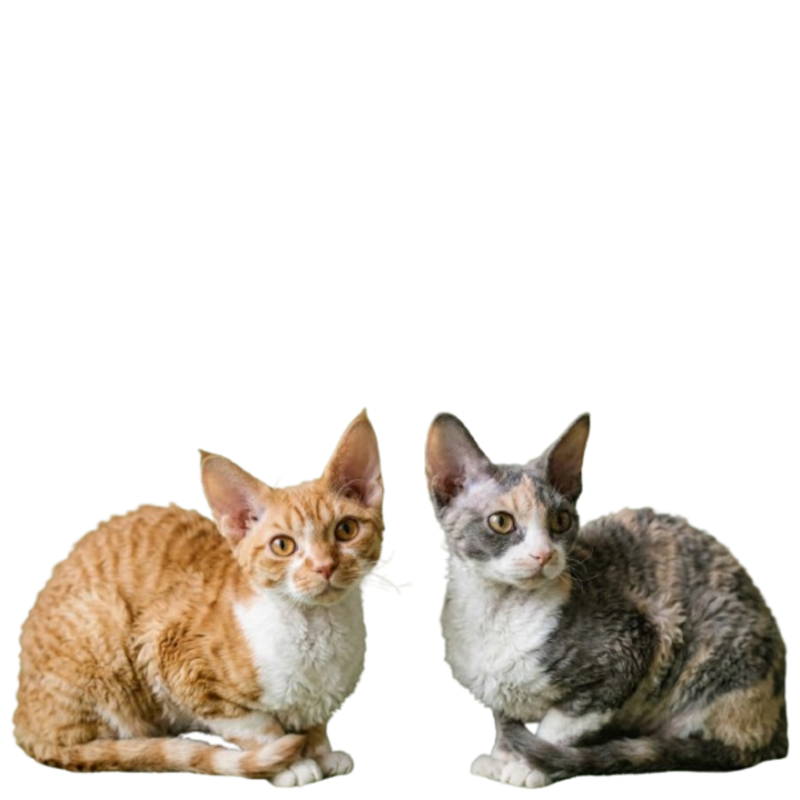
The Devon Rex is a distinctively slender, “pixie-like” feline characterized by a unique combination of coat texture and idiosyncratic skeletal features. The most striking aspect of Devon Rexs is the juxtaposition of large, low-set ears and a wide, short-muzzled head.
Cranial Structure and Facial Features
The head of the Devon Rex is a modified wedge with a series of well-defined curves.
- The Head: Devon Rex’s head is relatively small compared to the body. It features a flat skull and a prominent, curving forehead that leads to a strong “stop” at the bridge of the nose.
- The Muzzle: Short and well-developed, with prominent whisker pads that contribute to a “crabbiness” or “elfin” expression.
- Eyes: Large, oval-shaped, and set wide apart. They are slanted slightly toward the outer edges of the ears.
- Ears: Strikingly large and set very low on the head. They are wide at the base, tapering to rounded tips, and are often covered with fine fur—sometimes featuring “ear muffs” or lynx tips.
The Unique Coat (Rexing)
The defining characteristic of Devon Rexs is the coat texture, which is caused by a lack of or mutation in the guard hairs.
Coat Composition
Unlike most domestic cats, the Devon Rex coat is primarily composed of down and awn hairs. This results in a soft, fine texture that ripples when the cat moves.
Wave Patterns
The fur is typically “rexed,” meaning it grows in waves or ripples rather than straight lines. The density of the wave can be described by the following spatial frequency approximation where represents the wavelength of the ripple:
The “Tightness” of the Curly Wave
- : “Wave Density,” how many curls or ripples are packed into the fur.
- : “Changes With,” a math symbol showing that as waves get longer, the curls look looser.
- : “Wave Length,” the actual distance in millimeters from one curl peak to the next.
To evaluate a show-quality Devon Rex, a judge examines the “Marcel wave” across the back. If a kitten has a loose wave with a wavelength , the is . However, an adult with a tight, dense coat might have a wavelength of only , resulting in an intensity of . Because the intensity is inversely proportional to the wavelength, the smaller gap creates a higher visual “Rexing Intensity,” which is the preferred standard for the breed. If becomes too large, the coat appears “shaggy” rather than “rexed,” which would be noted as a deviation in a professional assessment.
Whiskers and Eyebrows
Devon Rex’s whiskers and eyebrows are typically short, brittle, and crinkled. It is common for these hairs to appear broken or sparse.
Body and Appendages
The Devon Rex possesses a “hard” and muscular body that feels heavier than its appearance suggests.
Torso and Neck
The neck is long and slender, supporting the head at an elegant angle. The chest is broad, and the torso is medium-long, leading to a slender but firm muscular structure.
Legs and Paws
The legs of the Devon Rex are long and slim. Due to the breadth of the chest, the front legs often appear slightly bowed.
| Feature | Description |
|---|---|
| Bone Structure | Fine to medium |
| Musculature | Firm and lean |
| Paws | Small and oval with five toes in front, four in back |
| Tail | Long, fine, and tapering, covered in short fur |
behavior
The behavioral repertoire of the Devon Rex is defined by high-intensity kinesis, complex object manipulation, and specific social proximity requirements. Devon Rexs exhibit a range of actions that distinguish them from more sedentary domestic feline varieties.
Locomotion and Verticality
Devon Rexs prioritize height and rapid movement within their environment.
- Aerial Orientation: The Devon Rex frequently seeks the highest possible vantage point in a room, often utilizing vertical surfaces to reach the tops of doors or shelving.
- Atypical Movement: Due to their specific skeletal leverage, Devon Rex’s gait often includes a rhythmic, spring-like hopping during high-speed transitions.
Environmental Interaction and Problem Solving
The interaction between the Devon Rex and its physical surroundings involves significant cognitive engagement and manual dexterity.
Object Manipulation
The Devon Rex utilizes its paws for tasks that go beyond simple swatting. Observed behaviors include:
- Opening cabinet latches and doors.
- Retrieving small items through the use of tactile scooping.
- Operating light switches or water faucets.
Foraging and Dietary Interest
Devon Rexs demonstrate a persistent interest in human dietary activities. This behavior typically manifests as “food-seeking,” where the Devon Rex will attempt to intercept items directly from a plate or follow the path of a utensil from table to mouth.
Social and Interpersonal Engagement
Devon Rex’s behavior toward humans and other animals is marked by a constant need for physical contact and proximity.
Proximity Seeking
The Devon Rex rarely remains in a separate room from its inhabitants. Common proximity behaviors include:
- Perching: Resting specifically on the shoulders or neck of a human.
- Burrowing: Seeking out heat sources, often resulting in the Devon Rex tunneling under blankets or clothing.
Vocalization and Communication
The Devon Rex employs a specific vocal range to signal intent or demand attention.
| Vocalization Type | Contextual Application |
|---|---|
| Chirp/Trill | Used during greeting or when observing prey through glass. |
| Soft Mew | Typically used to initiate proximity or request food. |
| Repetitive Vocalization | Directed at humans to solicit active play or environmental change. |
Play Mechanics and Energy Expenditure
The play cycle of the Devon Rex is characterized by sustained bursts of activity followed by deep rest.
Fetch and Retrieval
A significant percentage of Devon Rexs naturally engage in retrieval play. This involves the Devon Rex returning a thrown object to the feet of the human to initiate a repeated cycle.
Interactive Duration
The duration of an active play session for the Devon Rex can be modeled by the energy dissipation function , where represents the breed’s metabolic efficiency constant:
How Fast the “Internal Battery” Drains
- : “Current Energy,” how much “zoomie” power is left at any minute ().
- : “Starting Energy,” the 100% full battery at the start of playtime.
- : A math constant used to show how things naturally fade or drop off.
- : “The Burn Rate,” a number representing how fast this active breed uses fuel.
- : “Play Time,” the number of minutes spent running and jumping.
To determine when a Devon Rex will reach its “cooldown” phase, we assume an initial energy level and a high-intensity metabolic constant . After minutes of chasing a feather wand (), the formula calculates the remaining energy: . This simplifies to . While a standard cat might stop playing at energy, the Devon Rex is known to ‘override’ this decay if a new toy is introduced, effectively resetting and , which is why they are often described as having ‘boundless’ or ‘monkey-like’ energy despite their small size.
Despite this decay, Devon Rexs often bypass standard rest intervals if a novel stimulus is introduced.
color
The Devon Rex is recognized in an extensive array of pigmentations and patterns. Because the breed standard permits all known feline colors and markings, Devon Rexs exhibit one of the most diverse chromatic ranges in the domestic feline world.
Solid Color Categories
Solid or “self” colors in the Devon Rex require the pigment to be uniform from the root of the hair to the tip, across the entire dermal surface.
- Black: A dense, coal-black pigmentation without a “rusty” tinge or white hairs.
- Blue: A uniform shade of slate grey, preferably a lighter tone, without shading or ghost markings.
- Chocolate: A rich, warm, milk-chocolate brown.
- Cinnamon: A light reddish-brown, often described as “terracotta” or “burnt sienna.”
- Lavender (Frost/Lilac): A warm, dove-grey with a pinkish tone.
- Red: A deep, clear, brilliant orange-red.
- Cream: A pale, buff-cream without red or apricot undertones.
- White: A pure, glistening white without yellowing.
Patterned and Multi-Color Variations
Devon Rexs frequently display complex patterns involving multiple pigment types.
Tabby Patterns
Tabbies are categorized by specific markings (classic, mackerel, spotted, or ticked). The contrast between the ground color and the marking color is a primary feature of Devon Rex’s chromatic assessment.
Shaded and Smoke
In these varieties, the hair shaft is only partially pigmented. This can be quantified by the ratio of the pigmented tip () to the total hair length ():
The “Sparkle” and Color-Tip Ratio
- : “Color Percentage,” the fraction of the hair that actually has color.
- : “Color Length,” the length of the dark or colored tip of the hair.
- : “Total Length,” the full length of the hair from the skin to the tip.
To distinguish between a “Shaded” and a “Smoke” Devon Rex, a breeder measures a guard hair from the mid-back. If the total hair length and the pigmented tip , the (or ). This confirms the cat is a ‘Shaded’ variety. However, if the pigment extends further down the shaft to , the ratio becomes (or ), classifying the Devon Rex as a ‘Smoke.’ This distinction is vital for show benching, as the visual ‘sparkle’ of the coat is determined by how much of the silver-white undercoat remains visible.
- Smoke: A deep pigmentation covering approximately to of the hair length.
- Shaded: Pigmentation covering approximately of the hair length.
- Chinchilla: Pigmentation limited to the extreme tips (approximately of the length).
Calico, Bi-Color, and Tortoiseshell
These involve combinations of two or more colors, often with white.
| Pattern Type | Color Distribution Characteristics |
|---|---|
| Bi-Color | White plus any other solid or tabby pattern. |
| Tortoiseshell | Black and red (or their dilute versions, blue and cream) intermingled. |
| Calico | White with distinct patches of black and red. |
Pointed and Mink Variations
The Devon Rex is also found in patterns where pigment is restricted primarily to the extremities (face, ears, paws, and tail).
- Pointed (Siam-style): Strong contrast between a pale body and dark points.
- Mink (Tonkinese-style): Medium contrast between body and points, often associated with specific ocular hues.
- Sepia (Burmese-style): Subtle contrast with a rich, full-bodied color.
Ocular Coloration and Integumentary Pigment
Devon Rex’s eye color is generally expected to harmonize with the coat color, although odd-eyed (heterochromia) white Devon Rexs are recognized. Additionally, the skin pigment on the nose leather and paw pads corresponds to the dominant coat color—for instance, “brick red” leather for red tabbies or “lavender-pink” for lilac Devon Rexs.
compatibility
Ease of Maintenance
Rating: 5/5
Child Friendly
Rating: 5/5
Annual Cost
Rating: 3/5
Lifetime Cost
Rating: 3/5
Adaptability
Rating: 5/5
Velcro Factor
Rating: 5/5
Quietude
Rating: 3/5
Apartment Suitability
Rating: 4/5
Hypoallergenic
Rating: 4/5
Handling Tolerance
Rating: 5/5
Hardiness/Longevity
Rating: 4/5
Prey Drive
Rating: 3/5
genetics
The genetic profile of the Devon Rex is centered around a specific mutation affecting hair follicle development and keratin structure. This mutation is distinct from those found in other wavy-coated feline varieties.
The Autosomal Recessive Nature of the re Gene
The primary determinant for the unique coat of the Devon Rex is a mutation at the re locus. This trait is inherited in a strictly autosomal recessive manner.
Mendelian Inheritance Patterns
For the phenotypic expression of the trait to occur, an individual must be homozygous for the recessive allele (). If a Devon Rex is crossed with a straight-coated cat carrying no recessive alleles (), the entire generation will possess straight coats but function as obligate carriers ().
The probability of a phenotypically “rexed” offspring from two carrier parents () follows the standard Mendelian ratio:
Odds of Getting a Curly Kitten
- : “The Curly Chance,” the probability that a kitten will have wavy fur.
- : The “One-in-Four” rule (25%) when two straight-haired carrier parents mate.
In a breeding program aimed at expanding the gene pool, a breeder mates two ‘variants’—straight-coated cats that are known carriers of the mutation (). If the resulting litter consists of kittens, we apply the probability to predict the outcome. Mathematically, , suggesting that kittens will express the curly Devon Rex coat, while the remaining will have straight coats. Among those straight-coated kittens, statistical probability further dictates that will be ‘obligate carriers’ () and will be ‘non-carriers’ (), highlighting why genetic testing is essential for identifying future breeding stock within the Devon Rexs community.
Comparison of Rex Loci
Genetic testing has confirmed that the mutation in Devon Rexs is located at a different locus than the Cornish Rex (r locus). Consequently, these mutations are non-complementary.
| Cross Type | Expected Offspring Phenotype |
|---|---|
| Devon Rex (rere) Devon Rex (rere) | 100% Devon Rex coat |
| Devon Rex (rere) Cornish Rex (rr) | 100% Straight coat (double carriers) |
Molecular Biology: The KRT71 Mutation
The specific gene responsible for the Devon Rex phenotype is Keratin 71 (KRT71). This gene encodes a protein essential for the cornification of the inner root sheath of the hair follicle.
Protein Structure Disruption
In Devon Rexs, a mutation—typically a splice-site mutation—leads to a functional change in the type II keratin protein. This disruption alters the structural integrity of the hair shaft.
The relationship between the protein folding energy and the stability of the hair shaft structure can be conceptually represented as:
The Strength of the Fur’s Structure
- : “Devon Strength,” the energy holding together the Devon Rex’s curly hair proteins.
- : “Normal Strength,” the energy holding together standard straight hair proteins.
- : “Is Weaker Than,” showing that the curly protein isn’t as sturdy as the straight kind.
To analyze the microscopic ‘fragility’ of the Devon Rex’s coat, we compare the energy required to maintain a straight hair shaft. If a standard cat’s keratin has a folding stability of , the mutated splice-site keratin in the Devon Rex might only reach . Because (meaning it is less negative and thus less stable), the protein lacks the ‘stiffness’ to support a straight, vertical shaft. Under the physical stress of growth, the hair shaft collapses into the characteristic ‘Marcel wave’ instead of standing upright. This lower stability also explains why the Devon Rex’s whiskers are often brittle and prone to breaking compared to the more stable found in wild-type feline keratin.
This lower stability results in the characteristic “wave” rather than a straight, rigid shaft.
Genetic Diversity and Outcrossing
To maintain chromosomal health within the population, outcrossing is utilized. This introduces genomic variation while the re allele is maintained through strategic backcrossing.
Genomic Mapping
Modern mapping shows that the KRT71 gene is situated on feline chromosome E1. Research into Devon Rex’s DNA involves identifying Single Nucleotide Polymorphisms (SNPs) to ensure the preservation of the recessive trait alongside a diverse genetic background.
Phenotypic Variance in Heterozygotes
While the trait is recessive, some genomic studies suggest that carriers () may occasionally exhibit a slightly different hair texture than homozygous dominant individuals (), though they do not display the full Devon Rex phenotype.
health
The physiological landscape of the Devon Rex involves several breed-specific vulnerabilities and hereditary conditions that require clinical monitoring. These conditions primarily affect the cardiovascular system, the neuromuscular junction, and the integumentary system.
Hypertrophic Cardiomyopathy (HCM)
The most prevalent cardiac concern within Devon Rexs is Hypertrophic Cardiomyopathy. This condition is characterized by an idiopathic thickening of the left ventricular myocardium, which reduces the volume of the ventricular chamber and impairs diastolic function.
Clinical Presentation and Diagnostics
Diagnosis is typically achieved through echocardiography. The thickening can be modeled by measuring the left ventricular wall thickness () over time (). In affected Devon Rexs, the rate of change is significantly higher than in healthy populations:
Heart Wall Thickness and Health Tracking
- : “Wall Thickness,” the size of the heart’s main pumping chamber wall in millimeters.
- : “The Change In,” a math marker looking at the difference between two measurements.
- : “Time Gap,” the number of months or years between vet checkups.
- : “Is Increasing,” a warning sign that the heart muscle is getting too thick over time.
To monitor a Devon Rex predisposed to HCM, a veterinary cardiologist performs two scans. At months, the is . At months (), the has increased to . The rate of change is . Because , the model confirms a positive progression of the disease. In a healthy Devon Rex, the would remain constant (e.g., to ), resulting in a rate of , which does not satisfy the ‘greater than zero’ requirement for active HCM modeling.
Clinical signs often remain occult until the disease reaches an advanced stage, manifesting as congestive heart failure or thromboembolism.
Neuromuscular Disorders: Devon Rex Myopathy
Specific to this lineage is a hereditary condition historically referred to as spasticity. This is a congenital myasthenic syndrome that impacts the transmission of signals between nerves and muscles.
Mechanism of Action
The disorder results from a localized deficiency in the synaptic structure of the neuromuscular junction. Affected Devon Rexs exhibit localized muscle weakness, particularly in the cervical region.
- Cervical Ventriflexion: A common symptom where the Devon Rex is unable to maintain the head in an upright position.
- Protruding Scapulae: Weakness in the pectoral girdle causes the shoulder blades to appear unusually prominent during locomotion.
Dermatological and Otic Vulnerabilities
The unique skin environment of the Devon Rex creates a predisposition for specific dermatological issues—largely due to the altered distribution of cutaneous lipids.
Malassezia Dermatitis
The Devon Rex frequently experiences overgrowth of Malassezia yeast. This is particularly prevalent in areas of high friction or folds.
| Clinical Area | Manifestation in the Devon Rex |
|---|---|
| External Ear Canal | Excessive production of dark, waxy sebum (Ceruminous otitis). |
| Nail Beds | Accumulation of oily debris leading to paronychia. |
| Ventral Surface | Erythema and pruritus due to yeast colonization. |
Urticaria Pigmentosa
Devon Rexs may develop cutaneous mastocytosis, resulting in pigmented macules and crusting sores, often triggered by inflammatory responses or external irritants.
Patellar Luxation
Orthopedic health in the Devon Rex is often centered on the stability of the stifle joint. Patellar luxation occurs when the patella (kneecap) displaces from the trochlear groove of the femur.
Grading Scale
The severity of the displacement in Devon Rex’s hind limbs is categorized on a four-point scale:
- Grade I: Manual luxation is possible, but the patella returns spontaneously.
- Grade II: Frequent luxation occurs during flexion; requires manual reduction.
- Grade III: The patella remains luxated most of the time but can be reduced manually.
- Grade IV: Permanent luxation where manual reduction is impossible.
Coagulopathy: Vitamin K-Dependent Factors
Some lineages of the Devon Rex have shown a predisposition for a hereditary coagulopathy related to the vitamin K cycle. This results in a deficiency of clotting factors II, VII, IX, and X. Without intervention, affected Devon Rexs are at risk for spontaneous hemorrhage or prolonged bleeding during surgical procedures.
longevity
The life span of the Devon Rex is a primary metric of its long-term biological viability within domestic environments. Statistical data indicates that Devon Rexs generally possess a life expectancy that aligns with or slightly exceeds the average for domestic feline breeds.
Statistical Life Span Averages
Based on actuarial data from feline registries and longitudinal veterinary studies, the typical life expectancy for a healthy Devon Rex is situated within a specific range.
| Category | Years |
|---|---|
| Standard Range | 9 to 15 years |
| Median Age | 12.5 years |
| Maximum Recorded | 18+ years |
Survival Probability Modeling
The probability of a Devon Rex reaching a specific age can be modeled using a survival function. For Devon Rexs, the curve typically remains high throughout the first decade, with a steeper decline in the transition from late maturity to the geriatric phase.
The Probability of Reaching a Target Age
- : “Survival Probability,” the percentage of cats that reach a certain age.
- : “The Odds,” the mathematical likelihood (from 0 to 1).
- : “Actual Life Span,” how long a specific cat actually lives.
- : “Target Age,” the specific birthday we are checking (like 15 or 18 years).
- : “Goes Beyond,” meaning the cat lives past that target age.
To calculate the probability of a Devon Rex reaching its geriatric phase, we look at a population study where out of cats reached age . Here, . If we want to find the probability of a specific Devon Rex reaching years (), and the data shows only cats out of the original survived that long, the formula yields . This survival probability helps owners and veterinarians decide on the intensity of geriatric screenings as the cat approaches the ‘steeper decline’ portion of the survival curve.
Life Stages and Age Classification
The chronological aging process of the Devon Rex is divided into distinct biological phases. Understanding these stages is essential for quantifying Devon Rex’s developmental milestones and senescence.
Developmental and Mature Phases
- Junior (Birth to 2 years): The period of rapid somatic growth and reproductive maturation.
- Prime (3 to 6 years): The peak of physiological vigor.
- Mature (7 to 10 years): The transitional phase where metabolic rates begin to decelerate.
Senior and Geriatric Phases
Devon Rexs entering the senior phase (11 to 14 years) and geriatric phase (15+ years) exhibit biological markers of aging. In this stage, the mortality rate increases, which can be expressed by the Gompertz-Makeham law of mortality:
The Biological Clock and Aging Risk
- : “Total Risk,” the immediate health risk at a specific age.
- : “Current Age,” how old the cat is now in years.
- : “Breed Starting Risk,” the natural health baseline for this specific breed.
- : A math constant for exponential (fast) growth.
- : “Aging Speed,” how fast the body’s systems naturally decline.
- : “General Safety,” the risk from outside things (like accidents or indoor hazards).
To calculate the mortality risk for a -year-old geriatric Devon Rex (), we use breed-specific constants: an initial vulnerability , a senescence rate , and a low age-independent risk for an indoor cat. The formula becomes: . Calculating the exponent: . Then, . Adding : . This suggests a immediate annual risk of mortality at age . If the same cat was only , the risk would drop significantly to , mathematically illustrating the ‘steep decline’ in vitality as the Devon Rex moves deeper into the geriatric phase.
Impact of Environmental Variables on Longevity
While biological factors provide the baseline for life expectancy, environmental variables significantly influence the actual age attained by an individual Devon Rex.
Indoor vs. Outdoor Lifestyle Factors
Actuarial data consistently demonstrates a correlation between strictly indoor environments and increased longevity in Devon Rexs. The elimination of external hazards—such as predation, vehicular accidents, and infectious disease transmission—results in a statistically significant shift in the survival curve.
Comparative Longevity Data
When compared to other feline varieties, the Devon Rex demonstrates a robust survival rate.
| Breed Group | Average Life Span (Years) |
|---|---|
| Devon Rex | 12-15 |
| Mixed Breed (Indoor) | 13-17 |
| Purebred Average | 10-13 |
Geriatric Transitions in the Devon Rex
As Devon Rexs approach their second decade, physiological changes indicate the final stages of the life cycle. The deceleration of cellular repair mechanisms and the gradual decline in organ function efficiency are the primary drivers of natural senescence in the Devon Rex. Successful progression into the late geriatric stage (18 years and beyond) is often attributed to the synergy of favorable environmental conditions and the lack of early-onset chronic systemic failure.
maintenance
The physiological configuration of the Devon Rex necessitates a specialized maintenance regimen. Due to the specific structure of the integumentary system and the overproduction of certain glandular secretions, standardized feline care routines must be modified.
Integumentary Care and Hygiene
The primary focus of Devon Rex maintenance is the management of cutaneous lipids. Unlike most domestic cats, the Devon Rex does not possess sufficient primary guard hairs to wick oils away from the epidermis.
Cleansing Frequency and Methodology
To prevent the accumulation of sebum, regular bathing is required. The frequency depends on the individual Devon Rex’s lipid production rate, typically ranging from bi-weekly to monthly intervals.
- Solution Selection: Use only mild, pH-balanced feline surfactants.
- Temperature Regulation: Maintain water at approximately 38°C to prevent thermal stress or chilling.
- Drying Protocol: Pat the skin dry using highly absorbent micro-fiber materials to avoid mechanical irritation of the delicate follicles.
Otic and Digital Maintenance
Devon Rexs exhibit a high density of sebaceous glands within the ear canals and around the nail beds, requiring targeted intervention.
Aural Hygiene
The external ear canal of the Devon Rex often accumulates dark, waxy cerumen. Failure to manage this can lead to secondary complications.
- Inspection: Perform weekly checks for excessive buildup.
- Extraction: Utilize a veterinarian-approved ceruminolytic solution.
- Application: Gently wipe the accessible portions of the pinna; avoid deep insertion into the canal.
Ungual and Digital Care
The nail folds of Devon Rexs are prone to collecting a thick, oily residue.
- Cleaning: Use a soft, damp cloth to remove debris from the base of each claw.
- Trimming: Maintain the claw length using standard feline guillotine or scissor-style trimmers.
Dental Prophylaxis
Oral maintenance for the Devon Rex follows standard carnivorous requirements but is emphasized due to the systemic impact of oral bacteria.
| Technique | Frequency | Objective |
|---|---|---|
| Mechanical Brushing | Daily or tri-weekly | Removal of soft plaque (biofilm) |
| Enzymatic Gels | As needed | Chemical breakdown of bacterial deposits |
| Professional Scaling | Annual | Removal of calcified tartar (calculus) |
The accumulation of calculus () over time () can be approximated as a function of plaque mineralization:
The Buildup of Tartar Over Time
- : “Total Tartar,” the amount of hard buildup on the teeth at time ().
- : “The Accumulator,” a math symbol that adds up every tiny bit of buildup day by day.
- : “Clean Slate,” the day of a professional dental cleaning.
- : “Days Elapsed,” how many days have passed since the teeth were cleaned.
- : “Hardening Speed,” how fast soft plaque turns into hard tartar.
To determine the optimal cleaning interval for a Devon Rex, we track the mineralization rate. If a specific cat has a high-alkaline saliva pH resulting in a constant mineralization rate of , the calculus accumulation over one year () is calculated as: . This evaluates to . If the clinical threshold for gingivitis in a Devon Rex is , this mathematical model proves that a -month cleaning cycle is insufficient for this individual, and the owner should shift to an -month (-day) interval, where , to keep the cat below the inflammatory threshold.
Environmental and Thermal Management
Maintenance of the Devon Rex includes the regulation of the immediate physical environment to compensate for reduced natural insulation.
Ambient Temperature Optimization
Devon Rexs require a consistent thermal baseline. If the ambient temperature falls below a certain threshold, supplemental heat sources are necessary to maintain the Devon Rex’s core body temperature .
The Minimum Comfort Temperature
- : “Room Temp,” the actual temperature of the cat’s house.
- : “Must Be At Least,” showing the room shouldn’t get colder than the target.
- : “The Chilly Line,” the magic number (about 72°F) where this thin-coated breed stays warm.
To ensure the comfort of a Devon Rex during a winter night, an owner checks the thermostat. If the living room sensor reads , the formula returns a ‘False’ state. Because the temperature has dropped below the baseline, the cat’s body must increase its metabolic rate to maintain a of . To correct this, the owner provides a heated pet mat set to or dresses the Devon Rex in a fleece sweater. These interventions effectively raise the immediate micro-environment temperature to , satisfying the requirement and allowing the cat to rest without shivering.
Protection from Ultraviolet Radiation
Due to the lack of a dense protective canopy of fur, the Devon Rex is susceptible to solar radiation. Maintenance involves restricting access to direct high-intensity sunlight during peak UV hours to prevent epidermal damage.
measurements
| Measurement | Female | Male | ||
|---|---|---|---|---|
| Metric | Imperial | Metric | Imperial | |
height | 23 – 28 centimeters | 9 – 11 inches | 25 – 30 centimeters | 10 – 12 inches |
length | 35 – 41 centimeters | 14 – 16 inches | 38 – 46 centimeters | 15 – 18 inches |
weight | 2.3 – 3.6 kilograms | 5 – 8 pounds | 3.6 – 4.5 kilograms | 8 – 10 pounds |
• Height: Refers to the measurement at the withers (shoulders).
• Length: Measured from the tip of the nose to the base of the tail.
origin
The history of the Devon Rex is a documented instance of a spontaneous biological occurrence within a specific geographic and temporal context. The lineage is traced back to a singular event in the mid-20th century in South West England.
The Initial Discovery in Buckfastleigh
The provenance of the Devon Rex began in 1960 in the town of Buckfastleigh, located in Devon, England. This discovery occurred when Beryl Cox encountered a unique stray male residing near a local disused tin mine.
Kirlee: The Foundation Individual
A specific offspring, a male named Kirlee, was born to a feral female that had mated with the aforementioned inhabitant of the mine area. Kirlee is recognized as the progenitor of all subsequent Devon Rexs.
Early Breeding Programs and Breed Recognition
Following the identification of Kirlee, efforts were initiated to establish a sustainable population and secure formal recognition from feline governing bodies.
Integration with the Cornish Rex Lineage
Initially, researchers hypothesized that the mutation in the Devon Rex was identical to the one found in the Cornish Rex, which had emerged ten years prior in the neighboring county. However, test matings conducted in 1960 and 1961 yielded results that indicated a biological distinction between the two groups.
The probability of the two mutations being identical () was disproven when the cross-breeding produced only straight-coated offspring, as expressed by the logic of non-complementation:
The “Unique Gene” Proof
- : “The Devon Parent,” a curly cat from the Devon mutation.
- : “Breeding Match,” a cross between two different curly breeds.
- : “The Cornish Parent,” a curly cat from the Cornish Rex mutation.
- : “Result,” the appearance of the kittens.
- : “Straight Fur,” proof that the two curly parents have different “broken” genes that fix each other.
To prove that the Devon Rex was a unique mutation, 1960s researchers performed a test cross. They mated a curly-coated Devon Rex () with a curly-coated Cornish Rex (). If the mutations were the same, of the kittens would have been curly. Instead, the formula resulted in ‘Wild Type’ (straight-coated) kittens with the genotype . Because each parent provided a dominant ‘wild-type’ allele to mask the other’s recessive mutation, the experiment mathematically proved that the Devon Rex’s curls are governed by a distinct gene located at a different position on the feline genome.
Formal Registration Milestones
The path to official status involved several key international organizations.
| Organization | Year of Recognition |
|---|---|
| Governing Council of the Cat Fancy (GCCF) | 1967 |
| Fédération Internationale Féline (FIFe) | 1968 |
| Cat Fanciers’ Association (CFA) | 1979 |
Global Expansion and Demographic Stabilization
After achieving recognition in the United Kingdom, the Devon Rex was exported to North America and Continental Europe to expand the breeding pool.
Arrival in North America
The first Devon Rexs arrived in the United States in approximately 1968. These individuals served as the foundation for the North American branch of the Devon Rex’s history. Throughout the 1970s, the population grew through carefully managed programs designed to preserve the original traits discovered in Buckfastleigh.
Establishment of the Breed Standard
The formalization of Devon Rex’s history concluded with the definitive separation of the breed from other “Rex” varieties in official registries—this separation ensured that the historical identity of the Devon Rex remained tied exclusively to its Devonshire roots rather than being categorized as a subset of other wavy-coated varieties.
temperament
The temperament of the Devon Rex is characterized by a high degree of cognitive engagement and a specialized emotional orientation toward human companions. Unlike many domestic felines that maintain a solitary or independent disposition, the Devon Rex possesses a personality structure that is inherently social and interdependent.
Core Emotional and Social Orientation
The Devon Rex’s emotional state is defined by a consistent requirement for social proximity. This is not merely a preference but a fundamental component of the Devon Rex’s psychological well-being.
Inter-species Attachment and Bonding
Devon Rexs exhibit an intense level of devotion that often mirrors canine social structures. They categorize their human counterparts as essential social anchors. This bonding is characterized by:
- Persistent Proximity Seeking: A constant desire to occupy the same physical space as their primary caregivers.
- Adaptive Social Intelligence: An ability to interpret and mirror human emotional cues.
- High Trust Threshold: A generally fearless and welcoming attitude toward strangers and other household animals.
Cognitive and Intellectual Disposition
The Devon Rex is defined by an inquisitive and high-functioning intellect. Their mental state is one of active observation and analysis of their immediate surroundings.
Curiosity and Investigative Drive
The Devon Rex’s temperament includes a profound investigative drive. If a new object or person enters the environment, the Devon Rex will typically prioritize exploration over caution. This can be quantified by the Devon Rex’s high novelty-seeking () score in feline personality assessments.
The “Monkey-Cat” Curiosity Score
- : “Curiosity Rating,” how badly the cat wants to explore new things.
- : “Is Proportional To,” showing that more touches equal more curiosity.
- : “Touch Count,” how many times the cat pokes, sniffs, or bats at something.
- : “New Objects,” how many new things were put in the room.
To measure the curiosity of a Devon Rex compared to a more cautious breed, a researcher introduces new object (a mechanical toy) into a room. While a standard cat might watch from a distance ( interaction per change), the Devon Rex typically records an of (sniffing, batting, and climbing on the object) within the same . This results in an that is higher than the baseline. If the owner introduces new grocery bags, the Devon Rex’s high predicts they will perform at least distinct investigative actions, mathematically illustrating why the breed is often nicknamed the ‘Monkey in a Cat Suit.’
Learning Propensity
Due to their attentive nature, Devon Rexs possess a notable aptitude for associative learning. Their psychological makeup thrives on mental stimulation; in the absence of such engagement, they may experience boredom-induced stress.
Sociability and Gregariousness Scales
The following table categorizes the common temperamental traits of the Devon Rex relative to the standard domestic feline baseline:
| Temperamental Trait | Intensity Level | Description |
|---|---|---|
| Social Extraversion | High | Active seeking of interaction with diverse social groups. |
| Emotional Dependency | Elevated | Strong reliance on social cues and physical contact. |
| Aggression Threshold | Low | Significant tolerance for handling and environmental noise. |
| Adaptability | High | Quick recovery from changes in territory or routine. |
Dispositional Resilience
Devon Rexs are noted for their psychological resilience. While sensitive to social isolation, they are remarkably stable in their moods and lack the skittishness or defensive posturing common in more aloof breeds. The Devon Rex’s default temperamental setting is one of optimistic engagement—viewing the environment as a series of opportunities for social and intellectual interaction.