Birman Cat
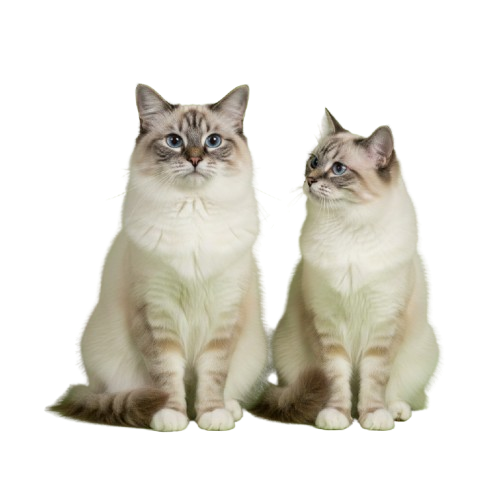
appearance
The Birman is defined by a substantial and harmonious physical presence. It is characterized as a medium-to-large cat with a heavy-boned, stocky frame that conveys both power and elegance. Its most identifying features include a specialized coat texture and a strictly defined pattern of white extremities.
Facial Features and Head Shape
The facial structure of the Birman is designed to project a soft, pleasant expression. It avoids the extreme angularity found in many other oriental-derived breeds.
Skull and Muzzle
The head is characterized by a strong, wide jaw and a slightly arched forehead. The nose is medium in length with a gentle dip in the profile, leading to a well-developed muzzle and a firm, vertical chin.
Eyes
A primary hallmark of the Birman is the eyes, which are nearly circular and must exhibit a deep, luminous sapphire blue.
Ears
These are medium in size and positioned with significant space between them, featuring rounded tips.
The Body and Conformation
The Birman’s build is solid and powerful, often categorized as a semi-cobby type. This structure provides the cat with a grounded, sturdy appearance.
Structural Proportions
The frame of the Birman is long and muscular. The relationship between the vertical height from the floor and the horizontal body length generally maintains a specific ratio:
Body Shape and Balance Rule
- : The “Body Length,” measured from the chest to the base of the tail.
- : A symbol meaning “should be about.”
- : The “Length Multiplier” that gives the Birman its sturdy, rectangular look.
- : The “Shoulder Height,” from the floor to the top of the shoulder blades.
If a Birman stands tall at the shoulder (), we can calculate its ideal proportional length: . This results in an ideal body length of . If a specific cat measures in length for that same height, it may appear overly elongated, whereas a length of would indicate a more “compact” or “cobby” frame than the Birman’s standard calls for.
General Description
| Feature | Description |
|---|---|
| Torso | Lengthy and robust with significant muscle mass. |
| Legs | Strong, of medium height, and thick in diameter. |
| Paws | Large and rounded with firm padding. |
| Tail | Luxuriously plumed and proportional to the torso length. |
Coat and Texture
The Birman’s fur is a semi-long, single-layered coat. A significant genetic advantage for the Birman is the silk-like texture, which lacks the dense, woolly undercoat that typically leads to severe matting in other longhaired felines.
Ruff
A thick collar of fur often develops around the neck, particularly in mature males.
Texture
The fur feels remarkably smooth and light, drifting back into place when the cat moves.
The Point Pattern and Coloration
Birmans are part of the colorpoint group, meaning pigment is restricted to the facial mask, ears, legs, and tail. The main body should remain a pale, contrasting shade—often described as a light cream or eggshell—which may develop a warm golden tint as the cat matures.
The Gloves and Laces
The white markings on the paws are the most technically demanding aspect of the Birman’s appearance and are essential for breed verification.
Front Paws (Gloves)
On the forelegs, the white pigment should ideally stop in a clean, straight line across the knuckles of the toes, covering only the paw itself.
Hind Paws (Laces)
The white markings on the rear legs, referred to as laces, must extend further than the front gloves. These should travel up the back of the leg to form a distinct point.
Back-Leg “Gauntlet” Color Symmetry
- : The “Lace Area,” the white fur markings on the back of the rear legs.
- : A symbol meaning “grows along with.”
- : The distance from the cat’s “heel” down to the paw.
In a competitive show evaluation of Birmans, a judge measures the hock length as . According to the “halfway” ideal (), the should ideally terminate at a point exactly up from the heel. If the white extends only (low laces) or climbs (high laces), the proportionality is lost. This mathematical symmetry ensures that the “gauntlets” of the Birman appear balanced regardless of whether the individual cat is a large male or a smaller female.
In a well-marked Birman, these laces taper to a point located roughly halfway to the hock, as detailed below:
| Marking | Location | Ideal Symmetry |
|---|---|---|
| Gloves | Forepaws | A uniform, horizontal boundary at the toe joints. |
| Laces | Rear Legs | A symmetrical inverted “V” rising toward the hock. |
Summary of Appearance
The overall impression of the Birman is one of balance and weight. They are designed to be substantial felines that pair a rugged, muscular body with a silky, ethereal coat and the striking precision of their blue eyes and white-gloved paws.
behavior
While temperament involves the internal nature of the cat, the behavior of the Birman focuses on the specific, observable actions and social routines this breed typically displays. Birmans are frequently characterized by an “inquisitive assistant” behavior, where they actively integrate themselves into the daily life of their human household.
Social Interaction and Engagement Patterns
The social conduct of the Birman is defined by a desire for participation. They are not passive observers; they prefer to be involved in the center of domestic activity.
The Proactive Companion
A hallmark behavior of the Birman is the tendency to follow household members between rooms. This is rarely a demand for immediate resources like food; rather, the Birman simply wishes to monitor and “assist” with tasks—whether that involves sitting on a laptop, inspecting laundry, or watching the preparation of a meal.
Reception of Visitors
In social settings, Birmans generally demonstrate a confident and welcoming demeanor. They typically approach newcomers with a gentle curiosity, using their scent glands to investigate visitors before settling nearby to observe the gathering.
Communication and Vocalization
While communicative, Birmans maintain a sophisticated and quiet vocal profile, prioritizing subtle physical signals over loud vocalizations.
Vocal Quality
When the Birman chooses to speak, the sound is usually a soft, rhythmic trill or a delicate “chirrup” instead of a sharp or repetitive meow.
Tactile Communication
A common Birman’s habit is the “silent tap”—using a soft, gloved paw to gently touch an owner to request attention or to express interest in an object.
Visual Language
They frequently use “slow blinking” and sustained, soft eye contact to reinforce social bonds and communicate a lack of threat.
Activity Cycles and Play Mechanics
The energy levels of the Birman are typically balanced—avoiding the extremes of hyperactivity or total lethargy.
Play Preferences
Birmans generally favor ground-based play over vertical climbing. They are notably skilled at “retrieval” games, often carrying small plush toys in their mouths back to their owners. This behavior highlights their high level of focus and desire for interactive engagement.
Circadian Patterns
The daily activity of the Birman over time often follows a bimodal distribution, with the highest levels of movement occurring during dawn and dusk:
Daily Energy Peaks and Play Cycle
- : The “Activity Level” of the Birman at a specific time of day.
- : The “Peak Energy,” representing the high-activity bursts at dawn and dusk.
- : The “Companion Baseline,” the steady, calm presence the cat maintains throughout the day.
- : A math rule that creates energy peaks every 12 hours.
Suppose a Birman has a peak energy factor and a baseline companion factor . To find their activity level at 6:00 PM (), we calculate: . Since and , the result is . Conversely, at noon (), , so . This shows that while the Birman is 6 times more active during their evening “zoomies,” they never drop to zero activity, maintaining a consistent level of companionship throughout the day.
In this model, signifies the peak energy during crepuscular hours, while represents the steady “companion” activity maintained during the rest of the day.
Environmental Interaction and Habits
Birmans display specific preferences in how they navigate and utilize their living space.
| Behavior Category | Common Observation |
|---|---|
| Vertical Space | Most prefer mid-level surfaces like sofas or desks over high-altitude perches. |
| Self-Maintenance | They are exceptionally diligent groomers, spending significant time on their silk-textured fur. |
| Sleep Posture | Often found in a “belly-up” position, signifying total comfort and a high degree of trust in their environment. |
| Exploratory Style | They tend to be cautious and methodical when encountering new objects or spaces. |
Nutritional Manners and Feeding Habits
The Birman is typically a methodical eater, showing a preference for a refined and consistent feeding routine.
Sensory Preferences
Birmans are often sensitive to the tactile sensation of their food. If a Birman is dissatisfied with a specific texture or the cleanliness of their station, they may perform a “scrubbing” motion with their paws on the floor—an instinctive behavior related to caching food in the wild.
Social Diplomacy with Other Pets
In homes with multiple animals, the Birman’s behavior is remarkably diplomatic. They generally seek to avoid conflict through the use of de-escalating body language. This non-confrontational approach allows the Birman to integrate seamlessly into households that include calm dogs or other feline companions.
color
The Birman is a colorpointed feline, a trait resulting from a genetic form of temperature-sensitive albinism. This biological mechanism ensures that pigment is concentrated only on the cooler extremities—specifically the face, ears, legs, and tail—while the warmer core of the body remains pale. The hallmark of a high-quality Birman is the sharp, clean contrast between these dark points and the light-colored torso.
The Point System and Body Contrast
In a typical Birman, the body fur should be uniform and clear, often displaying a warm, golden hue frequently likened to the color of eggshell or golden-cream.
Genetics of Pointed Coloration
The depth of the point color in Birmans is regulated by the tyrosinase enzyme. The biochemical production of melanin in the extremities can be represented as a function of the skin’s surface temperature :
Skin Temperature and Fur Darkness Rule
- : The “Pigment Amount,” how much dark color is made at a certain temperature.
- : The “Surface Heat” of the skin at a specific body part.
- : The “Shutdown Temp” (about ) where color-making stops.
- : The “Color Depth,” based on the specific genetic shade (like Seal or Lilac).
In a Birman, the core body temperature is typically , which is equal to . Therefore, on the torso, , resulting in a pale eggshell coat. However, the tip of the tail may have a surface temperature of only . If the cat has a Seal point coefficient of , the melanin concentration is . This explains why the Birman’s extremities—ears, face, legs, and tail—develop deep pigment while the warmer body remains light.
Here, represents the concentration of melanin, and is the specific thermal limit above which the pigment-producing enzyme loses its activity.
Recognized Color Varieties
While the foundational Birman was primarily recognized in Seal Point, contemporary breeding programs have introduced a wider spectrum of approved shades.
| Variety | Point Coloration | Body Shade |
|---|---|---|
| Seal Point | Rich, dark seal brown. | Pale fawn to warm cream. |
| Blue Point | Slate or silvery blue. | Cold bluish-white. |
| Chocolate Point | Warm, milk-chocolate brown. | Ivory with no grey undertones. |
| Lilac Point | Silvery-grey with a pinkish tint. | Glacial, cool white. |
| Red Point | Bright apricot to vivid orange-red. | Creamy white. |
| Cream Point | Soft, warm buff-cream. | Pure white to light cream. |
Tabby and Tortie Pattern Variations
Modern standards for Birmans also permit Lynx (Tabby) and Tortie patterns within the pointed areas.
Lynx Points
In a Lynx Point Birman, the pigmented areas are defined by clear, dark striations against a paler background. A prominent “M” shaped marking on the forehead is required, alongside distinct horizontal stripes on the cheeks and spotted whisker pads.
Tortie Points
The Tortie Point Birman features points that are mottled or patched with red or cream highlights. Because the orange gene is X-linked, this specific pattern is almost exclusively found in female individuals.
The Pristine White Markings
A unique requirement for the Birman—setting it apart from other pointed cats—is the presence of pure white paws. These markings must be clearly defined and free from any colored spots.
Front Gloves
On the forepaws, the white pigment should cover the toes and ideally terminate in a symmetrical, horizontal line where the paw meets the leg joint.
Hind Laces (Gauntlets)
The white markings on the rear legs, known as laces, must cover the foot and extend upward along the back of the leg. Further details are as follows:
- Length: These markings should end between and of the distance to the hock.
- Shape: They must taper to a point, forming a clear inverted “V” shape.
Eye Color Requirements
A non-negotiable trait for any Birman is the eye color. Regardless of the specific point shade, the eyes must be a deep, saturated blue. Breed enthusiasts value a vivid sapphire intensity; eyes that appear pale, greyish, or watery are considered a significant departure from the Birman’s ideal. This striking blue gaze provides the final, essential component of the breed’s visual identity.
compatibility
Ease of Maintenance
Rating: 4/5
Child Friendly
Rating: 5/5
Annual Cost
Rating: 3/5
Lifetime Cost
Rating: 3/5
Adaptability
Rating: 4/5
Velcro Factor
Rating: 5/5
Quietude
Rating: 4/5
Apartment Suitability
Rating: 5/5
Hypoallergenic
Rating: 2/5
Handling Tolerance
Rating: 5/5
Hardiness/Longevity
Rating: 4/5
Prey Drive
Rating: 4/5
genetics
The biological blueprint of the Birman results from a precise combination of several genetic loci. While many felines share individual characteristics with this cat, the specific convergence of the Himalayan allele, the long-hair mutation, and the recessive gloving gene produces the distinct phenotype of the Birman.
The Himalayan Gene (Colorpoint Restriction)
The most prominent genetic driver in the Birman is the allele, which belongs to the albino series at the locus. This mutation produces a temperature-sensitive form of tyrosinase—an enzyme that restricts the development of pigment to the cooler parts of the body.
Thermal Melanin Regulation
In Birmans, the production of melanin is inversely linked to the skin’s surface temperature . The concentration of pigment follows this biological relationship:
Thermostatic Color Regulation
- : The “Color Level” produced in the fur.
- : A symbol meaning “is determined by.”
- : A rule ensuring the color amount never goes below zero.
- : The “Color Stop” temperature (roughly ).
- : The “Skin Temp” at a specific anatomical location.
Consider a Birman where the is . On the cat’s warm torso, the skin temperature is . The calculation results in , meaning no pigment is produced and the fur remains cream-colored. However, at the tip of the ear where might be , the calculation yields a value of . This positive value triggers the biochemical production of melanin, resulting in the deep, contrasting “points” characteristic of the Birman.
This mechanism ensures that the warmer torso remains pale while the extremities—the mask, ears, legs, and tail—develop the darker pointed coloration.
The Gloving Gene (White Spotting)
A defining genetic trait of the Birman is the localized white spotting on the paws. Genomic studies have identified a specific mutation in the KIT gene (the v-kit feline sarcoma viral oncogene homolog) that is uniquely responsible for the Birman’s white gloves and laces.
Gloving Inheritance Patterns
Unlike the dominant white spotting gene () found in many common household cats, the Birman’s gloving trait is autosomal recessive. To exhibit the required white markings, a Birman must inherit the mutation from both parents.
| Genotype | Phenotypic Expression |
|---|---|
| G/G | Solid points; no white markings present. |
| G/g | Carrier status; typically solid points, though minor white spotting may occur. |
| g/g | Standard Birman markings; symmetrical gloves and laces. |
Coat Length and Texture Genetics
The semi-long coat of the Birman is governed by recessive mutations in the fibroblast growth factor 5 () gene. Birmans are homozygous for the long-hair allele ().
Absence of Undercoat
A prized genetic attribute of the Birman is the lack of a dense, woolly undercoat. While the specific modifier genes responsible for this texture are still being researched, the resulting phenotype is a coat that resists matting far more effectively than those of other long-haired breeds.
Color Loci and Pigment Expression
The specific shade of the Birman’s points is dictated by the interaction of primary color genes at the (Black) and (Dilution) loci.
The Black/Brown and Dilution Interaction
The four primary color variations of the Birman are produced by the following genetic combinations:
| Point Color | Genetic Formula |
|---|---|
| Seal | B/- , D/- |
| Blue | B/- , d/d |
| Chocolate | b/b , D/- |
| Lilac | b/b , d/d |
Genetic Health and Diversity
Due to their unique marking requirements, Birmans have historically maintained a specific gene pool, making DNA screening an essential tool for modern breeders.
Blood Type Distribution
Most Birmans possess Type A blood, but Type B is present in a small percentage of the population. Breeders track these genotypes (, , or ) to prevent neonatal isoerythrolysis—a life-threatening condition for kittens born to a Type B queen and a Type A tom.
Polycystic Kidney Disease (PKD)
Through consistent genetic testing, the Birman has been largely protected from the mutation. Modern DNA panels allow owners to verify that Birmans remain free of this hereditary renal condition.
health
The Birman is typically a sturdy and resilient feline, often enjoying a lifespan of 12 to 16 years. While they are not considered a high-risk breed for hereditary diseases, their specific physiology and genetic history necessitate a focus on several key areas of veterinary concern to maintain optimal health.
Cardiovascular Health
The primary cardiac concern for the Birman is Hypertrophic Cardiomyopathy (HCM). This disease is characterized by an abnormal thickening of the heart’s muscular walls—particularly the left ventricle.
Pathophysiology of HCM
In an affected Birman, the muscular thickening restricts the internal volume of the heart chambers and prevents the cardiac tissue from relaxing properly during the diastolic phase. This relationship between the wall thickness and the resulting stroke volume can be expressed as:
Heart Muscle Thickness vs. Blood Capacity
- : “Blood Volume,” the amount of blood pumped with each beat.
- : A symbol showing that as one value goes up, the other goes down.
- : “Wall Thickness,” the depth of the heart muscle.
- : The “Stiffness Factor,” how much the heart tissue has hardened.
Suppose a healthy Birman has a myocardial wall thickness of and an elasticity constant , resulting in a relative volume factor of . If Hypertrophic Cardiomyopathy (HCM) causes the wall to thicken to , even if remains the same, the volume factor drops to . This represents a reduction in the efficiency of each heartbeat. Because the ventricle can no longer hold enough blood, the Birman’s heart must beat faster to compensate, leading to the clinical signs of lethargy or rapid breathing.
If left unmanaged, this condition can lead to congestive heart failure or the formation of dangerous blood clots.
Renal and Urinary System Management
While the Birman has a lower predisposition for Polycystic Kidney Disease (PKD) compared to other long-haired cats, maintaining kidney and bladder health is vital as the cat matures.
Chronic Renal Health
As Birmans enter their senior years, they may experience a decline in kidney function. Veterinarians typically monitor this through blood markers like SDMA and creatinine levels to catch changes in the glomerular filtration rate early.
Lower Urinary Tract Health
Birmans can be prone to feline lower urinary tract disease (FLUTD), which may involve the development of crystals or stones. Ensuring high water intake and a stress-free environment are key behavioral strategies for prevention.
| Condition | Diagnostic Focus | Preventive Approach |
|---|---|---|
| HCM | Specialized Echocardiogram | Regular cardiac screening |
| Kidney Disease | SDMA and Blood Chemistry | High-moisture diet and hydration |
| Urinary Stones | Urinalysis and Ultrasound | Proper hydration and pH-balanced diet |
Neurological and Sensory Wellness
Some specific neurological issues have been identified within the Birman’s history, though modern breeding practices have successfully reduced their frequency.
Spongiform Degeneration
This rare, inherited neurological disorder can occasionally appear in young Birmans. It typically presents as a lack of coordination or a wobbly gait in the hind legs during the first few months of a kitten’s life.
Ocular Health
The sapphire-blue eyes of the Birman are generally healthy, but they should be monitored for involuntary movements (nystagmus) or corneal sequestrum—a condition where a dark patch of tissue develops on the eye’s surface, often following a chronic viral infection or injury.
Metabolic Health and Weight Control
Because of the Birman’s stocky and substantial build, it is easy for owners to overlook early signs of weight gain.
The Risk of Obesity
Maintaining an ideal Body Condition Score (BCS) is essential for preventing secondary issues like Type II Diabetes. The daily caloric balance for a Birman is determined by the relationship between intake and energy expenditure:
Daily Calorie and Weight Balance
- : “Total Food Calories” eaten per day.
- : “Resting Calories,” the energy needed just to stay alive while napping.
- : “Play Calories,” the energy burned through running and jumping.
Imagine a Birman with a resting metabolic rate () of . On a quiet day with minimal play, their is only , meaning their body needs to maintain balance. If the owner feeds them two meals totaling (), the cat has a surplus of . Since roughly of surplus creates of fat, this Birman would gain approximately of adipose tissue daily. Over a month, this leads to a weight gain, potentially shifting their Body Condition Score from a “5” (ideal) to a “6” (overweight).
When exceeds the energy used for basal metabolism and physical movement, the Birman will gain excess fat, which can lead to insulin resistance and joint strain.
Hereditary Blood Group Considerations
Proper blood typing is a critical health factor for Birmans, particularly for those involved in breeding programs.
Neonatal Isoerythrolysis
If a Type B mother is bred with a Type A father, her colostrum may contain antibodies that attack the red blood cells of her Type A kittens. This condition is life-threatening but entirely preventable by determining the Birman’s blood type (, , or ) through genetic testing prior to breeding.
longevity
The Birman is recognized for its impressive durability within the domestic cat population. Generally, a healthy Birman can be expected to live for 12 to 16 years, though it is quite common for well-cared-for individuals to reach their late teens or even enter a second decade.
Statistical Survival and Aging Models
The mortality patterns of the Birman generally follow a Gompertz-Makeham distribution, characterized by a steady increase in the probability of death as the cat moves past its early adult years. The hazard function for the Birman can be represented as:
Aging Speed and Biological Risk Model
- : The “Health Risk” at a specific age .
- : The “Starting Risk,” the baseline health level for the breed.
- : A math constant used to track natural growth and aging.
- : The “Aging Speed,” how fast the cat’s internal systems age.
- : The cat’s “Real Age” in years.
- : “Outside Risk,” threats like accidents or lifestyle factors.
Consider a Birman living in a safe indoor environment where . If the breed’s genetic aging parameters are and , we can calculate the hazard at age : . This simplifies to . At age , this Birman has a annual risk of mortality. By age , the exponential nature of causes this to jump to (), illustrating why preventative geriatric screenings become mathematically more critical every year.
In this mathematical model, and reflect the age-linked biological aging inherent to the Birman’s genetic structure, while accounts for external environmental hazards that remain constant regardless of age.
Factors Influencing Lifespan
The ultimate duration of a Birman’s life depends on the interaction between its inherited traits and the quality of its domestic environment.
Indoor Lifestyles
Research indicates that Birmans kept strictly indoors enjoy significantly longer lives. This environment removes the threats of predatory encounters, traffic accidents, and the transmission of serious feline viruses like FeLV or FIV.
Nutritional Management
Weight control is a primary factor in extending the Birman’s life. Because this breed possesses a naturally heavy, substantial frame, preventing obesity is vital. Excess fat leads to chronic inflammation—which can accelerate the aging of vital organ systems.
Life Stages of the Birman
The Birman develops at a steady pace, usually reaching full physical and social maturity by the age of three.
| Life Stage | Age Range | Physiological Focus |
|---|---|---|
| Kitten | 0—12 Months | Skeletal growth and immune development. |
| Young Adult | 1–6 Years | Maintaining lean mass and oral hygiene. |
| Mature Adult | 7–10 Years | Screening for early metabolic or heart changes. |
| Senior | 11–15 Years | Monitoring renal health and joint mobility. |
| Geriatric | 16+ Years | Focus on comfort and specialized nutrition. |
Senior Health Challenges and Longevity
To help a Birman thrive in its later years, owners must manage the physiological changes that accompany the geriatric phase.
Preserving Renal Function
A gradual decrease in the glomerular filtration rate (GFR) is a frequent factor that limits the lifespan of Birmans. Ensuring constant access to fresh water and providing high-quality, easily digestible proteins can help minimize the strain on the kidneys.
Supporting Cognitive Health
Older Birmans may occasionally show signs of cognitive decline. Keeping a predictable daily routine and offering gentle mental engagement can help maintain neurological pathways, ensuring the Birman remains interactive and comfortable into its advanced years.
The Impact of Preventive Veterinary Care
Proactive medical management is perhaps the most significant variable in maximizing the Birman’s lifespan. Biannual geriatric screenings—including full blood panels and cardiac ultrasounds—allow for the detection of subclinical issues before they significantly impact the cat’s quality of life.
maintenance
Providing proper care for the Birman involves a consistent routine that accounts for its silken coat, distinctive white markings, and deeply social nature. While Birmans are often noted for being more manageable than other long-haired cats, their specific physical characteristics still require focused attention to keep them in peak condition.
Coat Care and Grooming
The Birman’s fur is characterized by a semi-long, silky texture that lacks a dense, woolly undercoat. This specific genetic trait is a major advantage for owners, as it significantly minimizes the risk of painful matting and tangling.
Brushing Regimen
Regular grooming sessions are vital for removing dead hair and distributing the skin’s natural oils across the coat. A high-quality stainless steel comb or a soft-bristled slicker brush is generally the most effective tool for the Birman.
- Standard Frequency: Brushing twice a week is usually sufficient to maintain the coat’s luster.
- Seasonal Shedding: During the transition between seasons (spring and autumn), daily grooming becomes necessary as the Birman sheds its seasonal coat.
Dynamics of Shedding
The amount of fur lost by the Birman is closely tied to the photoperiod , or the amount of daily light exposure. This biological shift can be modeled as:
Seasonal Shedding and Daylight Change
- : The “Shedding Amount,” the volume of fur lost per day.
- : The “Shedding Constant,” representing the Birman’s unique coat type.
- : “Daylight Hours,” the total hours of sun in a day.
- : “Daylight Shift,” how quickly the days are getting longer or shorter.
Consider a Birman during the spring equinox. If the daylight is increasing rapidly at a rate of () and the breed’s shedding constant is , the shedding volume is . In mid-summer, when the change in daylight slows to , the shedding volume drops to . This explains why the Birman experiences “heavy” shedding periods only during rapid seasonal shifts, rather than a constant high volume year-round.
Here, represents the breed-specific shedding constant. As the days lengthen or shorten, the Birman will naturally adjust its coat density.
Hygiene and Specialized Cleaning
Because of the white “gloves” and “laces” that define the Birman, keeping the paws clean is often more important than giving the cat a full-body bath.
Maintaining the White Markings
The bright white paws of the Birman can occasionally become discolored by litter dust or floor debris.
- Spot Cleaning: Use a soft, damp cloth or specialized feline grooming wipes to gently clean the white areas.
- Bathing: Full baths are rarely required unless the Birman is intended for competition. If a bath is necessary, use a gentle whitening shampoo specifically formulated for cats to restore the brilliance of the white fur without irritating the skin.
Eye and Ear Care
The facial structure of the Birman may lead to minor moisture accumulation in the corners of the eyes. Gently wiping these areas with a soft cotton ball dampened with warm water helps prevent staining and keeps the Birman comfortable.
Dental and Claw Maintenance
Routine care of the teeth and claws is essential for preventing common feline health issues and ensuring the Birman’s comfort.
| Activity | Suggested Frequency | Primary Goal |
|---|---|---|
| Teeth Brushing | 3x weekly | To prevent tartar buildup and gum disease. |
| Claw Trimming | Every 2—3 weeks | To prevent snagging on furniture and overgrowth. |
| Ear Inspection | Weekly | To check for debris, redness, or signs of mites. |
Environmental and Social Maintenance
The Birman is a highly interactive and companionable feline. Their emotional and mental well-being is just as critical as their physical grooming.
Social Engagement
Birmans generally do not cope well with long periods of solitude. They thrive on daily interaction with their owners and often enjoy the company of other compatible pets.
Play and Physical Exercise
Despite their sturdy and somewhat heavy build, Birmans maintain a playful spirit throughout their lives. Interactive play sessions are necessary to manage the Birman’s weight and keep their muscles toned.
Nutritional and Hydration Upkeep
General maintenance for the Birman must include a diet that supports their specific metabolic needs and activity levels.
Supporting Kidney Health
To safeguard renal function, Birmans should be encouraged to stay well-hydrated. This can be achieved by using water fountains or mixing wet food into their meals. The estimated daily water requirement in milliliters is:
Daily Water Intake for Kidney Support
- : The “Daily Water Target” in milliliters.
- : A symbol meaning “is roughly.”
- : The “Hydration Rule,” requiring 50mL of water for every 1kg of weight.
- : The “Cat’s Weight” in kilograms.
For a sturdy male Birman weighing , the calculation is . This equals of water per day. If this cat eats two cans of wet food (which are roughly water), they are already getting from their diet. To meet the target, the owner needs to ensure the Birman drinks an additional from a water fountain or bowl to prevent the concentrated urine that can lead to crystal formation or chronic kidney stress.
Where represents the mass of the Birman in kilograms. Consistent fluid intake is a fundamental aspect of the Birman’s internal maintenance.
measurements
| Measurement | Female | Male | ||
|---|---|---|---|---|
| Metric | Imperial | Metric | Imperial | |
height | 18 – 23 centimeters | 7 – 9 inches | 20 – 25 centimeters | 8 – 10 inches |
length | 33 – 41 centimeters | 13 – 16 inches | 38 – 46 centimeters | 15 – 18 inches |
weight | 2.7 – 4.5 kilograms | 6 – 10 pounds | 3.6 – 6.8 kilograms | 8 – 15 pounds |
• Height: Refers to the measurement at the withers (shoulders).
• Length: Measured from the tip of the nose to the base of the tail.
origin
The lineage of the Birman is a blend of mystical Southeast Asian folklore and documented European breeding efforts from the early 20th century. Known traditionally as the “Sacred Cat of Burma,” the journey of the Birman from a temple companion to a global domestic favorite is one of the most distinctive histories in the feline world.
The Legend of the Lao-Tsun Temple
Mythology suggests that the ancestors of the Birman were the dedicated guardians of the Temple of Lao-Tsun—a site built to honor Tsun-Kyan-Kse, a goddess characterized by her brilliant sapphire eyes.
The Metamorphosis of Sinh
The central legend involves a high priest named Mun-Ha and his faithful white feline companion, Sinh. According to the tale, when the temple was raided and the priest killed, Sinh remained steadfastly by his side. It is claimed that the goddess Tsun-Kyan-Kse intervened, transforming the cat: his coat took on a warm, golden radiance, his eyes turned a deep sapphire blue to match her own, and his paws stayed pure white as a symbol of the priest’s untainted spirit.
Arrival in the West and Breed Survival
The verifiable history of the Birman begins in France during the early 1900s, marking the transition from myth to formal documentation.
The 1919 Introduction
While various stories circulate regarding how Birmans first reached Europe, official records indicate that a pair was transported from Burma to France in 1919. Although the male did not survive the ocean crossing, the female, named Sita, arrived while pregnant. Her kittens formed the essential genetic foundation for the breed’s expansion in the Western world.
Recovery Efforts Following World War II
The Birman was nearly lost during the devastation of World War II. By the conclusion of the conflict in 1945, only two Birmans—Orloff and Xenia de Kaabaa—were known to have survived in France. To prevent the breed’s disappearance, enthusiasts utilized a series of outcrosses with other long-haired felines, including Persians and Siamese.
The replenishment of the Birman’s population can be described by a logistic growth model , where early growth was restricted by a severe genetic bottleneck:
Post-WWII Breed Survival and Growth Model
- : The “Population Size” at a specific number of years .
- : The “Growth Limit,” the maximum capacity for registered cats.
- : The “Starting Survivor Count” in 1945.
- : The “Recovery Rate,” how fast the population grew through careful breeding.
- : A math constant used for tracking population explosions.
To model the first decade of recovery (1945–1955), we set . If we assume a recovery rate (due to aggressive outcrossing) and a modest initial carrying capacity , the calculation is: . This simplifies to , which is . This indicates that within just ten years, the Birman moved from the brink of extinction ( cats) to a more stable population of approximately registered individuals, eventually plateauing as the gene pool stabilized.
In this model:
- represents the maximum capacity supported by global breeding programs.
- represents the surviving post-war population ().
- signifies the recovery rate achieved through strategic outcrossing.
International Milestone and Recognition
Following the successful restoration of the population, the Birman received formal status from major feline organizations around the globe.
| Date | Historical Milestone | Governing Body |
|---|---|---|
| 1925 | First formal breed acceptance | Federation Feline Francaise |
| 1966 | Official status granted in Britain | GCCF |
| 1967 | Official status granted in North America | CFA |
Development of Physical Standards
Although the “golden” appearance mentioned in the legend is now known to be a result of the Himalayan gene and specific modifiers, the physical requirements for the Birman have remained remarkably steady.
Facial Profile
Unlike the flat face of some long-haired breeds, Birmans are characterized by a “Roman” nose, featuring a gentle convex curve.
Marking Precision
Strict standards were developed for the “gloves” on the front paws and the “laces” on the rear, requiring symmetrical white markings that must stop before reaching the hock.
Modern Scientific Standing
In the present day, the Birman is cherished for the gentle temperament that mirrors its legendary past. Advanced genomic testing has successfully mapped the Birman’s unique genetic markers, confirming their distinct identity separate from the Siamese and Himalayan lines that were used during the mid-century recovery period.
temperament
The psychological makeup of the Birman is frequently described as a harmonious balance of feline traits. They possess the inquisitive nature and high intelligence of their Oriental ancestors but lack the frantic energy levels—maintaining a serene and grounded disposition instead.
Emotional Intelligence and Social Bonding
The Birman is deeply people-oriented, exhibiting a high degree of emotional sensitivity toward its human family. Unlike more independent varieties, the Birman actively seeks out shared space, preferring to remain in close proximity to its owners without becoming overly intrusive.
Affinity for Interaction
Birmans are characterized by a “shadowing” quality. This behavior is not an expression of clinginess but rather a manifestation of a strong social drive. Their temperament is remarkably confident; they often greet visitors with a level of social ease that is quite unusual for domestic felines.
Sensitivity to Human Emotion
The Birman’s capacity to mirror or respond to the emotional states of its owners can be qualitatively modeled as a resonance factor . In this context, the cat’s physical proximity often decreases as the owner’s stress level increases:
Owner Stress and “Velcro Cat” Closeness
- : The “Closeness Distance” between the cat and its owner.
- : A symbol showing that distance moves in the opposite direction of stress.
- : The “Comfort Rule”—as owner stress () increases, the cat’s distance decreases.
Suppose a Birman typically maintains a “relaxed” distance () of when the owner’s stress level is at a baseline of . If the owner returns home with an elevated stress level of (a fourfold increase), the formula predicts the distance will scale inversely (). The Birman will likely reduce the gap to , moving from across the room to sitting directly beside the owner or on their lap. This mathematical shift illustrates the breed’s reputation as a “velcro cat” that actively closes the physical gap to provide emotional support during high-stress intervals.
During stressful periods, a Birman will typically reduce the distance between itself and its owner, offering a quiet, comforting presence.
Cognitive and Playful Disposition
While the Birman is known for its calmness, it remains a mentally active animal. Their intelligence is usually expressed through a quiet, analytical curiosity rather than high-energy exploration.
Problem-Solving and Intelligence
Birmans are often considered “observational” learners. They tend to watch human activities closely and may attempt to participate in daily tasks. This cognitive focus makes them highly receptive to training, as their temperament is naturally cooperative.
Adaptability to Multi-Pet Households
The relaxed nature of the Birman makes them exceptionally well-suited for homes with other animals. Their low tendency for territorial aggression allows them to integrate into existing social structures with very little conflict.
| Temperament Trait | Description | Intensity Level |
|---|---|---|
| Sociability | Preference for human and animal interaction. | Very High |
| Vocalization | Quiet communication; rarely loud or demanding. | Low |
| Activity Level | Playful but balanced with long periods of rest. | Moderate |
| Docility | Tolerance for handling and grooming routines. | High |
Vocalization and Communication Style
The communication style of the Birman is a reflection of its gentle personality. They do not possess the loud, insistent voice found in some other pointed breeds. Instead, they utilize a subtle vocabulary of soft “chirps” and melodic “trills.”
Non-Verbal Communication
This vocal restraint is central to the Birman’s temperament. They prefer to communicate through their presence and soft eye contact—frequently using the “slow blink” technique—rather than through auditory demands.
Tolerance and Gentleness
One of the most prized aspects of the Birman is its significant patience. This makes the Birman a premier companion for households with children, as they are very rarely prone to defensive swatting or fear-based aggression.
Handling and Trust
When lifted, a Birman will often relax its entire body, which is a physical sign of absolute trust. This trait, combined with a sturdy and confident sense of self, ensures that the Birman remains an active social participant in the home rather than a passive observer.