Bengal Cat
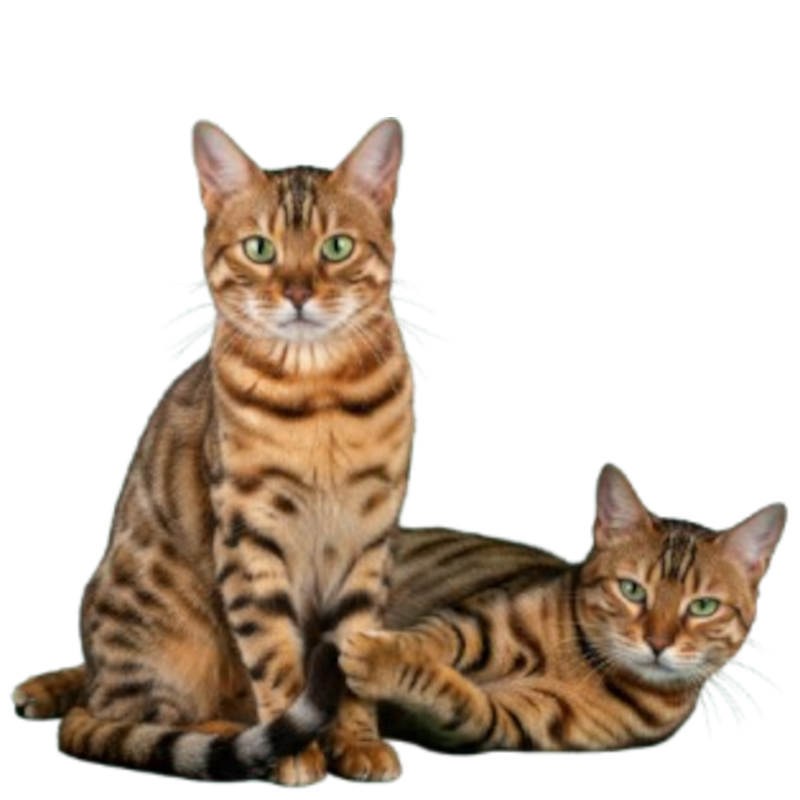
appearance
The Bengal is meticulously bred to emulate the visual signature of a small, jungle-dwelling predator. Its physical presence is defined by a powerful, athletic frame, a specialized coat texture, and high-contrast markings that distinguish it from all other domestic lineages.
Body Structure and Conformation
The anatomy of the Bengal emphasizes strength and lithe movement over the delicate or exaggerated features found in other show breeds.
- Torso: The body is elongated and sturdy, presenting a sleek musculature that is particularly evident in males. It is built for power rather than speed, avoiding a thin or “oriental” silhouette.
- Boning: The skeletal structure is heavy and robust. A Bengal should feel substantial and solid when lifted—never appearing fragile or light-boned.
- Legs and Paws: The limbs are of moderate length, with the rear legs slightly taller than the front. This elevation in the hindquarters provides the Bengal’s characteristic powerful leap. Paws are large, symmetrical, and round.
- Tail: The tail is medium in length and thick, ending in a rounded tip. It is typically carried low, mirroring the stalking posture of wild felids.
The Head and Facial Features
The facial structure of the Bengal is designed to project a “wild” expression, following a broad, modified wedge with rounded edges.
- Profile and Nose: The profile shows a subtle curve from the forehead to a large, wide nose. The bridge of the nose is often “puffed,” creating a more feral appearance.
- Ears: Ears are relatively small and positioned toward the side of the skull. They feature a wide base and rounded tops, lacking the pointed tips or tufts common in other domestic cats.
- Eyes: The eyes are large, set wide apart, and shaped like slightly slanted ovals. They are expressive and come in various shades including gold, green, and blue (in snow variations).
- Muzzle: The muzzle is full and broad, emphasized by prominent whisker pads and high, defined cheekbones that contribute to a fierce yet graceful look.
Coat Texture and “Glitter”
One of the most remarkable aspects of the Bengal is the unique “pelt” that covers its body.
- Texture: The fur is exceptionally short, dense, and feels more like luxurious silk or satin than traditional cat hair. It is remarkably soft and lies close to the body.
- Glitter: Many Bengals exhibit a unique genetic phenomenon known as “glitter.” This effect is caused by translucent hair tips that catch and reflect light, making the coat appear as though it is dusted with precious metals.
Patterns and Markings
The Bengal stands alone as the only domestic cat capable of displaying “rosettes,” which are multi-toned spots that mimic those found on leopards or jaguars.
Spotted and Rosetted Patterns
These markings must be distinct and stand out sharply against the background color. Common forms include:
- Arrowhead: Sharply defined, triangular spots that point toward the rear of the body.
- Pawprint: Open-centered markings where a darker border partially surrounds a lighter interior.
- Donut: Fully enclosed circular markings with a center that is significantly lighter than the dark outline.
Marbled Pattern
The marbled pattern consists of irregular, horizontal swirls. Unlike the circular “bullseye” found in common tabby cats, the Bengal’s marbling should look like flowing liquid or stone veins—avoiding any vertical “mackerel” stripes.
Comparative Measurements and Ratios
The balance of the Bengal is best observed in its rectangular proportions. If represents the length of the torso and represents the height at the shoulder, the animal typically maintains a sturdy ratio:
Body Shape and Athletic Balance Rule
- : The “Rectangle Score,” showing how well-balanced the cat’s body looks.
- : A symbol meaning “should be about.”
- : The “Torso Length,” measured from the chest to the base of the tail.
- : The “Shoulder Height,” from the floor to the top of the shoulder blades.
The Bengal is defined by an athletic, “wild” silhouette that is distinctly long and muscular rather than square or cobby. In this model, the ratio ensures that the Bengal’s torso provides the necessary surface area for its powerful musculature and striking rosetted or marbled patterns. If this ratio drops significantly, the cat may appear too “oriental” or “heavy,” losing the sleek, prowling gait that is the hallmark of its Asian Leopard Cat ancestry.
Summary of Aesthetic
| Feature | Description | Ideal Standard |
|---|---|---|
| Contrast | Clarity between ground color and markings | Very High |
| Ventral Area | The underbelly coloration | Spotted and Lighter |
| Tail Tip | Coloration at the very end | Solid Black/Dark |
| Chin/Throat | Shade of the lower face | Off-white to Cream |
The Bengal functions as a living piece of art, intended to bring the beauty of the wild into a domestic environment. Every physical attribute—from the dense, silken pelt to the powerful hindquarters—reflects its ancestral heritage while ensuring it remains a social and healthy household companion.
behavior
The behavior of the Bengal is a direct reflection of its athletic morphology and its proximity to the active hunting styles of its wild ancestors. Unlike more sedentary domestic lineages, the Bengal exhibits a high degree of kinetic movement, complex social interaction, and environmental manipulation.
Predatory Drive and Foraging Behavior
The Bengal retains a highly developed predatory sequence. In a domestic setting, this translates into specific play-action patterns.
- High-Intensity Stalking: Bengals often engage in “stealth” movements, utilizing low-profile belly crawls and erratic pouncing patterns that mimic the hunting of small rodents or birds.
- Toy Fetching: Many Bengals exhibit a “retrieving” behavior, where they carry toys in their mouths and bring them back to their owners to initiate further interaction—a trait more common in canines than felines.
- Food Puzzles: Due to their active minds, Bengals often prefer “working” for their meals. They are adept at using their paws to manipulate treat dispensers or opening cabinets to access food storage.
Aquatic Affinity and Interaction
One of the most distinctive behavioral markers of the Bengal is its lack of aversion to water, which distinguishes it from the majority of domestic feline species.
- Paw Dipping: A Bengal will frequently dip its paws into water bowls to “splash” or “fish” before drinking.
- Active Swimming: It is common for Bengals to willingly enter bathtubs, showers, or shallow pools. This behavior is rooted in the ancestral habitat of the Asian Leopard Cat, which often hunts in riparian environments.
- Flowing Water Preference: They are often mesmerized by running taps and will perform complex maneuvers to drink directly from a stream of water.
Spatial and Vertical Utilization
For the Bengal, horizontal space is rarely sufficient. Their behavior is defined by a three-dimensional utilization of their environment.
Vertical Progression
Bengals possess an innate drive to reach the highest point in any room. This is not merely for play—it serves as a vantage point for environmental monitoring.
- Climbing Mechanics: Their powerful hindquarters allow for vertical leaps that can exceed six times their own body height.
- Shoulder Riding: Many owners report that the Bengal will jump onto a human’s shoulder as a preferred perch for observation.
Communication and Vocalizations
The Bengal’s vocal behavior is diverse and communicative, often described as “chirping” or “chattering” rather than standard meowing.
- The Chirrup: Used primarily for greeting or when the Bengal is excited by the sight of potential prey.
- The Growl-Talk: A unique, low-frequency vocalization used during intense play or when protecting a “captured” toy.
- Responsiveness: Bengals are exceptionally responsive to human speech, often engaging in “back-and-forth” vocal exchanges with their owners.
Cognitive Simulation and Manipulation
The intelligence of the Bengal leads to behaviors focused on environmental control.
Problem-Solving and “Boredom Breakout” Odds
- : The “Escape Chance” (how likely the cat is to try and change or open something).
- : The “Smartness Score,” representing the cat’s natural cleverness and curiosity.
- : The “Challenge Level,” or how many boring barriers (like closed doors) are in the cat’s way without other fun things to do.
Consider a Bengal with a high Cognitive Ability score of 95. If it is placed in a laundry room with an Environmental Restriction score of 5 (e.g., a simple lever-handle door and no toys), the becomes . This high value indicates a near-certainty that the cat will manipulate the door handle to escape. Conversely, if you increase the Environmental Restriction to 50 by adding complex puzzle feeders and cat wheels, the probability drops to , meaning the cat is far more likely to focus its energy on the provided enrichment rather than trying to “break out” of the room.
If the environment is too restrictive, the Bengal’s behavior shifts toward “ingenious” manipulation:
- Door Operation: Learning to pull or push levers to exit rooms.
- Light Control: Toggling switches to observe the change in illumination.
- Water Management: Turning on faucets to satisfy their aquatic curiosity.
Social and Inter-species Behavior
Bengals are highly social and do not thrive in isolation. Their behavior in a group setting is characterized by “active companionship.”
| Behavioral Category | Observation | Interpretation |
|---|---|---|
| Grooming | Mutual allogrooming | Strengthening social bonds within the “colony.” |
| Play-Fighting | High-speed chasing | Practice of motor skills and hierarchy establishment. |
| Proximity | “Shadowing” owners | A need for constant cognitive and social engagement. |
Summary of Daily Activity Cycle
The behavioral rhythm of the Bengal is polyphasic, but with higher peaks of activity during dawn and dusk—crepuscular behavior. To maintain a healthy behavioral state, the Bengal requires a daily routine that provides outlets for its climbing, swimming, and problem-solving instincts. Without these, the Bengal’s behavior may become “over-creative,” leading to the redesign of household furniture or storage systems.
color
The visual identity of the Bengal is defined by a sophisticated interplay between standard domestic feline genes and specific pigments inherited from the Asian Leopard Cat. In professional felinology, these colors are categorized based on the base shade of the pelt and the genetic modifiers that influence the distribution of pigment along the hair shaft.
Standard Recognized Colors
While the Bengal can possess various genetic traits, major international registries generally acknowledge three primary color divisions.
The Brown Bengal
As the most traditional color—genetically classified as black—the Brown Bengal displays a diverse range of warm, earthy tones.
- Ground Color: This background shade varies from a cool beige-gray to a glowing golden-orange or intense rufous hue.
- Marking Color: Ideally a deep, saturated black, though shades of dark charcoal or rich cocoa are common.
- Distinctive Features: The standard prioritizes high contrast, accompanied by a black-tipped tail and eye colors ranging from copper to vibrant green.
The Silver Bengal
The Silver Bengal is created by the inhibitor gene (), which suppresses the production of warm phaeomelanin throughout the coat.
- Ground Color: A clean, luminous white or a pale, icy silver.
- Marking Color: Deep black markings are preferred to provide the sharpest possible definition.
- Visual Effect: The silver mutation often emphasizes the “glitter” trait, giving the Bengal’s fur a distinctive metallic sheen.
The Snow Bengal
Derived from the albino genetic series, Snow Bengals are categorized into three distinct phenotypes based on their specific alleles.
Non-Standard and Rare Colorations
Selective breeding has highlighted unique color variations that, while not always accepted in every championship class, remain highly sought after by enthusiasts.
- Charcoal: This effect results from a specific agouti gene variant (). It produces a dark “Zorro” mask on the face and a dense, dark “cape” of pigment across the spine.
- Blue: A dilute form of the brown Bengal, resulting in a soft slate-gray background with darker, blue-toned markings.
- Melanistic: Essentially a solid black Bengal. While they appear monochrome, their rosettes are often visible as “ghost markings” when viewed under direct sunlight.
The Science of Pigment Intensity
The aesthetic quality of a Bengal’s coat is often judged by its “rufism”—a term describing the saturation of red and yellow pigments. The visual impact () can be modeled as a relationship between Contrast () and Rufism ():
Coat “Glow” and Visual Impact Model
- : “Visual Impact,” the overall “wow factor” and wild look of the coat.
- : “Contrast,” the sharpness between the dark spots and the light background.
- : “Rufism,” the amount of warm, reddish-orange “glow” in the fur.
- : A math rule showing that while more orange is better, the human eye notices the first few boosts of color the most.
Imagine comparing two Bengals. Cat A has high contrast () but low rufism (), resulting in . Cat B has moderate contrast () but rich, warm rufism (), resulting in . Despite Cat A having sharper markings, the mathematical model shows that Cat B has a higher Visual Impact () because the high rufism provides a “glow” that significantly boosts the overall aesthetic appeal favored in the Bengal standard.
Greater differentiation between the base color and the rosettes enhances the “wild” appearance that is the hallmark of the Bengal.
Essential Color Markers
Regardless of the base color, every Bengal should exhibit specific ancestral markers that point to its wild heritage:
- Tail Tip: The very end of the tail must always be a solid, dark color—usually black or dark seal.
- Paw Pads: These should be dark, providing a stark contrast to the fur, though they may be lighter in some snow varieties.
- Ventral Surface: The underbelly should be lighter than the rest of the body—ideally a creamy white—and must always feature clear spots.
- Facial Accents: Lighter “spectacles” around the eyes and a pale chin are vital traits of the Bengal’s primitive aesthetic.
Summary of Coat Genetics
The wide variety of colors available in the Bengal ensures that while the exotic pattern remains constant, the background can range from tropical warmth to the stark beauty of a winter landscape. This genetic richness reflects the complex ancestry of Bengals—merging the raw beauty of nature with the refined characteristics of a domestic pet.
compatibility
Ease of Maintenance
Rating: 5/5
Child Friendly
Rating: 3/5
Annual Cost
Rating: 2/5
Lifetime Cost
Rating: 2/5
Adaptability
Rating: 3/5
Velcro Factor
Rating: 3/5
Quietude
Rating: 2/5
Apartment Suitability
Rating: 1/5
Hypoallergenic
Rating: 4/5
Handling Tolerance
Rating: 2/5
Hardiness/Longevity
Rating: 3/5
Prey Drive
Rating: 1/5
genetics
The genetic blueprint of the Bengal represents a unique interspecies hybridization, merging the DNA of the Asian Leopard Cat (Prionailurus bengalensis) with that of the domestic feline (Felis catus). This biological bridge enables the expression of exotic wild phenotypes within a manageable domestic genomic structure.
Interspecies Hybridization and Filial Generations
The creation of the Bengal is predicated on the successful pairing of two distinct species. The genealogical distance between an individual cat and its wild ancestor is categorized through filial () designations.
- F1 Generation: The immediate offspring resulting from a wild Asian Leopard Cat and a domestic feline parent.
- F2 and F3 Generations: These represent the second and third generations of backcrossing, respectively, typically using domestic males.
- F4 and Beyond (SBT): Classified as “Stud Book Tradition,” these cats are at least four generations removed from the wild ancestor and are considered fully domestic Bengals.
Chromosomal Compatibility
Both ancestral species share a chromosomal count, which facilitates the production of viable hybrid offspring. However, breeders must navigate Haldane’s Rule—a biological principle observing that in hybrid crosses, the heterogametic sex—in this case, the male ()—often suffers from sterility in early generations, whereas the homogametic female () remains fertile.
Genetic Loci for Coat Patterns and Colors
The aesthetic appeal of the Bengal’s pelt is controlled by several specific genetic loci that dictate how pigment is distributed.
The Agouti Locus () and Charcoal Phenotype
The Agouti gene manages the layering of black pigment on individual hairs. A specific variant inherited from the Asian Leopard Cat, known as the allele, interacts uniquely with the domestic non-agouti () allele.
- Charcoal (): This heterozygous combination produces a distinct “Zorro” facial mask and a darkened “cape” across the back.
- Agouti ( or ): These genotypes result in the standard high-contrast spotted or rosetted patterns.
The Tabby Locus ()
The Bengal utilizes the domestic tabby gene complex, heavily modified by selective breeding to produce its hallmark “wild” markings.
- Spotted and Rosetted: These are produced by a dominant spotted gene, influenced by a cluster of polygenes that create “rosetting”—spots with a darker outline and lighter center.
- Marbled (): This occurs when a cat inherits two copies of the recessive classic tabby allele. In Bengals, this creates horizontal, flowing swirls rather than the vertical stripes seen in common house cats.
The Inhibitor () and Albino () Series
The background hue of the Bengal’s coat is influenced by genes that either strip away or chemically alter melanin production.
| Locus | Genotype | Phenotype | Visual Effect |
|---|---|---|---|
| Inhibitor | I/- | Silver | Eliminates warm yellow/orange pigments from the hair. |
| Color | cs/cs | Seal Lynx Point | Temperature-sensitive albinism resulting in a pale coat and blue eyes. |
| Color | cb/cb | Seal Sepia | Burmese-type albinism producing the darkest of the snow tones. |
| Color | cb/cs | Seal Mink | An intermediate phenotype with characteristically aqua-colored eyes. |
Modeling the “Glitter” Trait
Glitter is a recessive genetic trait that results in a lack of pigment at the hollow tips of the hair shaft, allowing for unique light refraction. If represents the intensity of the sparkle and is the refractive index of the translucent tip, the visual effect can be described as:
Coat “Glitter” and Light Reflection Total
- : The “Total Sparkle,” the strength of the metallic “glitter” effect seen on the fur.
- : A symbol meaning “is created by.”
- : The number of individual hairs reflecting light at once.
- : The “Shine Factor” of the hollow, glass-like tip of each hair.
- : The “Angle of Light,” which determines how much light bounces off each hair () toward your eyes.
Suppose a Bengal is standing in a room with a light source directly overhead. For an observer, the average angle of incidence on the cat’s back is (where ), while on the sides it is (where ). If the of the hair tip is , the glitter intensity on the back is calculated as per hair, whereas on the sides it is . This explains why the Bengal’s metallic “glow” appears to move and shimmer as the cat walks or as the light source changes position.
This “metallic glow” on the Bengal’s coat is a specific trait that is a hallmark of the Bengal and contributes to its metallic luster.
Health and Hereditary Screenings
Maintaining the health of the Bengal requires rigorous monitoring of several specific genetic markers common to the lineage.
- PK-Def (Pyruvate Kinase Deficiency): An autosomal recessive condition that can lead to hemolytic anemia.
- PRA-b (Progressive Retinal Atrophy): A breed-specific mutation that causes the gradual degeneration of the retina.
- HCM (Hypertrophic Cardiomyopathy): While likely polygenic, this heart condition has a known hereditary link in Bengals—necessitating regular cardiac ultrasounds.
Summary of Genomic Influence
The Bengal is a triumph of targeted genetic selection. By preserving the allele and the polygenes responsible for rosetting, breeders have mapped the appearance of a wild leopard onto a domestic genome. The result is an animal with the chromosomes of a household pet but the breathtaking physical expression of a forest predator.
health
The medical profile of the Bengal represents a combination of robust physical stamina—inherited from its wild ancestors—and specific hereditary predispositions common to its domestic lineage. While generally considered a hardy and active breed, maintaining the long-term vitality of the Bengal requires diligent genetic screening and proactive veterinary care.
Hereditary Genetic Conditions
Because the Bengal was developed from a concentrated ancestral pool, several autosomal recessive conditions have been identified. Responsible breeding programs utilize DNA testing to eliminate these markers from the population.
Pyruvate Kinase Deficiency (PK-Def)
PK-Def is an inherited metabolic disorder where the absence of the pyruvate kinase enzyme causes red blood cells to break down prematurely.
- Clinical Signs: Symptoms include lethargy, pale mucous membranes, and intermittent bouts of anemia.
- Inheritance: It follows an autosomal recessive pattern; carriers show no symptoms but can pass the gene to offspring.
Progressive Retinal Atrophy (PRA-b)
The Bengal’s version of this disease (specifically PRA-b) causes the gradual degeneration of photoreceptor cells within the retina.
- Progression: The condition typically begins with night blindness and progresses to total vision loss, often by mid-adulthood.
- Diagnosis: Genetic testing can identify the presence of specific breed mutations before clinical symptoms manifest.
Cardiovascular Health
Hypertrophic Cardiomyopathy (HCM) is the most significant cardiac concern for Bengals. It is a condition where the muscular walls of the heart—specifically the left ventricle—become abnormally thick.
Heart Space vs. Muscle Thickness Rule
- : The “Blood Space” (the room inside the heart for blood to fill).
- : A symbol showing that these two values move in opposite directions.
- : The “Muscle Depth” (how thick the heart wall has grown).
- : The “Opposite Rule”—as the wall gets thicker, the space for blood gets smaller.
In a clinical screening for a Bengal, a cardiologist uses an echocardiogram to measure these variables. If a healthy Bengal’s wall thickness is , the chamber volume () is at its functional maximum. However, if HCM causes the wall to thicken to (a increase), the relationship dictates that the available volume for blood () is effectively halved. This means the heart must beat twice as fast or with much higher pressure to move the same amount of oxygenated blood through the body.
As the wall thickness increases, the volume of the heart chamber decreases, leading to reduced efficiency and potential heart failure.
- Screening: Since no definitive genetic test exists for HCM in Bengals, annual echocardiograms by a board-certified veterinary cardiologist are the gold standard for detection.
- Management: Early detection allows for the use of medication to manage heart rate and blood pressure, reducing strain on the cardiac muscle.
Orthopedic and Joint Considerations
The high-energy, athletic lifestyle of the Bengal places unique demands on its skeletal system.
- Patellar Luxation: A condition where the kneecap (patella) shifts out of its natural groove. This is often hereditary and graded on a scale of severity from I to IV.
- Hip Dysplasia: While more common in larger breeds, it is observed in Bengals. It involves a malformation of the hip socket that can lead to chronic osteoarthritis over time.
Gastrointestinal Sensitivities
Bengals are frequently noted for having sensitive digestive systems. This is often linked to their specific dietary requirements and high metabolic rates.
| Condition | Common Symptoms | Management Strategy |
|---|---|---|
| Tritrichomonas Foetus | Chronic, foul-smelling diarrhea | Specialized PCR testing and targeted antiprotozoal treatment. |
| Inflammatory Bowel Disease (IBD) | Chronic vomiting or weight loss | Novel protein diets (e.g., rabbit or venison) and grain-free options. |
| Food Allergies | Skin irritation or over-grooming | Elimination diets to identify specific protein triggers. |
Preventative Care and Longevity
The average lifespan of a Bengal ranges from 12 to 16 years. To maximize this duration, owners should focus on the following preventative pillars:
- Dental Hygiene: Like many domestic cats, Bengals are prone to periodontal disease. Regular brushing and professional cleanings are vital to prevent systemic infections.
- Weight Management: Despite their activity levels, a caloric surplus can lead to obesity, which exacerbates joint issues and cardiac strain.
- Environmental Enrichment: Because the Bengal’s mental health is tied to physical activity, a lack of stimulation can lead to stress-induced behaviors, such as psychogenic alopecia (compulsive over-grooming).
Summary of Health Maintenance
The key to a thriving Bengal lies in the synergy between genetic transparency from the breeder and consistent monitoring by the owner. By focusing on annual cardiac screenings and maintaining a high-protein, high-quality diet, the Bengal remains one of the most resilient and capable companions in the domestic feline world.
longevity
The typical lifespan of the Bengal generally falls between 12 and 16 years, although it is not unusual for individuals receiving optimal care to reach their late teens or even enter their early twenties. This life expectancy is the result of the Bengal’s high-performance metabolic rate, diverse genetic background, and the level of specialized domestic care provided throughout its various life phases.
Factors Influencing Lifespan
The duration of a Bengal’s life is determined by an intersection of biological heritage and environmental management.
Genetic Heritage and Selective Breeding
In the early stages of the breed’s development, Bengals benefited from a degree of heterosis—often called hybrid vigor—arising from the cross of two distinct species. In contemporary, fully domestic Bengals, long-term health is sustained through rigorous selective breeding practices that prioritize low inbreeding coefficients and the exclusion of hereditary defects.
Lifestyle and Safety Parameters
Data suggests a marked difference in life expectancy based on the Bengal’s primary environment:
- Indoor Living: Bengals residing exclusively indoors typically live significantly longer than those with unsupervised outdoor access, as indoor environments eliminate risks from predators, vehicle strikes, and contagious feline pathogens.
- Physical Conditioning: Because of their high energy requirements, Bengals need consistent physical stimulation to avoid the metabolic slowdown and muscle loss often associated with aging.
Life Stages and Aging Physiology
As the Bengal matures, its biological needs undergo specific shifts. We can approximate the “human equivalent” age of the cat () using a non-linear calculation once the animal surpasses its initial two-year development period:
Cat-to-Human Age Comparison Calculator
- : The equivalent age if the cat were a human.
- : The “Real Age” of the Bengal in years (for cats older than 2).
- : The human years a cat “earns” by their 2nd birthday.
- : The “Aging Multiplier” for every year after the age of 2.
- : The number of years the cat has been a full adult.
Suppose you have a senior Bengal named Leo who is 14 years old. To find his human physiological equivalent, we plug into the formula: . This simplifies to , then , resulting in a human equivalent age of 72. This calculation helps the owner understand that while Leo may still have a high activity drive, his internal systems are entering a geriatric phase that requires closer monitoring of renal and cardiac health.
This formula applies when , representing the age of the Bengal in years.
Life Stages Physiology
| Life Stage | Age Range (Years) | Physiological Focus |
|---|---|---|
| Kitten | 0 — 1 | Intensive skeletal development and immune maturation. |
| Young Adult | 1 — 6 | Peak physical prowess and optimal digestive efficiency. |
| Mature Adult | 7 — 10 | Vigilance regarding metabolic changes or early cardiac markers. |
| Senior | 11 — 15+ | Focused management of kidney filtration and joint comfort. |
Critical Health Indicators for Longevity
To ensure the Bengal achieves its maximum biological potential, owners must monitor key physiological systems as the cat enters its senior years.
Renal Health and Hydration
The efficiency of the kidneys is a fundamental predictor of feline lifespan. Because the Bengal often thrives on a protein-dense diet, maintaining proper glomerular filtration is paramount.
- Hydration Strategies: Many Bengals have a natural affinity for moving water; using recirculating fountains can significantly boost fluid intake, which aids in flushing the renal system.
- Nutritional Adjustment: Transitioning to senior-specific diets with restricted phosphorus levels in later life helps preserve kidney function and delays the onset of chronic renal issues.
Cardiovascular Endurance
As highlighted in health assessments, Hypertrophic Cardiomyopathy (HCM) can shorten a Bengal’s life. Longevity is most frequently seen in Bengals descending from ancestral lines with documented “clear” cardiac ultrasounds performed well into their senior stages.
Cognitive Preservation in Aging Bengals
Mental vitality is just as essential as physical health for the Bengal. Older Bengals may occasionally exhibit signs of Feline Cognitive Dysfunction (FCD).
- Identifying Symptoms: These may include evening disorientation, shifts in social habits, or disrupted sleep patterns.
- Cognitive Support: Maintaining a routine of environmental enrichment and interactive “puzzle feeders” can help sustain neural plasticity and keep the Bengal mentally sharp.
Summary of Senior Care
A long and vibrant life for the Bengal is achieved through proactive veterinary care and a diet tailored to its specific life stage. By emphasizing weight control and conducting comprehensive blood panels once the cat reaches seven years of age, owners can help their Bengal remain an active and spirited companion for nearly two decades.
maintenance
Caring for the Bengal necessitates a specialized strategy that accounts for its high metabolic rate, muscular physique, and distinct coat quality. Because Bengals possess a lineage connecting them to the Asian Leopard Cat, their daily requirements differ from the standard domestic cat, particularly in the realms of mental engagement and physical upkeep.
Nutritional Management and Metabolic Support
The Bengal is defined by an exceptionally high ratio of lean muscle to body fat, which demands a diet centered on high-quality animal proteins. To preserve the Bengal’s vitality and muscle density (), caloric intake () must be precisely tuned to their energetic output.
Optimal Macronutrient Balance
For a physically active Bengal, the nutritional profile should prioritize proteins while limiting unnecessary fillers:
- Protein: Should exceed 40% of the total dry matter.
- Fat: Ideally maintained between 15% and 20% for sustained energy.
- Carbohydrates: Should remain below 10% to prevent metabolic strain.
Hydration Strategies
While Bengals often exhibit a low natural thirst drive, they are famous for their fascination with moving water. Effective maintenance involves:
- Recirculating Fountains: These cater to the Bengal’s instinctual preference for running water, increasing fluid consumption.
- Moisture-Rich Foods: Incorporating wet food helps protect the renal system from the dehydration risks associated with dry-only diets.
Coat Maintenance and “Glitter” Preservation
The pelt of the Bengal is a hallmark of the breed, often likened to the texture of fine silk. Many Bengals carry the “glitter” gene—a unique trait that gives the hair shafts a metallic, light-reflecting quality.
Grooming Protocols
Because the Bengal lacks a heavy undercoat, they are minimal shedders. Over-brushing can be counterproductive and may irritate the skin.
- Weekly Brushing: A soft silicone or rubber brush is perfect for capturing loose hairs without damaging the delicate coat texture.
- Bathing: Although many Bengals enjoy water, regular baths are generally unnecessary and should only occur if the coat becomes noticeably greasy.
Environmental Stimulation and Behavioral Upkeep
The cognitive capacity of the Bengal is significantly higher than that of the average house cat. Without intentional mental maintenance, Bengals may seek their own entertainment—which can lead to destructive household behaviors.
Vertical Territory and Exercise
A Bengal views its home three-dimensionally. To support their physical health, the environment should include:
- Vertical Climbing Structures: High-reaching cat trees allow for full-body stretching and climbing.
- Activity Wheels: Large exercise wheels are excellent for providing the high-speed aerobic activity that Bengals crave.
Intellectual Engagement
To determine the necessary “Stimulation Index” () for a Bengal, one can evaluate the relationship between waking hours () and dedicated interactive sessions ():
The “Boredom Score” and Playtime Balance
- : The “Boredom Index” (a high score means the cat is likely to get into trouble).
- : “Waking Hours,” the total time the cat is awake and looking for something to do.
- : “Play Sessions,” the number of times the owner plays or trains with the cat.
- : A “Base Number” to keep the math working even if there are zero play sessions.
Consider a highly active Bengal that is awake for hours a day. If the owner provides only dedicated play session, the index is . This high value suggests the cat is likely to become bored or destructive. However, if the owner increases engagement to sessions (e.g., clicker training, fetch, and puzzle solving), the index drops to . This lower indicates a much more stable and satisfied temperament, as the “boredom gap” has been mathematically narrowed.
A lower value generally indicates a more satisfied and well-adjusted Bengal.
Dental and Claw Care
Oral Health
The Bengal is susceptible to early-onset dental issues. Maintenance routines should incorporate:
- Enzymatic Brushing: Daily cleaning with feline-safe toothpaste is the most effective way to prevent plaque.
- Water Additives: These can help reduce the bacterial load in the mouth between brushings.
Claw Trimming
The powerful climbing drive of the Bengal means their claws grow and sharpen quickly.
- Frequency: Trimming every two to three weeks prevents snagging and accidental injury.
- Scratching Outlets: Providing a variety of vertical and horizontal surfaces satisfies the Bengal’s need to mark territory and shed claw sheaths.
Scheduled Health Inspections
Consistently monitoring the Bengal allows for the early detection of issues specific to their lineage.
| Maintenance Task | Recommended Frequency | Objective |
|---|---|---|
| Weight Monitoring | Once per Month | Mitigating obesity to protect joints and the heart. |
| Aural Inspection | Once per Week | Checking for debris or wax buildup in active cats. |
| Cardiac Ultrasound | Once per Year | Screening for HCM by a specialist. |
| Diagnostic Testing | Twice per Year | Screening for internal parasites or digestive imbalances. |
Summary of Care Philosophy
Successful maintenance of the Bengal is built on the understanding that they are active, intelligent participants in their environment. By providing a solid nutritional base, ample vertical space, and consistent mental challenges, the Bengal will remain a sleek, vibrant, and highly engaged member of the family.
measurements
| Measurement | Female | Male | ||
|---|---|---|---|---|
| Metric | Imperial | Metric | Imperial | |
height | 18 – 25 centimeters | 7 – 10 inches | 20 – 28 centimeters | 8 – 11 inches |
length | 33 – 41 centimeters | 13 – 16 inches | 36 – 46 centimeters | 14 – 18 inches |
weight | 3.6 – 5.4 kilograms | 8 – 12 pounds | 4.5 – 6.8 kilograms | 10 – 15 pounds |
• Height: Refers to the measurement at the withers (shoulders).
• Length: Measured from the tip of the nose to the base of the tail.
origin
The history of the Bengal is a unique chronicle of scientific curiosity and intentional selection—marking the first successful and sustainable hybridization between a wild feline species and the domestic cat (Felis catus). The breed’s existence is predicated on the genetic bridge between the domestic genome and that of the Asian Leopard Cat (Prionailurus bengalensis).
Biological Foundation: The Asian Leopard Cat
The primary progenitor of the Bengal is the Asian Leopard Cat (ALC), a small wild felid native to South and East Asia. The ALC is roughly the size of a domestic cat but possesses a distinctively elongated physique, a white ventral region, and striking rosetted or spotted markings.
Genetic Divergence
While both species belong to the Felidae family, they branched off millions of years ago. The genetic distance between them necessitated careful management during the early stages of the Bengal’s development to ensure fertility and domestic temperament.
| Characteristic | Asian Leopard Cat (ALC) | Domestic Cat |
|---|---|---|
| Taxonomy | Prionailurus bengalensis | Felis catus |
| Chromosomes | 2n = 38 | 2n = 38 |
| Diet | Obligate Carnivore | Obligate Carnivore |
Initial Hybridization Efforts
The earliest recorded instances of ALC–domestic crosses date back to the late 19th century, but these were isolated events rather than a concerted effort to establish a new breed.
Jean Mill and the 1963 Crossing
The modern Bengal owes its existence primarily to Jean Mill, a breeder in California. In 1963, Mill acquired a female Asian Leopard Cat and—to provide her with companionship—placed a black domestic tomcat in her enclosure. To Mill’s surprise, the two mated, producing a hybrid kitten named “KinKin.”
The Dr. Willard Centerwall Research
During the 1970s, Dr. Willard Centerwall at Loyola University conducted research into the Asian Leopard Cat’s apparent natural immunity to Feline Leukemia Virus (FeLV). He crossed ALCs with domestic cats to study the inheritance of this resistance. When the project concluded, several of the hybrid offspring were given to Jean Mill, providing the genetic foundation for the contemporary Bengal.
The Filial Generation Scale
The development of the Bengal is measured through filial () designations, which track the proximity of an individual to its wild ancestor.
- F1 (First Generation): One ALC parent and one domestic parent. These hybrids are often wild in temperament and the males are universally sterile.
- F2 (Second Generation): An F1 female bred back to a domestic male.
- F3 (Third Generation): An F2 female bred back to a domestic male.
- F4 and Beyond (SBT): Known as “Stud Book Tradition,” these are considered fully domestic Bengals. They are at least four generations removed from the wild ancestor.
Haldane’s Rule in Bengal Development
In the early stages of breeding, the heterogametic sex (the male) typically suffers from sterility. This is a biological phenomenon known as Haldane’s Rule.
Haldane’s Rule and Male Hybrid Fertility Set
- : Being unable to have kittens.
- : A symbol meaning “is part of the group.”
- : The group of male kittens from the original wild-to-domestic cross.
- : The very first stages (F1 to F3) of building the Bengal family tree.
During the creation of the Bengal, a breeder crosses an Asian Leopard Cat with a domestic shorthair. In the resulting F1 generation, if there are 4 kittens—2 females (XX) and 2 males (XY)—the set identifies the sterile individuals. Applying the formula, the 2 males are elements of the Sterility set (), while the 2 females are not. This required breeders to use only the fertile females to move the lineage forward to the F2 generation, where the process repeated until the XY males eventually fell out of the sterility set by the F4 generation.
Consequently, the lineage of the Bengal was maintained exclusively through fertile female hybrids bred back to domestic males for the first three generations.
Recognition and Breed Standardization
By the 1980s, the Bengal began to gain traction in the competitive cat fancy. Jean Mill’s goal was to create a cat that looked like a forest predator but possessed the affectionate nature of a lap cat.
- 1983: The International Cat Association (TICA) accepted the Bengal as an experimental breed.
- 1991: The Bengal was granted full championship status.
Summary of Evolutionary Synthesis
The Bengal represents a successful synthesis of wild aesthetics and domestic sociability. By merging the Agouti gene of the Asian Leopard Cat with the varied coat colors of the domestic feline, breeders created the first “leopard-spotted” house cat. Today, the Bengal stands as one of the most popular and recognizable pedigreed cats in the world—a testament to the complex genetic journey from the Asian jungles to the domestic living room.
temperament
The temperament of the Bengal is a sophisticated psychological framework that balances ancestral alertness with domestic devotion. Unlike more sedentary varieties, Bengals possess a foundational personality defined by high sensory acuity, an insatiable intellectual drive, and a requirement for deep social integration.
Psychological Archetype: The “Sentinel” Persona
The Bengal functions with a heightened level of environmental engagement. This is not merely high energy, but a core personality trait that can be classified as an “active-alert” temperament.
Sensory Vigilance and Awareness
The Bengal’s temperament is grounded in a constant state of readiness. They are psychologically “tuned in” to their surroundings, often displaying a personality more akin to a working canine than a typical domestic feline. This results in a cat that is emotionally present and exceptionally sensitive to shifts in the household atmosphere.
Cognitive Drive and Problem-Solving
Intellectual curiosity is perhaps the most defining characteristic of the Bengal. They have a psychological compulsion to analyze cause-and-effect relationships. This can be viewed as a “Curiosity Coefficient” (), where the motivation to explore is a function of environmental complexity () and social interaction ():
Daily Curiosity Total and Mental Satisfaction Model
- : “Total Curiosity Satisfied,” the amount of “brain work” the cat got done.
- : A way to add up all the “Smart Activity” over a whole afternoon.
- : “Environment Fun,” the variety of toys and puzzles available.
- : “Friendship Time,” how much the cat played with people or other pets.
Suppose a Bengal spends an afternoon ( hours) in a room. For the first hours, they have a complex puzzle toy () and a human playing with them (), resulting in an engagement rate of per hour. For the next hours, the human leaves () and the puzzle is solved ( drops to ). The total is the area under this curve: . If the Bengal’s baseline need is for that period, the resulting deficit of explains why they might begin “analyzing” the mechanics of a door hinge or a kitchen faucet to satisfy their remaining drive.
A Bengal with a high will relentlessly pursue new challenges, showing a resilient and determined personality when encountering obstacles.
Social and Emotional Dynamics
Despite their exotic appearance, the Bengal’s temperament is rooted in social connectivity. They do not possess a “solitary” emotional outlook; instead, they are “community-oriented” felines.
Affectionate Interdependence
While a Bengal may not fit the traditional mold of a “lap cat,” their temperament is marked by intense loyalty. They frequently develop a profound psychological bond with a primary caregiver, manifesting as a “shadowing” personality that leads them to participate in every aspect of their human’s daily routine.
Assertive Communication
The Bengal is temperamentally predisposed to express itself. Their personality is proactive rather than passive. Utilizing a diverse repertoire of vocalizations—from soft chirps to resonant yowls—the Bengal communicates its emotional requirements and intentions with significant clarity.
Temperamental Versatility and Resilience
The Bengal’s psychological profile is remarkably flexible, provided their fundamental needs for engagement are fulfilled.
| Temperament Trait | Description | Behavioral Impact |
|---|---|---|
| Confidence | Deep self-assurance; rarely intimidated by novel guests or environments. | Creates a bold, adventurous presence in the household. |
| Playfulness | A persistent “juvenile” outlook that remains through adulthood. | Requires a lifelong commitment to interactive stimulation. |
| Intensity | A highly focused, mission-driven approach to activities. | Can be perceived by owners as demanding or single-minded. |
| Gregariousness | A powerful urge for companionship and shared activity. | Struggles in settings where they are isolated for extended periods. |
The Synthesis of Wild and Domestic Spirits
The Bengal’s temperament is often characterized as “dynamic harmony.” It is vital to separate their wild lineage from their domestic identity:
- Neophilia: While many cats are naturally wary of change (neophobia), the Bengal possesses a temperament that thrives on novelty. This makes them uniquely capable of learning complex tasks—such as walking on a leash or engaging in water-based play.
- Sensitivity: Despite their outward boldness, Bengals are temperamentally responsive to the emotional climate of their home. They can experience stress in high-conflict settings, highlighting their need for a stable yet intellectually rich social life.
Summary of the Bengal’s Spirit
The Bengal is not a companion for those seeking a passive pet. Their temperament is courageous, communicative, and intellectually demanding—a rare blend of primitive instincts and modern domestic affection. To live with a Bengal is to share a space with a vivid, sentient personality that continuously seeks to bridge the gap between the wild and the domestic.